Taxes, the Imperium, and You!

Not sure the applicability of the HMS Dreadnought's construction is here. Yes, in 4 months they laid down the hull, but it took another 8 months of fittings before the ship was actually ready to begin its trials. Initial construction time was 366 days - still great progress for the time.

When a nation puts its mind towards something it can accomplish great things. The US did this during WW2, with its' command economy that was coupled with multiple capitalistic ideals and processes. Ford built bombers at it's Willow Run facility, and at its' peak was able to roll a bomber an hour off the production line. Of course this took something like 40k workers in this plant alone to make this happen. Kaiser shipyards were able to assemble a Liberty ship in just 4 days. Amazing feats of production, but there were soooo many things that had to be done ahead of time to make this occur. And it was wartime as well - when nations go to war for survival the standards are thrown out the window. On the other side of this coin we have Nazi Germany. Most people don't realize that Germany production numbers were nearly as great as they were at the end of the war as they were at the beginning. Germany was still ramping up it's production levels at the beginning of the war - not to mention capturing other locations that they were able to bring into the fold. Nazi Germany also suffered far greater from self-inflicted issues. Rather than having a unified approach to its industrial might, the three major sectors (four if you count those shits in the Gestapo/SS) - Wermacht, Kriegsmarine and Luftwaffe - ALL were competing with one another for budget, resources and manufacturing. Thankfully the Teutonic efficiency did NOT extend to leadership.

I know the LBB blurbs on depot systems makes it out like these are megafactories and such, but I think there are many practical limitations to this. Within the description of the depot it talks about the systems being self-sufficient and able to go 'years' without outside contact or setback. But, in order for this to work that would mean the entire system is self-sufficient in production capabilities - food, raw materials, manufacturing, etc. Theoretically possible, certainly, but one has to also keep in mind that in order to build "fleets" they would need ALL the smaller industrial facilities - able to mine the materials, build the electronics, have all the necessary manufacturing facilities, docks and slips. Per the description that would also mean the system had a completely self-sufficient civilian side of food and consumer electronics manufacturing capabilities as well. When you are talking a star system, lots of things are possible. But you are also talking about hundred of millions, if not more when you consider the large numbers of people required to support all this, AND all their families. It's not unreasonable to expect such a location to have a population in the billion or more once everything is accounted for. Examples of crazy production capabilities like the Dreadnought or the Liberty ship don't take into account the planning or costs associated with setting up the environment to make that possible. Dreadnoughts main guns had to be planned years ahead of time since that's how long it took to make a single naval gun. The Liberty ship required massive amounts of pre-assembly work so that the 4 days only accounted for putting it together.

So it's possible that depots are going to have some extra capacity just in case, not even the Imperium could afford to have oodles and oodles of idle manufacturing capabilities (or stockpiles) just sitting around for the every century or so that a war happens. All of that equipment would have to be paid for, maintained and upgraded as changes occur. This is a massive investment with zero return except when there is a war. So yeah, there are some big logical holes you can drive through on descriptions such as these. Sure, it's a game and all, and you can make up whatever you want. But some of these sweeping descriptions defy common sense and logic, so take them with a grain of salt and move on.

Personally, based on what I understand a depot system to be, I think they have the capability to build warships, and to make some of the components locally. And they stockpile a reasonable amount of stores to act as logistical hubs. They can repair and refurbish ships and they regularly maintain reserve fleets for when wars may occur. But it's all going to be within reason - they'll still regularly import components and parts from other locations because that's how supply chains and integrated economies work. I certainly don't expect them to be able to churn out dozens of Tigress-class dreadnoughts in a year as a norm. Just how large of a capacity they'd have is debatable - and that's ok.


IMO depot systems being self-sufficient would make sense, since they probably serve as sector strongholds or fortress systems.
 
The shipyards of the DEPOT systems most likely spend the majority of their time on refits, repairs, and mothballing/de-mothballing reserve ships (as well as the aforementioned prototypes. These can get turned into traditional new production during wartime.

Another possibility is that depot shipyards produce ships that are still too secret to be built at civilian shipyards. Perhaps some capital ships are built at depot yards, along with spinal weapons and other large secret components. Another function of depot shipyards could be the breaking of ships that are too badly damaged to be returned to serviceable condition, and using the materials and salvageable components to repair or refit other ships at the depot.
 
If the writer meant to say that they have production-capable shipyards that they don't use in the century or so between major wars then the writer was a lunatic, because unless they are entirely unlike today's shipyards then you need to have a fairly constant order book so as not to lose the capability to build ships altogether. At the very least they'd have to keep them ticking over.

True, equipment and facilities tend to decay if they're not used and maintained. Skilled experienced workers need to stay employed or they'll go elsewhere.

To expand on my earlier comment, IMO it's possible that some depot shipyards are used to construct prototypes, and other depot yards would be used to produce large capital ships that take years to build and use highly secret components. Designs needed en masse like standard battleships, cruisers, and smaller ships, IMO those would be mass produced at megacorporate shipyards.

On a related note, something Traveller has never explored, to my imperfect knowledge anyway, is truly massive cargo ships, massive ships that ply the mains from one end to the other, or run routes from resource extraction worlds to industrial hubs, and from the industrial hubs to their market worlds. The commercial shipyards that would build these ships would be able to build capital ships in times of war.
 
IMO depot systems being self-sufficient would make sense, since they probably serve as sector strongholds or fortress systems.
Ah, but to what extent would they be self-sufficient? Are you going by the same definition in the LBB - where a depot system could operate for years without getting outside support/supplies? That begets another question - to what extent of self-sufficiency are we talking about? If we assume depots can build/repair ships in peacetime, then ideally their infrastructure is set to that level. And, hopefully, the system contains a habitable world that is nice enough that the military and civilians (and their families) don't mind being there. So long as one doesn't question it too much then it's an entirely OK view. It's not like players go adventuring in a Depot system. :)

Another possibility is that depot shipyards produce ships that are still too secret to be built at civilian shipyards. Perhaps some capital ships are built at depot yards, along with spinal weapons and other large secret components. Another function of depot shipyards could be the breaking of ships that are too badly damaged to be returned to serviceable condition, and using the materials and salvageable components to repair or refit other ships at the depot.
Building and testing new ships in a system that is strictly off limits offers a lot of opportunity for maintaining secrecy - sort of an Area 51 on a lot of anabolic steroids. It makes security easier, but also it's gotta be pretty expensive to maintain that level - and you know enemies, corporate spies and their ilk are going to be chomping at the bit to find out what's happening in that closed system.

I think its quite probable that a lot of military weapons testing and R&D goes on in a depot system - after all the military owns the entire system and they don't have to worry like they would in a normal system. Depot systems are natural harbors to store large number of reserve fleet ships where they get regular maintenance, updates and/or get scrapped and their hulls and components recycled.

Ships that are heavily damaged and slated for scrapping would not, I think, be sent to a depot for scrapping. It would be more economical for them to be scrapped at the nearest available facility - or even just salvaging the things you want and you send the rest of the hull to the breakers.
 
For most practical purposes, almost every main sequence star system is self sufficient. But even if you need particular resources to be present, Depot systems would be chosen at least partially on that basis.

It would be unusual for a Depot or even an industrial hub to NOT be self-sufficient in raw materials, although there may be economic reasons to ship some stuff in rather than make it on site. Especially in terms of salvaging.

Logistically, you would want production centres other than the big Sector depots. Ship a million missiles across an entire sector? More likely you'd set up smaller local sites. Or use logistics fleets.
 
Another possibility is that depot shipyards produce ships that are still too secret to be built at civilian shipyards. Perhaps some capital ships are built at depot yards, along with spinal weapons and other large secret components. Another function of depot shipyards could be the breaking of ships that are too badly damaged to be returned to serviceable condition, and using the materials and salvageable components to repair or refit other ships at the depot.
I am not aware of any examples IRL where the majority of the people who built military ships were actual members of the uniformed services the ships were for, but it's certainly not impossible. I know that the US Navy does have some of its own shipyards, but doesn't actually build things at them (They do repairs and refits). And even at these US Navy shipyards, around a 1/3 or more of the workers are vetted civilian workers. Whereas at the commercial shipyards that do build the US Navy's ships, there are US Naval personnel as liaison/overseers of the vetted commercial workers.

The Traveller Adventure tells us that spinal mounts are made by and shipped on commercial interests, since the scheme running in the background is an attempt to steal and redirect a spinal mount being shipped on a Tukera liner.

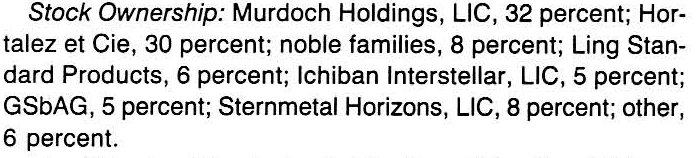
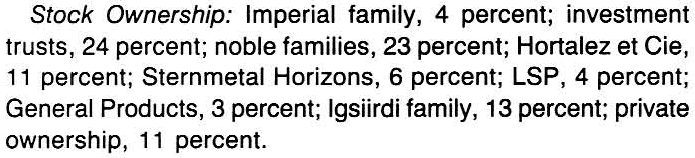
A thing that doesn't get a lot of attention is that the the Emperor, the Imperial Family, and the Imperial Nobility are major shareholders in most or all of the Megacorporations and lots of the other large corps as well. That's not exactly state ownership, but it's not like the (mostly) stateless independent megacorps of cyberpunk settings either.

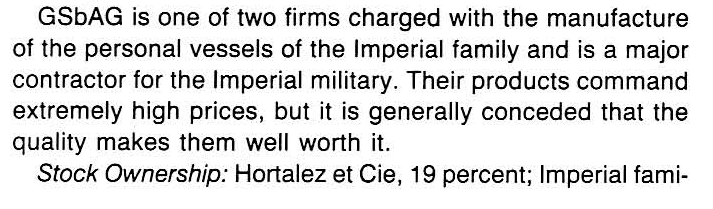
For example, Geschichtkreis Sternschiffbau AG is the company noted for making vessels for the Imperial Family and being a naval contractor. GsBAG is 4% owned by the Imperial Family, 44% by other Imperial Nobles (including former Imperial families like the Zhunastus), another 32% is owned by other large Imperial corporations like Hortalez et Cie and Zarunkariish, so only about 20% is owned by members of the general public, pension funds, and other such investors. And, of course, chunks of Hortalez et Cie and Zarunkariish are owned by the Imperial family and the aristocracy.

Even without getting into shenanigans about voting and non voting stock, priority shares, and other ways to "control" more than you technically own, the Imperium already largely controls these companies. We aren't talking about putting out open bids on Imperial Navy vessels.
 
As I keep mentioning, the alternative name for the Third Imperium is Cleon Industries - the megacorporation. The Imperial family and nobles are really shareholders in Cleon Industries, the Moot is a shareholders meeting. The other megacorporations are only allowed to incorporate if they offer shares to the Emperor and the nobility.

Are there major shareholders with megacorporation stock that are not part of the nobility...
 
a 1/3 or more of the workers are vetted civilian workers.

Exactly, vetted civilian workers/contractors, many of which are probably IN veterans or retirees. Given the work takes place at depot systems, working at depot shipyards could even be a generational occupation, with children being born, growing up, and finally taking up careers at the depot shipyards and facilities.
 
I am not aware of any examples IRL where the majority of the people who built military ships were actual members of the uniformed services

And IMO they shouldn't be. Military people change roles and responsibilities every few years. A technician works with the equipment for a few years, but then he gets promoted to section leader and he has to devote more of his time to leading his subordinates and other administrative tasks. Military personnel would gain the desired experience, but as they gained seniority they would move into more administrative roles. Otherwise the technical roles wouldn't be available for new personnel to move into and gain experience.

Military contractors, the vetted civilian employees, don't have that pressure. A welder can get a job at a shipyard and do that for 20 years, becoming an expert with a deep well of experience. Workers and technicians can specialize, and develop great expertise in their specializations.
 
A thing that doesn't get a lot of attention is that the the Emperor, the Imperial Family, and the Imperial Nobility are major shareholders in most or all of the Megacorporations and lots of the other large corps as well.

So when megacorporations get shipbuilding contracts from the Imperial government, the nobility are taking tax revenue from the subjects of 10,000 worlds, using it to pay megacorporations they own, and enriching themselves as their stock investments in these corporations gain value.
 
I always thought that the spaceyard is actually a systems integrator.

Ship components, such as drives, electronics, weapon systems, sensors, and so on, being manufactured by civilian run factories, likely extrasystem.
 
I always thought that the spaceyard is actually a systems integrator.

Ship components, such as drives, electronics, weapon systems, sensors, and so on, being manufactured by civilian run factories, likely extrasystem.

Very plausible, very plausible.

Consider, if a micro jump from a resources extraction site in a system's asteroid takes a week, importing a finished product from a system 1 jump away, wouldn't take any longer, and the shipyard wouldn't have to refine the resources and manufacture the finished product.
 
Very plausible, very plausible.

Consider, if a micro jump from a resources extraction site in a system's asteroid takes a week, importing a finished product from a system 1 jump away, wouldn't take any longer, and the shipyard wouldn't have to refine the resources and manufacture the finished product.
No need to micro jump. Just use regular maneuver drives.
 
As I keep mentioning, the alternative name for the Third Imperium is Cleon Industries - the megacorporation. The Imperial family and nobles are really shareholders in Cleon Industries, the Moot is a shareholders meeting. The other megacorporations are only allowed to incorporate if they offer shares to the Emperor and the nobility.

Are there major shareholders with megacorporation stock that are not part of the nobility...
One would have to wonder if the nobility of the Imperium are like much of the nobility in England around the turn of the century. They had titles and balls and such, but were essentially broke. One thing we've seen time and again is that over the generations families and heirs tend to assume the wealth will always be there, and they can be profligate spenders who are more than willing to mortgage their kingdom tomorrow for the pleasures of today.

Noblesse oblige often skips large swaths.
 
So when megacorporations get shipbuilding contracts from the Imperial government, the nobility are taking tax revenue from the subjects of 10,000 worlds, using it to pay megacorporations they own, and enriching themselves as their stock investments in these corporations gain value.
Well, this depends on the tax structure that we don't really know much about. Say they did steer ship building contracts to companies they owned stock in. Assuming a normal capital/tax structure, the value of their stock may go up due to the revenue, and the company itself would still end up paying the taxman first before it could divert any excess revenue to paying shareholders - and unless they set up multiple levels of equity (i.e. common and preferred stock), any stockholder would gain on payouts or stock-buyback schemes that lift EPS and stock prices. So other than steering the contracts to certain companies (and probably costing more than a pure bidded contract would), it really doesn't do much for them.

The sheer size of the companies means ownership will be widely distributed. Nobles would have to share the revenue with the rest of the shareholders, and even an obscenely rich noble would have very diluted interest in a megacorp due to their sheer size. Though even a 1% ownership would make them massively wealthy by any standard. At a point the value of the company means their ownership doesn't need to be great in order to reflect wealth.
 
Well, this depends on the tax structure that we don't really know much about. Say they did steer ship building contracts to companies they owned stock in. Assuming a normal capital/tax structure, the value of their stock may go up due to the revenue, and the company itself would still end up paying the taxman first before it could divert any excess revenue to paying shareholders - and unless they set up multiple levels of equity (i.e. common and preferred stock), any stockholder would gain on payouts or stock-buyback schemes that lift EPS and stock prices. So other than steering the contracts to certain companies (and probably costing more than a pure bidded contract would), it really doesn't do much for them.

The sheer size of the companies means ownership will be widely distributed. Nobles would have to share the revenue with the rest of the shareholders, and even an obscenely rich noble would have very diluted interest in a megacorp due to their sheer size. Though even a 1% ownership would make them massively wealthy by any standard. At a point the value of the company means their ownership doesn't need to be great in order to reflect wealth.
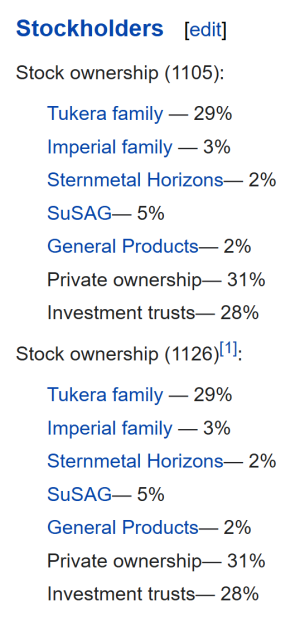
Using Tukera Lines as an example, according to the Wiki, it has this ownership structure. One could guess that it would be similar for other megacorporations.

1767671571543.png
 
Back
Top