Taxes, the Imperium, and You!

Clearly *some* ship building is done in conjunction with the private sector, but the two examples, famous though they may be, are both unusual ones. And, it should be pointed out, are Spinward Marches designs that are not fleet ships.

The Kinunir class is, by Naval standards, tiny. At best, it's a local Marches project that failed. It's no stretch for a commercial yard to build, though final fitting of the
black globe
and the
AI Computer
would probably happen at a navy base.

The Lightning class is a 60,000 ton cruiser. Not insignificant, but also small enough that a big commercial yard might be able to manage it. Again, it appears to be a Spinward Marches special.

I would think that FLEET assets, would need specialist yards big enough to handle those large, armoured hulls, spinal weapons and other purely military things. And of course the Navy would be keeping all that under naval security and oversight. Even with a private concern being involved, they'd be contractors, and the yard would be overkill for any commercial ship.

To put it in real world context, no one ever designed and built an Aircraft Carrier or (in the days of Battleships) a Battleship and shopped around for a buyer. Second hand ones get sold by navies, sure, but that's military surplus. Smaller ships DO, though, especially utility and patrol craft.

It was NOT tiny at the time that book was published. The Kinunir was routinely described as a major fleet combatant and "The pride of the fleet", equipped with a variety of speculative technology (early AGI and black globes back when they were provisional reverse engineered Ancients tech, not a random line item in the ship building catalogue.

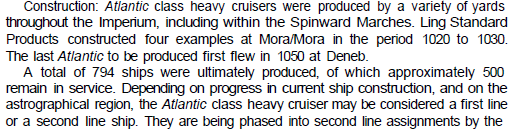
There is numerous references to Imperial Navy warships being built by private sector shipyards. I would be interested to see any published reference to the Navy building their own ships. IIRC, even the DEPOT systems have corporate liaison elements mentioned.

The Kinunir adventure was published the same year as the first edition of High Guard. Sadly, I can't recall if it was before or after in terms of hitting the stores. But it was definitely conceived of prior to High Guard expanding the ships to vastly larger sizes. Most of the descriptions of what the Kinunir class ships got up to are nonsensical once 200k ships are actually the line of battle.
 
Even in 1977 Book 2 you could build 5000 ton ships that would outfight the Kinunir. "pride of the fleet" comments notwithstanding, it was never the be all and end all of naval ships.

In any case, are we discussing 1978 products or Mongoose era? Or even that new lore breaking book from 1981, Supplement 9: Fighting Ships?

In any case, yes, it is clear that some ships are contracted out. But it seems pretty well established that the ones that really matter are Depot built.
 
Last edited:
In real life, it includes refits, upgrades, repairs, and maintenance.


To meet Fisher's goal of building the ship in a single year, material was stockpiled in advance and a great deal of prefabrication was done from May 1905 with about 6,000 man weeks of work expended before she was formally laid down on 2 October 1905.[38] She was built at HM Dockyard, Portsmouth, which was regarded as the fastest-building shipyard in the world. No. 5 Slip was screened from prying eyes; attempts were made to indicate that the design was no different to other battleships. Some 1,100 men were already employed by the time she was laid down, but soon this number rose to 3,000. Whereas on previous ships the men had worked a 48-hour week, they were required on Dreadnought to work a 69-hour, six-day week from 6 a.m. to 6 p.m., which included compulsory overtime with only a 30-minute lunch break. While double-shifting was considered to ease the long hours which were unpopular with the men, this was not possible due to labour shortages.[38] On Day 6 (7 October), the first of the bulkheads and most of the middle-deck beams were in place. By Day 20, the forward part of the bow was in position and the hull plating was well underway. By Day 55 all of the upper-deck beams were in place, and by Day 83 the upper deck plates were in position. By Day 125 (4 February), the hull was finished.
 
So, both. The Imperial Navy both produces ships at its own yards, and contracts out production to corporate yards.
I would say no.
It produces prototypes at its own r&d depot facilities and then puts the plans out to tender with the ship construction yards.

If anyone can find any canon references to the IN building the majority of its fleet at its own yards I would like to see it, so far I have not been able to find such a statement.
 
In real life, it includes refits, upgrades, repairs, and maintenance.


To meet Fisher's goal of building the ship in a single year, material was stockpiled in advance and a great deal of prefabrication was done from May 1905 with about 6,000 man weeks of work expended before she was formally laid down on 2 October 1905.[38] She was built at HM Dockyard, Portsmouth, which was regarded as the fastest-building shipyard in the world. No. 5 Slip was screened from prying eyes; attempts were made to indicate that the design was no different to other battleships. Some 1,100 men were already employed by the time she was laid down, but soon this number rose to 3,000. Whereas on previous ships the men had worked a 48-hour week, they were required on Dreadnought to work a 69-hour, six-day week from 6 a.m. to 6 p.m., which included compulsory overtime with only a 30-minute lunch break. While double-shifting was considered to ease the long hours which were unpopular with the men, this was not possible due to labour shortages.[38] On Day 6 (7 October), the first of the bulkheads and most of the middle-deck beams were in place. By Day 20, the forward part of the bow was in position and the hull plating was well underway. By Day 55 all of the upper-deck beams were in place, and by Day 83 the upper deck plates were in position. By Day 125 (4 February), the hull was finished.
Not sure the applicability of the HMS Dreadnought's construction is here. Yes, in 4 months they laid down the hull, but it took another 8 months of fittings before the ship was actually ready to begin its trials. Initial construction time was 366 days - still great progress for the time.

When a nation puts its mind towards something it can accomplish great things. The US did this during WW2, with its' command economy that was coupled with multiple capitalistic ideals and processes. Ford built bombers at it's Willow Run facility, and at its' peak was able to roll a bomber an hour off the production line. Of course this took something like 40k workers in this plant alone to make this happen. Kaiser shipyards were able to assemble a Liberty ship in just 4 days. Amazing feats of production, but there were soooo many things that had to be done ahead of time to make this occur. And it was wartime as well - when nations go to war for survival the standards are thrown out the window. On the other side of this coin we have Nazi Germany. Most people don't realize that Germany production numbers were nearly as great as they were at the end of the war as they were at the beginning. Germany was still ramping up it's production levels at the beginning of the war - not to mention capturing other locations that they were able to bring into the fold. Nazi Germany also suffered far greater from self-inflicted issues. Rather than having a unified approach to its industrial might, the three major sectors (four if you count those shits in the Gestapo/SS) - Wermacht, Kriegsmarine and Luftwaffe - ALL were competing with one another for budget, resources and manufacturing. Thankfully the Teutonic efficiency did NOT extend to leadership.

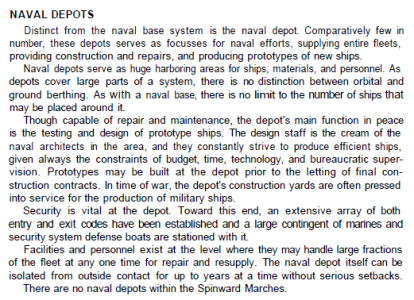
I know the LBB blurbs on depot systems makes it out like these are megafactories and such, but I think there are many practical limitations to this. Within the description of the depot it talks about the systems being self-sufficient and able to go 'years' without outside contact or setback. But, in order for this to work that would mean the entire system is self-sufficient in production capabilities - food, raw materials, manufacturing, etc. Theoretically possible, certainly, but one has to also keep in mind that in order to build "fleets" they would need ALL the smaller industrial facilities - able to mine the materials, build the electronics, have all the necessary manufacturing facilities, docks and slips. Per the description that would also mean the system had a completely self-sufficient civilian side of food and consumer electronics manufacturing capabilities as well. When you are talking a star system, lots of things are possible. But you are also talking about hundred of millions, if not more when you consider the large numbers of people required to support all this, AND all their families. It's not unreasonable to expect such a location to have a population in the billion or more once everything is accounted for. Examples of crazy production capabilities like the Dreadnought or the Liberty ship don't take into account the planning or costs associated with setting up the environment to make that possible. Dreadnoughts main guns had to be planned years ahead of time since that's how long it took to make a single naval gun. The Liberty ship required massive amounts of pre-assembly work so that the 4 days only accounted for putting it together.

So it's possible that depots are going to have some extra capacity just in case, not even the Imperium could afford to have oodles and oodles of idle manufacturing capabilities (or stockpiles) just sitting around for the every century or so that a war happens. All of that equipment would have to be paid for, maintained and upgraded as changes occur. This is a massive investment with zero return except when there is a war. So yeah, there are some big logical holes you can drive through on descriptions such as these. Sure, it's a game and all, and you can make up whatever you want. But some of these sweeping descriptions defy common sense and logic, so take them with a grain of salt and move on.

Personally, based on what I understand a depot system to be, I think they have the capability to build warships, and to make some of the components locally. And they stockpile a reasonable amount of stores to act as logistical hubs. They can repair and refurbish ships and they regularly maintain reserve fleets for when wars may occur. But it's all going to be within reason - they'll still regularly import components and parts from other locations because that's how supply chains and integrated economies work. I certainly don't expect them to be able to churn out dozens of Tigress-class dreadnoughts in a year as a norm. Just how large of a capacity they'd have is debatable - and that's ok.
 
In any case, yes, it is clear that some ships are contracted out. But it seems pretty well established that the ones that really matter are Depot built.
Pretty clear from what? I agree with Sygtrygg here. I have never seen any indication that the IN builds the ships at scale in Depot. Prototypes are what are mentioned.

You could certainly imagine that "Yard 17" refers to a facility in Depot rather than a shipyard business' name, but there's no information on what Yard 17 is that I recall and everything else on the lists where it appears are corporate shipyards.
 
As I was told, one consequence of the government running their own shipyard(s), is that in the event of asking for bids from private contractors, their own experts can vet them, since they have a very precise knowledge of the actual costs and resources involved.

Besides, setting priorities in their own yards, as to the order of construction and/or repairs.
 
Within the description of the depot it talks about the systems being self-sufficient and able to go 'years' without outside contact or setback. But, in order for this to work that would mean the entire system is self-sufficient in production capabilities - food, raw materials, manufacturing, etc. Theoretically possible, certainly, but one has to also keep in mind that in order to build "fleets" they would need ALL the smaller industrial facilities - able to mine the materials, build the electronics, have all the necessary manufacturing facilities, docks and slips.

I wonder if this was inspired by First Lensmans Project Bennett?
 
I would say no.
It produces prototypes at its own r&d depot facilities and then puts the plans out to tender with the ship construction yards.

If anyone can find any canon references to the IN building the majority of its fleet at its own yards I would like to see it, so far I have not been able to find such a statement.

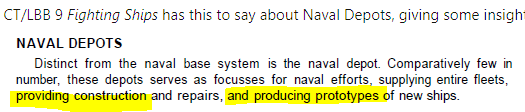
Though in @collins355 first reference post above, it does say

1767632174166.png

So depots provide construction of ships as well as the construction of prototype ships. I think that the bulk of ship construction for the Imperial Navy is done by corporate shipyards, but there is some production done by naval depots, in addition to the design and construction of prototypes.
 
Though in @collins355 first reference post above, it does say

View attachment 7094

So depots provide construction of ships as well as the construction of prototype ships. I think that the bulk of ship construction for the Imperial Navy is done by corporate shipyards, but there is some production done by naval depots, in addition to the design and construction of prototypes.
It also says that in time of war, the construction yards are pressed into service building warships. My guess is that is the only time they are used that way.
 
Reading the entire sentence through - it is referring to the construction of prototypes of new ships, not mass production of the fleet vessels.

Supplying entire fleets... so the consumables a fleet needs

providing construction and repairs... it does not say construction of fleet vessels, you are assuming construction refers to fleet vessels, while I assume it doesn't.
 
If the writer meant to say that they have production-capable shipyards that they don't use in the century or so between major wars then the writer was a lunatic, because unless they are entirely unlike today's shipyards then you need to have a fairly constant order book so as not to lose the capability to build ships altogether. At the very least they'd have to keep them ticking over.
 
Back
Top