I like the ideal of a weapon that leads to the Disintegrator that would show a progression.In one of the old CT JTAS Articles (one that was actually discussing some of the SDI Results mentioned above concerning C-PAWS & N-PAWS ironically), the author proposed an "A-PAWS" (Anti-Particle Accelerator Weapon System) that fired Anti-Neutrons (I suppose neutral AntiHydrogen would work as well and I am surprised he didn't suggest it given the article's topic). He called it a "V-Gun" (for "Vaporize") and it spanned Spinal Mounts TL15-18 IIRC.
That might fit your bill for a Main Weapon in that TL range that fits the Setting.
Also, Classic SciFi and Traveller/T5 have had "Disintegrators" (sometimes called "Disruptors") that come in two flavors:
- The "Classic" Traveller DISINTEGRATOR that suppresses the Residual Strong Nuclear Force (as it does in Damper-Tech) but causes the entire Nuclei of atoms to become unbound.
- The T5 Disruptor/Disintegrator (lower TL than the disintegrator above) a la Larry Niven's Pierson's Puppeteers that suppresses the charge on the electron and causes molecules to dissociate and atoms to ionize and/or plasmify.

You are using an out of date browser. It may not display this or other websites correctly.
You should upgrade or use an alternative browser.
You should upgrade or use an alternative browser.
Spinal Neutron Laser seriously broken
- Thread starter tytalan
- Start date
Except you have things in Traveller that are absolutely counter to science like Cold Fusion (now call Fusion +) and psionic. I think it’s funny that people try to claim a game that was largely inspired by Star Wars as being Hard Scifi especially when Marc Miller himself has repeatedly said it’s not hard scifi.At some point as TLs progress the science fiction has to become more handwavium due to the need to invent fictional physics. The important thing for fictional physics is that it achieves the desired new technology in a consistently applicable manner, the new physics needs to have parameters established.
Jump drive - opens a rift into extra-dimensional hyperspace. Is a hyperspace with different physics and different dimensions a scientific possibility? As things stand we can write the maths for it but we haven't a clue as to the technology that could make it a reality, nor the ontological explanation for it.
Damper and meson tech - manipulation of the strong and weak interactions... scientifically possible, but he mechanisms and technologies not so much...
Gravitics and acceleration compensation are the outliers - there is no handwavium for how gravitics even works or what the limits on the technology limits are, it is the real handwavium of Traveller. This is likely due to that here in the real world gravity is still being argued about. Is is quantisable? Can the gravitaional interaction be unified with the other interactions? You can read textbook after textbook where physicists describe gravity as a force, while others say it isn't, and then all the handwavium as they discus interactions...
I was reading about "mercury engines" as the motive power behind the UAPs and ARVs so beloved of UFO conspiracy theorists. Mercury has the unusual property that its electrons are moving close to the speed of light, so could adding angular momentum to mercury tip the relativistic effects of mercury electrons into the realm of new physics?
No, just no, but fun to speculate

WHULorigan
Emperor Mongoose
Except you have things in Traveller that are absolutely counter to science like Cold Fusion (now call Fusion +) and psionic. I think it’s funny that people try to claim a game that was largely inspired by Star Wars as being Hard Scifi especially when Marc Miller himself has repeatedly said it’s not hard scifi.
Traveller was already at the publishers when Star Wars hit the theatre.
Charted Space may have been influenced somewhat by Star Wars with High Guard onwards, but it's primary inspirations have been repeatedly emphasized by Marc Miller as books and pulp magazines of the 50s and 60s. E.C. Tubb, Poul Anderson, Larry Niven, Doc Smith, H. Beam Piper, etc.
WHULorigan
Emperor Mongoose
Oh yea for you Traveller is hard scifi crowd explain the fact that the Tachyon Cannons are an official weapon system in Traveller?
They don't belong in Charted Space. In other settings, sure - go for it. But as you have played Traveller and the Charted Space setting for so long, I of course do not need to tell you that there are no such things in Charted Space going back thru all the rulesets, nor anything described as remotely like them in style or character, either.
Now, if you want to import them into your version of Charted Space, have at it. But they are not a part of the historic baseline of the setting.
WHULorigan
Emperor Mongoose
Except you have things in Traveller that are absolutely counter to science like Cold Fusion (now call Fusion +) . . .
BTW - as an aside, there ARE legitimate Cold Fusion reactions - it was just the Fleischmann-Pons Apparatus of 1989 that was bunk.
Cold Fusion just means Fusion not requiring MegaKelvins to achieve. But we have performed Muon-Catalyzed Fusion in the lab at about 600K, IIRC (but it can't be sustained because of low muon production rates and subsequent decay, and muon capture by fusion products (if only we had Dampers . . . )
And we have commercially produced tabletop-sized fusion reactors for industry as low energy neutron sources since the 1980s - look up "Fusor" on the internet. Teenagers have built them for high school science projects for an outlay of anywhere between $500-$3000 (in 2005 dollars - don't ask me about today). They just don't work as a power-source - they have to be externally powered.

Sigtrygg
Emperor Mongoose
How can it have been insopired by Star Wars when Star Wars didn't come out until after the rules had been produced. That time machine of GDWs must have been working a lot back then.Except you have things in Traveller that are absolutely counter to science like Cold Fusion (now call Fusion +) and psionic. I think it’s funny that people try to claim a game that was largely inspired by Star Wars as being Hard Scifi especially when Marc Miller himself has repeatedly said it’s not hard scifi.
Star Wars may have inspired elements of the Third Imperium setting, Mongoose has certainly added more Star Wars, but the original LBB1-3 set published in 1977 not so much.
Fusion+ is not the same as the cold fusion that has been discredited by current physics, it is TL12 for a start, which likely means damper tech is involved.
Sigtrygg
Emperor Mongoose
But not in charted space - yet.Oh yea for you Traveller is hard scifi crowd explain the fact that the Tachyon Cannons are an official weapon system in Traveller?
As to what a tachyon cannon is you will notice the handwavium has changed - maybe someone listened when it was pointed out that tachons do not do what they think they do...
Sigtrygg
Emperor Mongoose
Nore were personal energy screens and ion cannons, that hasn't stopped them being written into the setting by Mongoose. It is only a matter of time until someone writes a charted space book with tachyon weapons, neutron lasers and all the other stuff.They don't belong in Charted Space. In other settings, sure - go for it. But as you have played Traveller and the Charted Space setting for so long, I of course do not need to tell you that there are no such things in Charted Space going back thru all the rulesets, nor anything described as remotely like them in style or character, either.
Now, if you want to import them into your version of Charted Space, have at it. But they are not a part of the historic baseline of the setting.
MongooseMatt is on record as sayonmg charted space is open to all the possibilities of every Traveller book, which is one of the reasons my purchasing of Mongoose Books will be a lot more selective going forward. I am not interested in a charted space where an author can just introduce hyperdrive or some other tech that had no precedent.
That said post Singularity anything can happen, since it could all be a simulation...

MarcusIII
Emperor Mongoose
Personally I use induced quantum tunneling in my P-P fusion reactor.Cold Fusion just means Fusion not requiring MegaKelvins to achieve. But we have performed Muon-Catalyzed Fusion


Jet_Black
Banded Mongoose
Tachyon weapons are already officially written into the setting - see Yusote's Ship, Mysteries of the Ancients, p. 159 - it's equipped with a small tachyon cannon bay...Nore were personal energy screens and ion cannons, that hasn't stopped them being written into the setting by Mongoose. It is only a matter of time until someone writes a charted space book with tachyon weapons, neutron lasers and all the other stuff.
MongooseMatt is on record as sayonmg charted space is open to all the possibilities of every Traveller book, which is one of the reasons my purchasing of Mongoose Books will be a lot more selective going forward. I am not interested in a charted space where an author can just introduce hyperdrive or some other tech that had no precedent.

Yeah, those books have missiles, pulse lasers and beam lasers. Every other thing published since is post-Star Wars.Traveller was already at the publishers when Star Wars hit the theatre.
Charted Space may have been influenced somewhat by Star Wars with High Guard onwards, but it's primary inspirations have been repeatedly emphasized by Marc Miller as books and pulp magazines of the 50s and 60s. E.C. Tubb, Poul Anderson, Larry Niven, Doc Smith, H. Beam Piper, etc.
Also, Star Wars the MOVIE came out in May 1977, but the bestselling novelization, with colour plates, was a November 1976 release. I got two copies for Christmas 1976.
I can assure you that well before Traveller went to the printers, GDW would have been aware of the upcoming movie and its story. How much influence that had is a matter of speculation (my opinion is not that much), but regardless of that, Traveller was released in July 1977 into the height of the original Star Wars craze.
I'd also make the point that the GDW Adventures were not adverse to adding in non-standard tech as Maguffins or player rewards.
Annic Nova. The AI in Kinnunir. Grandfather and all his stuff.
It IS a stock SF trope that the protagonists stumble across something weird and useful. Ancient Artefacts have been a staple of Charted Space all along.
No reason a Tachyon cannon might be found as an artefact, if you want that in YTU. For me, it's nice that High Guard (and TNE Fire Fusion and Steel before it) has a chapter on other tech ideas.
Last edited:

ProfGrizzlyJon
Emperor Mongoose
And this is how my "jumpspace intrusion weaponry" for TL-17 and beyond was born. I needed a "doomsday" weapon that wasn't Ancient based.Jump drive - opens a rift into extra-dimensional hyperspace. Is a hyperspace with different physics and different dimensions a scientific possibility? As things stand we can write the maths for it but we haven't a clue as to the technology that could make it a reality, nor the ontological explanation for it.
Damper and meson tech - manipulation of the strong and weak interactions... scientifically possible, but he mechanisms and technologies not so much...
ProfGrizzlyJon
Emperor Mongoose
I believe you are incorrect. Neutron Lasers are part of the Babylon 5 universe, and the rules were ported over from the 2008 Traveller-compatible ruleset. Same applies to the plasma-pulse cannon.The Neutron Laser is NOT a Charted Space weapon; It is from Warhammer 40k. It's text description is pure technobabble.
I always understood the Neutron Laser to be an Atomic Laser, as described here.
WHULorigan
Emperor Mongoose
I believe you are incorrect. Neutron Lasers are part of the Babylon 5 universe, and the rules were ported over from the 2008 Traveller-compatible ruleset. Same applies to the plasma-pulse cannon.
I always understood the Neutron Laser to be an Atomic Laser, as described here.
That is possible. I know they are Warhammer 40K because I did a web search before I posted.
Plasma Pulse weapons were definitely in Bab5.
What you linked as an Atom Laser potentially works for anything Bosonic (i.e. anything with net full integer quantum spin states) because it can be collapsed into a single quantum state and form a coherent beam of a single wavelength. I am intrigued by that possible description for the device.
But neutrons are still fermions, not bosons, and do not collapse into a coherent beam, and I do not understand the role their "flow" is supposed to play in stabilization of the laser (of whatever type); I still do not know what the "stabilizing neutron flow" of the text fluff means.
Last edited:
WHULorigan
Emperor Mongoose
Neutron Lasers are part of the Babylon 5 universe, and the rules were ported over from the 2008 Traveller-compatible ruleset.
BTW, do you have a descriptive game reference for the Bab5 "Neutron-Laser", or a reference from an online resource for the TV Series? I would be interested to see what has been said about it elsewhere, if anything.
ProfGrizzlyJon
Emperor Mongoose
Of course!have a descriptive game reference for the Bab5 "Neutron-Laser",
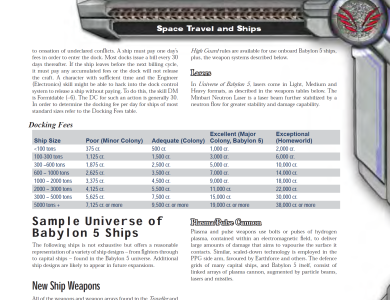
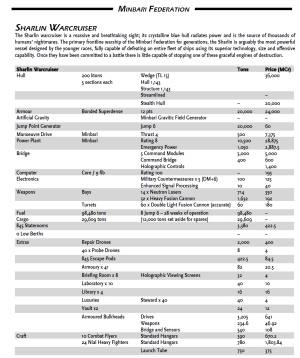
The Minbari Neutron Laser is a laser beam further stabilized by a neutron flow for greater stability and damage capability.
WHULorigan
Emperor Mongoose
Of course!
The Minbari Neutron Laser is a laser beam further stabilized by a neutron flow for greater stability and damage capability.
View attachment 7048
View attachment 7049
Unfortunately that doesn't give any more info than the MgT2 Core Book info (although it does confirm the MgT Bab5 reference - Thanks). I can't find a mention of the technology in Online Bab5 web resources unfortunately. Maybe someone else has a better Bab5 source.
ProfGrizzlyJon
Emperor Mongoose
Unfortunately that doesn't give any more info than the MgT2 Core Book info (although it does confirm the MgT Bab5 reference - Thanks). I can't find a mention of the technology in Online Bab5 web resources unfortunately. Maybe someone else has a better Bab5 source.
Minbari Neutron Cannon: Babylon 5 Tech-Manual.
The Babylon 5 Tech-Manual - the oldest and most detailed site concerning the technology, ships and weapons of Babylon 5. ENTER!
www.b5tech.org


