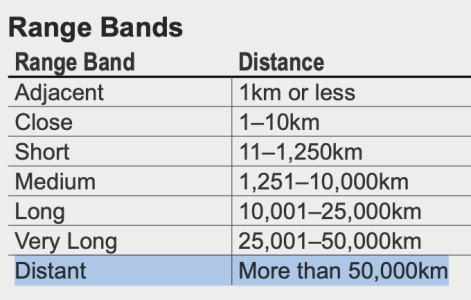
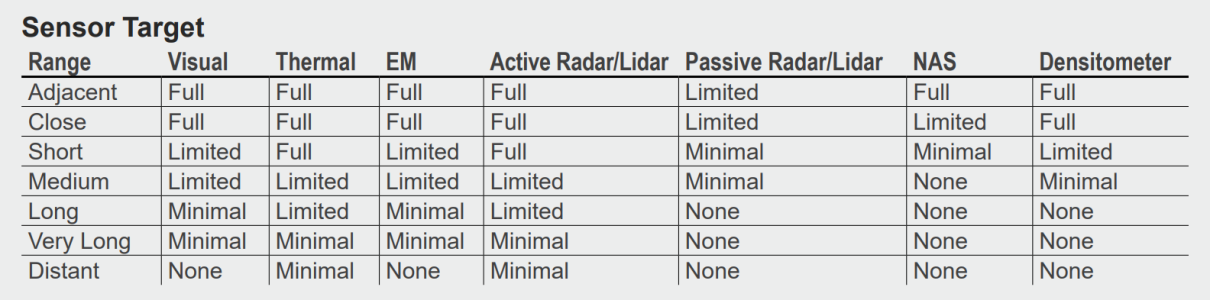
Totally disagree:
"When using these rules", i.e. optional, for specific purposes.
Attack can be made at up to 300 000 km, but sensors can see further.
This is a direct contradiction to your point.
"Sensors can see further" is not a direct contradiction of my point that there is no evidence that "Minimal" information can be obtained from sensors beyond Distant.
If it said "... but sensors can obtain "minimal" information at Very Distant but it requires a formidable check" then that would be a direct contradiction (but if it said that we wouldn't need to be discussing it).
Yes, at Far range, but not Very Distant. At Very Distant we can apparently get more information.
But what that information might be is not specified it is just more than jump flash and apparently a vague tonnage.
If there was a generic rule that allowed to you make out of range Sensor Checks at higher difficulty (which is not a bad idea) then it would have a context, but instead the amount of information decreases with range bands regardless of the ease you can make the skill check. If you make the check you get the type of information appropriate to that sensor at that range band no more no less. Obviously if you fail the check then you get nothing at all.
As no limitation or restriction is given, presumably as much as at Distant:
As you say, that is your assumption.
No limited information, just a more difficult check.
With sensors difficulty does not alter the type of information you get at a particular range.
"All Electronics (sensors) checks become Formidable (14+)." That sentence will apply to the check to determine if one of those random blips you see on your scope is a real object or a ghost image. It does not need to imply any increase in sensor range for it to have a purpose for being in the rules.
You are solely focussing on the information in the side bar (and reading into it more than is actually RAW). If you apply
"All Electronics (sensors) checks become Formidable (14+). to the Initial Detection rules on P76-77 then you will see that you can have to make check to differentiate blips. If you fail that check you cannot differentiate, regardless of the range of your sensors.
"Without closer inspection, detailed system charts or communication with other spacecraft in the vicinity, it can be difficult to determine the exact nature of many objects."
"...should one ship need to approach another for boarding or to engage in combat, more precise information is required. To obtain this level of information, the ship’s sensop must make an Average (8+) Electronics (sensors) check (1D minutes, EDU), adding DMs listed in the Initial Detection table and DMs for the type of sensors being used, as described under Install Sensors on page 21."
This is for distant and closer for Very Distant the check becomes formidable. You will note that the range of the specific sensors is not a factor in this part of the detection mechanics. You get a DM for the level of sensor (improved, Military etc.) and you get DMs for the circumstances. If your ship is running silent (or indeed is a wreck) you still get to make the check so it is not specific type of sensor check (e.g. Thermal), it is more a holistic check using all sensors and probably analytical software (i.e. anything that gives a DM).
"Success indicates that the data collected by the sensop is enough to pinpoint the location of the ship, whereupon the ship’s captain can decide whether to allow an approach or engage in space combat. Failure indicates that the location of the ship (
or even that it is a ship) cannot be accurately determined. Exceptional failure means the
object is not detected at all or just assumed to be some inert object such as a planetoid,
defunct satellite or space junk."
So doesn't provide the information given by a specific sensor at specific range, it just tells you exactly where it is and confirms whether it is a ship or not. If you want more information you need to move to a range where your specific sensors can detect that sort of thing. If you fail the check you don't even get an accurate position or know if it is a rock or a ship so changing the check from Average to Formidable is a significant effect.
None of the words in the sidebar require the range you can get "minimal" information from a specific sensor to be extended beyond that given in the CRB.
If you want to do that it is
your house rule. It is not RAW and I am not convinced it is even RAI based on the rules set out in Initial Detection and given there have been a number of revisions of both the CRB* and HG since 2016 and none of them have stated that Thermal or LIDAR/RADAR provide minimal information to Very Distant. Had this been RAI I would have expected it to have made the cut.
Unless you are willing to also discuss the words on p76-77 then there is no point continually rehashing the same old statements about what the words in the sidebar might mean since I think the context is critical.
*I am using CRB 2022 and HG 2022.