Space Combat - Did I miss something?

It really depends on the game you want to play.
Well, I said several pages back that the correct answer is "what makes the best gameplay". And that's probably not the same between different groups. And the game focuses on the things the player can make a difference in. There's no point where "rolling 1000s of dice" is useful gameplay. So the gamemaster is going to determine if the player needs to make a roll and, if so, what that roll will be about and how difficult it is.

All I need to know is that detection is possible in certain parameters or not. I don't think Mongoose's version of the sensor rules is actually very good at that. It has lots of fiddly bits that have vague effects.

I mainly need to know how much difficulty traffic control has in tracking commercial shipping and in spotting smugglers and pirates. And, to a lesser extent, what sort of ranges make sense for ships making interplanetary runs in real space.

Fleet battles should just be a boardgame, imho.
 
OK, so a battle fleet will detect anything, and detail everything, at Very Distant or even Far range in a round or so, long, long before we get into Distant range and can start shooting?

You just have to engage Virtual Crew and have the computer roll a few thousand dice...
If you like. I would be wondering how many instances of sensor op you could be running simultaneously and how good the virtual Senor Op was, but that is just detail and heavy automation is the most likely scenario. Actual sophont Sensor Ops are going to be be focussed on detailing the objects of interest picked out from the noise by the automated systems. Hopefully those automated systems err on the side of caution and throw anything that isn't unequivocally benign in the "object of interest" list.

I would also be interested in the number of fleet actions that have panned out that way, with an enemy fleet jumping in, both sides immediately identifying all possible targets, and letting loose all munition stores at maximum range. I am sure examples of this style of battle will have been set out in the Imperial Navy Handbook or some such.

For my tiny part of the game, no normal player or peer adversary is instantaneously going to know everything that is out there and like a sail boat passing blissfully ignorant over a pack of sharks in a feeding frenzy, that is probably a darn good thing.
 
To repeat the quoted text from earlier, ships with good sensors (like those accompanying BBs, for instance, absolutely can tell an asteroid from a ship. They can also detect out to Far (over 5 million kms) with the right sensor options (discussed already: sensor arrays) and a roll (14+) that’s in practice pretty easy for a ship with decent sensors and a skilled operator.

Most of the last couple of pages could have been avoided with this text! Distant range detection with appropriate detail is absolutely to be expected of a military fleet containing BBs.

View attachment 6975
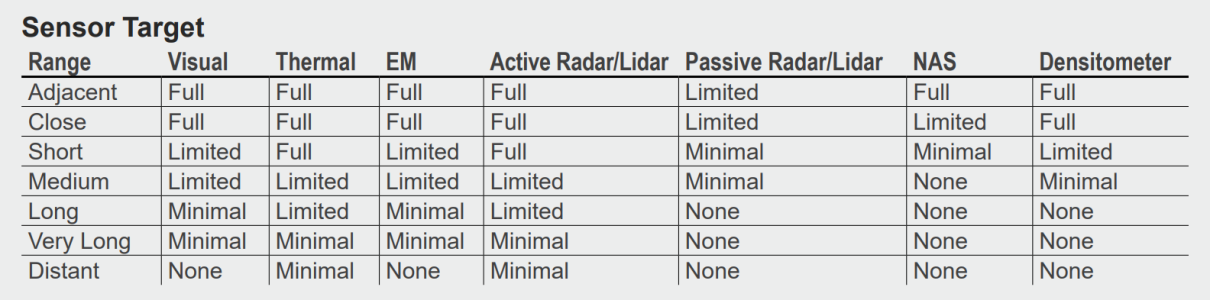
This is at least the fourth time this section of rules has been cited; and it seems you still have not read it. You seem to think it supports your point, when it does the exact opposite. No, Sensors do * NOT * provide 'Minimal' information at 'Very Distant' or 'Far' range; the quoted rules do not say that. The longest range sensors provide 'None' -- that is * NO INFORMATION * at 'Very Distant' and 'Far'. This is explicit in both the Core Rules Update on page 160, and High Guard update on page 26. All Sensors, even the fancy arrays are * OUT OF RANGE * at 'Very Distant' and 'Far' -- that is what 'provides no information' (and 'details available = None') means.

A Sensor can make a detection (put a numbered-but-undescribed blip on a list of thousands of other numbered-and-undescribed blips; and sometimes even the dTonnage is a guess) to out to as far as 'Far' IF the target creates a Jump-flash. Contacts which were previously detected (at shorter ranges, for example) can still continue-to-be (with Formidable rolls) tracked at 'Very Distant and 'Far', but no new information can be gained -- the sensors cannot provide any details, after all. But any contact which is lost cannot be re-acquired at 'Very Distant' or 'Far' unless it creates a Jump-flash, at which point it is gone anyway.

Determining if a blip is a rock or a ship is described in the rules -- the assumption is (given the extremely limited amount of information every sensor can provide) that a blip which is 'active in radio' is a ship. This requires an EM Sensor to provide at least 'Minimal' information, which they cannot do at 'Distant' without the help of an Extension Net, and cannot do under any circumstances at 'Very Distant' or 'Far'.

Ships are not picking out which of a lengthy list of numbered-but-undescribed blips is the enemy warship at 'Distant' range; although someone can make a wild, uniformed guess. But to have any assurance that those weapons were not wasted on a rock with an attached prospecting-beacon requires Active Radar / Lidar providing 'Limited' information -- that is the first time 'shape and structure' can be determined. That happens (with fancy sensor add-ons like an Extended Array) at 'Very Long' range and no further.
 
Last edited:
This is at least the fourth time this section of rules has been cited; and it seems you still have not read it. You seem to think it supports your point, when it does the exact opposite. No, Sensors do * NOT * provide 'Minimal' information at 'Very Distant' or 'Far' range; the quoted rules do not say that. The longest range sensors provide 'None' -- that is * NO INFORMATION * at 'Very Distant' and 'Far'. This is explicit in both the Core Rules Update on page 160, and High Guard update on page 26. All Sensors, even the fancy arrays are * OUT OF RANGE * at 'Very Distant' and 'Far' -- that is what 'provides no information' (and 'details available = None') means.

A Sensor can make a detection (put a numbered-but-undescribed blip on a list of thousands of other numbered-and-undescribed blips; and sometimes even the dTonnage is a guess) to out to as far as 'Far' IF the target creates a Jump-flash. Contacts which were previously detected (at shorter ranges, for example) can still continue-to-be (with Formidable rolls) tracked at 'Very Distant and 'Far', but no new information can be gained -- the sensors cannot provide any details, after all. But any contact which is lost cannot be re-acquired at 'Very Distant' or 'Far' unless it creates a Jump-flash, at which point it is gone anyway.

Determining if a blip is a rock or a ship is described in the rules -- the assumption is (given the extremely limited amount of information every sensor can provide) that a blip which is 'active in radio' is a ship. This requires an EM Sensor to provide at least 'Minimal' information, which they cannot do at 'Distant' without the help of an Extension Net, and cannot do under any circumstances at 'Very Distant' or 'Far'.

Ships are not picking out which of a lengthy list of numbered-but-undescribed blips is the enemy warship at 'Distant' range; although someone can make a wild, uniformed guess. But to have any assurance that those weapons were not wasted on a rock with an attached prospecting-beacon requires Active Radar / Lidar providing 'Limited' information -- that is the first time 'shape and structure' can be determined. That happens (with fancy sensor add-ons like an Extended Array) at 'Very Long' range and no further.
Oh come on. The rules explicitly say in that quote that attacks can be made at Distant range. Which is what we discussed. The extra range bands for detection far beyond that are just icing on the cake.

If your position is now that detection and attacks by opposing fleets can be made distant range then great. The last few pages have achieved agreement.
 
Last edited:
This is at least the fourth time this section of rules has been cited; and it seems you still have not read it. You seem to think it supports your point, when it does the exact opposite. No, Sensors do * NOT * provide 'Minimal' information at 'Very Distant' or 'Far' range; the quoted rules do not say that. The longest range sensors provide 'None' -- that is * NO INFORMATION * at 'Very Distant' and 'Far'. This is explicit in both the Core Rules Update on page 160, and High Guard update on page 26. All Sensors, even the fancy arrays are * OUT OF RANGE * at 'Very Distant' and 'Far' -- that is what 'provides no information' (and 'details available = None') means.
I don't think your interventions have been helpful. This is a legitimate and civil discussion about what the RAW means, what is most realistic, and what is best for gameplay and dogmatic assertions about what you think the rules say are not helpful. It's about thinking through the problem, assessing whether the current rules serve our purposes, and if needed proposing better solutions. Since people have different campaigns and different priorities, the solutions might sometimes be different, but it is not about "owning the other side," (there are no sides).
 
This is at least the fourth time this section of rules has been cited; and it seems you still have not read it. You seem to think it supports your point, when it does the exact opposite. No, Sensors do * NOT * provide 'Minimal' information at 'Very Distant' or 'Far' range; the quoted rules do not say that. The longest range sensors provide 'None' -- that is * NO INFORMATION * at 'Very Distant' and 'Far'. This is explicit in both the Core Rules Update on page 160, and High Guard update on page 26. All Sensors, even the fancy arrays are * OUT OF RANGE * at 'Very Distant' and 'Far' -- that is what 'provides no information' (and 'details available = None') means.
Where do you find the definite information of sensor resolution "None" at Very Distant range?
The Core book only gives "Minimal" for Thermal and Radar at range ≥50 000 km.

HG'22, p22 has this to say (as quoted a few times):
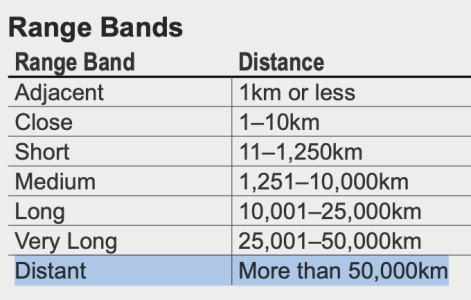
When using these rules, Distant covers ranges up to 300,000km, which is the maximum practical range that attacks can be made. However, it is possible for sensors to reach further in order to detect incoming threats. The following new range bands reflect this.
So, we can attack up to 300 000 km (≈1 ls), but sensors can reach further.
As far as I can tell Very Distant only turns Average sensor tasks into Formidable tasks.


A Sensor can make a detection (put a numbered-but-undescribed blip on a list of thousands of other numbered-and-undescribed blips; and sometimes even the dTonnage is a guess) to out to as far as 'Far' IF the target creates a Jump-flash.
That is not what HG'22, p26 says:
Far (over 5,000,000km): At these ranges, sensors can spot the signature of ships making jumps (inbound or out) and can determine only whether a contact is a ship or other similar-sized astronomical body. In either case, sensors are only able to determine the size of the contact to the nearest 10,000 tons.
It can detect jump flash and other contact. In either case the information is limited, i.e. these are two different cases, so jump flashes are not the only thing we can detect.
Even at Far range we can see the difference between a Broadsword and a Tigress.


Contacts which were previously detected (at shorter ranges, for example) can still continue-to-be (with Formidable rolls) tracked at 'Very Distant and 'Far', but no new information can be gained ...
That is not what HG'22, p77 says:
After initial contact, sensor detection is maintained under most circumstances. However, sensor contact with ships that have stealth may be lost if the range between ships extends by one or more bands during an encounter.
Normally no rolls needed to maintain tracking.


If you don't want sensors to reach too far, just house rule it; I certainly do.
I add the regular to hit range DM to sensor tasks, severely limiting civilian sensor range and making Stealth much more useful. Battle fleets tend to find each other anyway...
 
Where do you find the definite information of sensor resolution "None" at Very Distant range?
The Core book only gives "Minimal" for Thermal and Radar at range ≥50 000 km.
I think the point is that you get minimal information for thermal and Active RADAR/LIDAR out to the end of Distant Range (which is stated explicitly in HG2022 as 300,000 km. The rule about Very distant makes any sensor checks formidable. There is nothing in the text that explicitly extends the range of any sensor into the Very Distant or Far bands, it does however create an end to the Distant band at which Thermal and Active RADAR/LIDAR can provide minimal infromation. Other publications might have components or modifications that could extend the range of a sensor and that might mean they can be operated in the Very Distant or Far band.
It can detect jump flash and other contact. In either case the information is limited, i.e. these are two different cases, so jump flashes are not the only thing we can detect.
The only specific example of what can be detected at these new range bands is jump flash. Whilst other books might give a definition of the sensor required for that sort of detection, HG2022 doesn't. My reading of the rules is that None means no information can be determined about the target. However you can still detect a suspected presence. Jump flash will tell you if it a ship. If it moves (and you can triangulate on it with sufficient resolution) it may also indicate it is a ship. If it hasn't moved and hasn't just appeared I am not sure how you would be able to differentiate between a ship and other objects.

You still need that formidable check to avoid disregarding the blip as a ghost or otherwise irrelevant object and to get a more comprehensive position (and that hint as to its tonnage). If you get precise location you could in theory engage, but risk wasting ammunition and giving your own position away.
Even at Far range we can see the difference between a Broadsword and a Tigress.
If you succeed in the check you can say it is a ship of some type and that it is n*10,000 DTons. It seems odd that you can tell the difference between a 500,000 Dton ship and a 490,000 Dton ship, but not between a 20 Dton launch and a 5,000 Dton cruiser, but that is RAW.
 
Going back to the Torpedo/Missile miss-match, I find doubling the effect from the attack roll before multiplying for salvo size, gives results closer to what one would expect. Kind of a sloppy patch, but it does the trick from a gameplay perspective.
 
I think the point is that you get minimal information for thermal and Active RADAR/LIDAR out to the end of Distant Range (which is stated explicitly in HG2022 as 300,000 km. The rule about Very distant makes any sensor checks formidable. There is nothing in the text that explicitly extends the range of any sensor into the Very Distant or Far bands, it does however create an end to the Distant band at which Thermal and Active RADAR/LIDAR can provide minimal infromation. Other publications might have components or modifications that could extend the range of a sensor and that might mean they can be operated in the Very Distant or Far band.
I'm afraid you are overestimating the omniscience of the Core book.

As far as the Core book is concerned everything over 50 000 km is Distant range, up to infinity.
Core'22, p160:
Skärmavbild 2025-12-28 kl. 00.19.26.png
According to the Core book sensor detail at 100 000 km, 1 000 000 km, and 10 000 000 km is "Minimal" (for Thermal and Active Radar sensors).

Due to historic reasons (2015-16 beta program), Very Distant and Far was later added in HG.
See: https://forum.mongoosepublishing.com/threads/maximum-range-of-weapons.117984/
The textbox in HG was added in February 2016, when IIRC the Core book was more or less locked.
The Core book does not say anything whatsoever about Very Distant or Far range, because the Core book doesn't know those range bands exist; that is Distant range in the Core book.

Hence the Core book contains no definition of sensor performance at Very Distant range. That absence of evidence should not be seen as evidence of absence of sensor performance at Very Distant range...

HG adds Very Distant range as a subset of Core Distant range and discusses sensor performance at it. The only reasonable conclusion is that sensors actually reach that far.


Ideally that would have been updated in Core'20 or '22, but perfection isn't always attainable.


The only specific example of what can be detected at these new range bands is jump flash. Whilst other books might give a definition of the sensor required for that sort of detection, HG2022 doesn't.
Yes, we can see a Jump flash even at Far range. As that isn't defined anywhere else it was a reasonable place to put it?
This does explicitly not suggest that is the only thing we can see at Far range, as that is one of two cases in the rules text.


My reading of the rules is that None means no information can be determined about the target.
Agreed, but there is no table or text exactly defining sensor information at Very Distant range. There is no rule saying sensor detail is "None" at Very Distant and Far ranges.
That has to be inferred from the text box in HG, saying detection is possible at Very Distant range, hence some information must be available.

HG'22, p26:
Far (over 5,000,000km): At these ranges, sensors can spot the signature of ships making jumps (inbound or out) and can determine only whether a contact is a ship or other similar-sized astronomical body. In either case, sensors are only able to determine the size of the contact to the nearest 10,000 tons.
We are getting information, but restricted to less than normal for "Minimal" (Hot or cold overall + Basic outline) to just a blip and the difference between a ship and a rock (and ±10 000 Dton).


You still need that formidable check to avoid disregarding the blip as a ghost or otherwise irrelevant object and to get a more comprehensive position (and that hint as to its tonnage).
Agreed, and that is a problem for the average Free Trader, but not much of a problem for a decent warship.


If you succeed in the check you can say it is a ship of some type and that it is n*10,000 DTons. It seems odd that you can tell the difference between a 500,000 Dton ship and a 490,000 Dton ship, but not between a 20 Dton launch and a 5,000 Dton cruiser, but that is RAW.
Yes, it's very simplistic, but still quantified so it can actually be used.
The take home is probably that we see no difference between ACSs at Far range.
 
The following web site gives a great explanation why in real life there aint no stealth in space.

I mention this not for the stealth aspect, but the detection.


More than reasonable to go with the rules that there is minimal info available out to extreme ranges.

I think the rules are being quite generous in not letting you be identified at extreme ranges.
 
Last edited:
I'm afraid you are overestimating the omniscience of the Core book.

As far as the Core book is concerned everything over 50 000 km is Distant range, up to infinity.
Core'22, p160:
Yes, I addressed that in my post. Under the core rule book definition you could fire a volley of missiles at a target at infinite range (parsecs even) and it would only be at -6 to hit. This was clearly silly.

HG2022 added new range bands and that changed the extent of Distant. HG2022 did not however extend the Sensor Target table to allow sensors to extend into those new bands. When talking about sensor range it refers you out to the table in the CRB. It allowed formidable sensor checks at Very Distant but you need that regardless of whether your particular sensor has the range to obtain any useful information just to have the basic blip on your screen (exceptional failure means that you don't even detect the object). There may also have been a plan to introduce longer range sensors or add in modifications to extend sensor range (some shorter range sensors got a range increase).

There is no evidence that sensors can provide minimal information at Very Distant and Far, but there is evidence that they can't. The table was not updated to extend them to include Very Distant and Far. The Distant band was explicitly bounded at 300,000 km. The section discussing the them says you can't determine anything but rough tonnage. You need active sensors to get a positive fix so thermal can't help even within Distant range.

Should it be revisited, absolutely. Much of the text discusses ranges like they are absolute values rather than bands of distance. EM is an odd term as all sensors are EM since they all detect electromagnetic radiation of one sort or another The existence of radiation does not equate to an ability to detect it nor an ability to interpret it and the inverse square law applies. If you cannot reach an enemy ship with a laser weapon how does active LIDAR reach it. What the heck is passive LIDAR anyway? Lots of questions that ideally would have been answered in HG.
 
Love me some ProjectRho.

Traveller ships don’t use heat sinks and IIRC none of the stealth options discuss venting or redirecting heat signatures. So IMTU I use Power Plant output as +DM for detection and tracking. None of this “not sure if it’s a space rock or a ship” BS.

Doesn’t matter if it’s 5,000 km or 5,000,000 km away, even a small ship that is coasting with only life support functioning still has a Power output signature in the form detectable heat. So you know it’s a ship out there because Thermal/IR sensors can see them just like they can see stars and gas giants.

So the drama isn’t really in detection, it’s in the choice you make looking at your cluttered detection screen… which of these are regular traffic?… which are threats?…
 
Back
Top