Space Combat - Did I miss something?

HG p. 37, Missile and torpedoes are given flight times out to distant range, which ends at 300.000km. This is also stated to be the edge of practical space combat ( with the exception of missiles (and presumably also torpedoes), which are on ballistic trajectories that effectively have unlimited range (these can't hit a mobile target, but can hit a target that can't move out of the way)).

The rules are clear that space combat ranges go out to 300000. Though they are not as clear as they should be: lots of places in the rules 50000+ is cited for "Distant" and it becomes a research project to find out how far "Distant" goes out to; 300000 is mentioned RAW but not everywhere where Distant is defined. It should be: every single place where Distant is cited, the outer end of the range band should also be stated.

Not all ships will be making detections that far out: this is why premium sensors are useful, and cheap sensors are cheap. It is entirely plausible that the cheap ass old TL 12 free trader with its cheap minimal laser cannon and cheap ass commercial sensor system is not as capable in detection, targeting, and hitting stuff at long ranges as a TL15 Imperial Navy BATRON.

Direct fire weapons don't go out past Very Long range - and modifications don't let you mod beyond this either, not even for Imperial Navy BATRONs. So combat from 50000- 300000 will be using only missiles and torpedoes. Which makes those weapons important for long range combat and also makes the torpedoes endurance characteristic important - missiles can do it but the multiple halvings that tend to happen when you shoot this far away (plus the multiple rounds of EW) really make them pretty ineffective .

As per the rules, at this range, sensors per the rules don't allow detection of most characteristics which would distinguish possible targets from each other. There is always the option of assuming the unidentified object is the enemy and just shooting it. Whether this is a good idea is very context dependent - in a war zone or context where you've been tracking a ship and know from context what the blip is, shooting is probably just going to be the baseline presumption. In a non-war civilian environment, not- shooting will hopefully be the norm and more information needed. Also BATRONs will have swarms of fighters that they can send out to have a look for them.

Warships and aircraft IRL target each other on imperfect information, and they certainly will in space too, if IRL space war ever becomes a thing. I think we can assume it will happen in Traveller too. There will be mistakes as a result, systems to prevent those mistakes, as well as imperfections in those systems which cause the mistakes to happen anyways. But the logic of shooting first when you have the option to do so is quite strong, so Distant range combat is a thing.
 
HG p. 37, Missile and torpedoes are given flight times out to distant range, which ends at 300.000km. This is also stated to be the edge of practical space combat ( with the exception of missiles (and presumably also torpedoes), which are on ballistic trajectories that effectively have unlimited range (these can't hit a mobile target, but can hit a target that can't move out of the way)).

The rules are clear that space combat ranges go out to 300000. Though they are not as clear as they should be: lots of places in the rules 50000+ is cited for "Distant" and it becomes a research project to find out how far "Distant" goes out to; 300000 is mentioned RAW but not everywhere where Distant is defined. It should be: every single place where Distant is cited, the outer end of the range band should also be stated.

Not all ships will be making detections that far out: this is why premium sensors are useful, and cheap sensors are cheap. It is entirely plausible that the cheap ass old TL 12 free trader with its cheap minimal laser cannon and cheap ass commercial sensor system is not as capable in detection, targeting, and hitting stuff at long ranges as a TL15 Imperial Navy BATRON.

Direct fire weapons don't go out past Very Long range - and modifications don't let you mod beyond this either, not even for Imperial Navy BATRONs. So combat from 50000- 300000 will be using only missiles and torpedoes. Which makes those weapons important for long range combat and also makes the torpedoes endurance characteristic important - missiles can do it but the multiple halvings that tend to happen when you shoot this far away (plus the multiple rounds of EW) really make them pretty ineffective .

As per the rules, at this range, sensors per the rules don't allow detection of most characteristics which would distinguish possible targets from each other. There is always the option of assuming the unidentified object is the enemy and just shooting it. Whether this is a good idea is very context dependent - in a war zone or context where you've been tracking a ship and know from context what the blip is, shooting is probably just going to be the baseline presumption. In a non-war civilian environment, not- shooting will hopefully be the norm and more information needed. Also BATRONs will have swarms of fighters that they can send out to have a look for them.

Warships and aircraft IRL target each other on imperfect information, and they certainly will in space too, if IRL space war ever becomes a thing. I think we can assume it will happen in Traveller too. There will be mistakes as a result, systems to prevent those mistakes, as well as imperfections in those systems which cause the mistakes to happen anyways. But the logic of shooting first when you have the option to do so is quite strong, so Distant range combat is a thing.
Absolutely!

It would also be naive to imagine that the deployed sensor net model including drones, stealthy passive platforms etc (they’re both in the rules and it has happened IRL since at least the eighties) will be forgotten. Even in today’s naval combat, the model is to maintain range and strike at the edge of your own sensor capability (and preferably beyond the edge of your enemy’s). That’s been common since 1940s carrier warfare, with distributed sensor nets used there (manned spotters and radar).
 
I see nothing to support or refute the idea that 'minimal information' is enough to positively identify a ship, nevermind achieve a weapon-lock.
At Distant you get Minimal information, a sensor blip. You can't identify the ship, but that it is a ship.

Why would you need anything more than a position (and vector) to shoot at it? You might not want to, but you can.

A warfleet of 100+ sensor blips that refuses to identify in wartime, that can safely be assumed to be an attack, and you shoot.

If that sensor blip does not have a transponder and does not respond to hails, it's not up to anything good. In peacetime you might investigate, in wartime you might shoot, up to the commander on the spot.


The rules for 'ranges beyond Distant' make it clear that sensors are greatly degraded -- at 'Far' it is only possible to detect ships that jump in or out; and can only (presumably even after extended observation) approximate the size of a detected object 'to the nearest 10000 dTons'. Is that ~30000 dTon contact a Valiant-class Light Cruiser, or an unarmed Galoof?
So, you agree we can detect ships even beyond Distant range?


Very Distant makes Electonics (Sensor) checks Formidable (14+) -- and presumably no extra information is gained over what is available at 'Distant', although it seems very strange to suppose that even the same information is possible. Again, nothing here indicates that a hostile ship can be identified (or even detected, if it is not revealed by jump-flash) or engaged at these ranges.
In the Core book, Distant is anything beyond 50 000 km, HG restricted this to 300 000 km:
HG'22, p26:
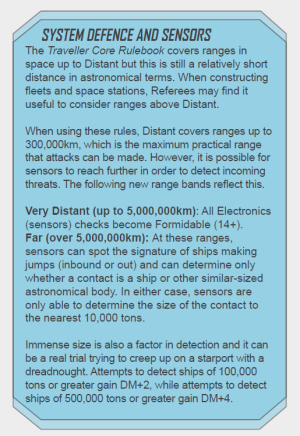
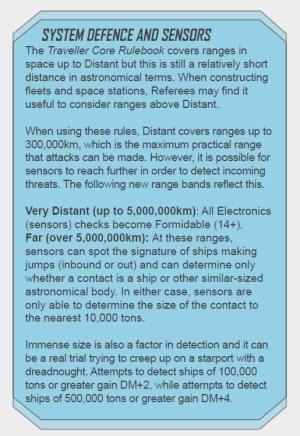
When using these rules, Distant covers ranges up to 300,000km, which is the maximum practical range that attacks can be made. However, it is possible for sensors to reach further in order to detect incoming threats. The following new range bands reflect this.
Very Distant (up to 5,000,000km): All Electronics (sensors) checks become Formidable (14+).
Far (over 5,000,000km): At these ranges, ...
So, we can attack at Distant range, and detect ships up to Very Distant range, it's just more difficult at Very Distant.

If you want to rule at your table that 'Minimal' information (or less) is enough to start shooting, then that is your call -- but I do not think that is the intent of the rules, and it does not seem to be a good way to run it for my table.
It is certainly the intent of the rules to allow attacks at Distant range, where we can't get more than Minimal sensor information:
Core'22, p172:
Note that while missile salvos can be fired at Distant ranges, the attacking ship must have detected its target before they can be launched. Given the limited information that can be gained from sensors at this range, friendly fire incidents may be common among Travellers who are too trigger happy with their missiles.


Honestly, if I was doing fleet battles non-narratively then I would probably start by cribbing something similar to D17.4 ('Levels of Information' for Tactical Intelligence) from Star Fleet Battles.
You can of course house rule anything you like.
 
I am reading the rules. Page 160 in the Core Rules update:
Yes, very selectively...

As we both have quoted before:
Core'22, p165:
Most hostile encounters in space will start at Very Long or Distant ranges, when the combatants first detect one another.
However, actual combat will start when one of the combatants manages to move into range of their weapons, typically Long or Medium range.
However, in some circumstances ships might get a lot closer before hostilities begin, perhaps getting as near as Close range if a pirate successfully pretends to be an honest merchant, for example.

Most hostile encounters in space will start at Very Long or Distant ranges, when the combatants first detect one another.
So we can explicitly detect at Distant range.

However, actual combat will start when one of the combatants manages to move into range of their weapons, typically Long or Medium range.
We can start shooting when weapons range.
For a Free Trader with a turret laser, that is Medium or Long range.
For a warship with a large particle bay or missiles, that is Distant Range.

However, in some circumstances ships might get a lot closer before hostilities begin, perhaps getting as near as Close range if a pirate successfully pretends to be an honest merchant, for example.
We might, under special circumstances, get closer before the shooting starts, but that has to be engineered.


Normally, warships can see each other at Distant range, and can start shooting when weapons bear at up to Distant range.


When the table says 'None', I interpret that to mean 'None'. Sensors report no information; not a detection, not an identification, not a friend-or-foe, not a firing solution. Nothing. That sensor is Out Of Range.
Quite, but all sensor packages, even Basic, includes Thermal and Radar sensors that gives information at Distant range.
That is Core book Distant, anything over 50 000 km.

Sure, HG restricts sensor performance at Far range (5 000 000+ km), but that does not restrict Distant range in any way.


The patch was needed because HGU introduced weapons which could realistically get into situations where firing at Distant range was possible, and they needed something to avoid infinite range weapons.
The Core book includes missiles that can attack at Distant range.
 
It would also be naive to imagine that the deployed sensor net model including drones, stealthy passive platforms etc (they’re both in the rules and it has happened IRL since at least the eighties) will be forgotten. Even in today’s naval combat, the model is to maintain range and strike at the edge of your own sensor capability (and preferably beyond the edge of your enemy’s). That’s been common since 1940s carrier warfare, with distributed sensor nets used there (manned spotters and radar).
Yes, the rules don't cover these as much as they should; there are probe drones and such, but their capabilities are defined in the Robot Handbook, with examples on p249. These are done in much more detail than HG, but the selection there is small, and they are pretty low end. TL15 versions optimized for naval warfare would make a lot of sense. It would be possible to design them using the RH rules. The ones in the RH are missile warheads, which makes sense, but putting a ship's brain on a HG light fighter design, with high end sensors would be a good idea to get an unmanned sensor platform. Also Navy ship designs which carry manned small craft optimized for sensors and stealth, should be common.

My players are always shooting off probe missiles at dangerous looking objects; if they didn't have a couple hundred engineers, workshops and several high end fabricators to build stuff for them, it would start to get kind of expensive. It makes it hard to sneak something up on them.
 
Sadly much of this conversation confirms why I don't have "space combat" in my game. I am sure is can be diverting as a wargame, but for an RPG it is reading as a rock paper scissors exercise with too many chances of instant and irrevocable death for the entire crew or complete financial evisceration if they just decide to bailout.

This might work as a climax to a campaign that you don't mind the characters dying, or you are purposefully removing a ship from a campaign to set up a plot, but it isn't coming across as particularly appealing for a number of players round a table as a semi-random encounter for example to add a bit of spice.

I think the core issue is that in individual combat you can suffer casualties but as long as the player win then that is generally recoverable, either their characters recover over time or the majority of the group survive and the replacement characters have a nucleus to form on. In ship combat they all go together. There is less opportunity for genuine peril without significant risk of TPK. Maybe if each player had their own ship it would be less of an issue, but that is seldom the case. In a naval campaign you could put them aboard different ships, but would they then not tend to just become just another crewman?

Now I have to ask, "Am I missing something?"
Do you stack the odds in the players favour so that a pirate is just an economic inconvenience (repairs and replenishment) or do you actually send peer opponents against them and just keep your fingers crossed? Is there a level where peer opponents just have a knock about where limping away is credible for both parties?
If your players are in a merchant and a real warship shows up, this demonstrates why they don't try to fight it. You fool it, or negotiate with it, or even surrender and hope you can escape later, but shooting at it means you're probably dead when it shoots back.

With scouts and merchants, peer opponents (usually) won't instantly knock out the other ship. Space combat at that scale can work at the tabletop.

I would never run a full scale warship-on-warship combat with a typical campaign. I might use the rules to model it and find out "what happens" before hand, but at the table it would be a backdrop to whatever the PCs are doing.
 
With scouts and merchants, peer opponents (usually) won't instantly knock out the other ship. Space combat at that scale can work at the tabletop.
Instant knock out isn't necessary. Actually if death is inevitable it is marginally worse for it to take several rounds, that just prolongs the agony. The question I am looking to answer is,

"Once combat is entered, is it credible that, most of the time, ships that are damaged can successfully escape as part of a logical consequence rather than only through referee fiat".

I follow a "Checkov's gun" philosophy. If there is a pirate ship that is referenced in the adventure then that has to attack before the end of the adventure.
 
60df2c0cbe885f001fbeefc7.png


This isn't the freighter you're looking for.
 
Yeah. So High Guard did not change being able to detect objects at any distance with minimal information. It just added a couple of range brackets. "Far" is the new "there's something there, I'll get back to you after we've observed it for a while".

The FULL section that's been partially quoted is:

1766530913287.png

You clearly CAN detect ships above 5,000,000km. In fact, unless there's some pretty active effort to disguise the ship as something else (like a rock), you will detect that it's a ship, and its size to within 10,000 tons. What the sensor rolls are for is to obtain more information about a target.

And for the record, 5,000,000km is about 16 light seconds. It is quite a distance.
 
Yeah. So High Guard did not change being able to detect objects at any distance with minimal information. It just added a couple of range brackets. "Far" is the new "there's something there, I'll get back to you after we've observed it for a while".

The FULL section that's been partially quoted is:

View attachment 6969

You clearly CAN detect ships above 5,000,000km. In fact, unless there's some pretty active effort to disguise the ship as something else (like a rock), you will detect that it's a ship, and its size to within 10,000 tons. What the sensor rolls are for is to obtain more information about a target.

And for the record, 5,000,000km is about 16 light seconds. It is quite a distance.
Sort of. The key word here is CAN detect. That is not the same as WILL detect. HG2022 P76-77) gives us:

"When a starship comes out of jump or during in-system transit, their sensors detect hundreds if not thousands of objects, depending on population and traffic in the system. Beyond Distant range (more than 50,000 kilometres), most of these objects simply appear as blips on a display, difficult to differentiate from each other.

Those that emit radio waves are assumed to be ships, satellites or space stations. Those that do not might be powered-down ships, planetoids, comets or other objects. Without closer inspection, detailed system charts or communication with other spacecraft in the vicinity, it can be difficult to determine the exact nature of many objects."


So beyond 50,000 km you have dots on a screen. Every asteroid, planet, chunk of space debris, and possibly some anomalous gassy objects will be there as well as any ships.

"For all intents and purposes, the knowledge that these ships and other objects are present is all that is needed; however, should one ship need to approach another for boarding or to engage in combat, more precise information is required. To obtain this level of information, the ship’s sensop must make an Average (8+) Electronics (sensors) check (1D minutes, EDU), adding DMs listed in the Initial Detection table and DMs for the type of sensors being used, as described under Install Sensors on page 21."

So sensors will automatically plot every object in detection range, but you have no idea what any of them are until you make a sensor check on a specific object. Depending on the number of objects in range that could be a lot of checks. For navigation it doesn't really matter, but if you intend to identify whether a specific object is a ship you need to choose which object to analyse further and note that unless you rush the job, it is not a few second exercise (and requires appropriate sensors).

"Success indicates that the data collected by the sensop is enough to pinpoint the location of the ship, whereupon the ship’s captain can decide whether to allow an approach or engage in space combat. Failure indicates that the location of the ship (or even that it is a ship) cannot be accurately determined. Exceptional failure means the object is not detected at all or just assumed to be some inert object such as a planetoid, defunct satellite or space junk. Note that attempting to locate a ship with this level of accuracy requires the use of active sensors."


An object that is out on its own, that has a changing vector, is particularly close or that has just appeared out of nowhere might be a good target for analysis and could be highlighted by automated systems as an object of interest, but on arrival in an unfamiliar system you have little to go on and you may choose to ignore things beyond a certain rang just to cut down on the work. If it has been a while since you were last here you might have less work to do, but things will have moved around. System defence boats will probably have mapped a lot of local space and will stand a much better chance of spotting something new turning up and will have already catalogued many objects. Canny captains could still configure their ships to "run silent" and look innocuous but certain emissions will be a dead giveaway.

This was supposed to be analogous to submarine warfare investigating suspicious sonar pings that could be the enemy or just schools of fish. It was not supposed to be Command and Conquer with every enemy unit marked for easy target designation.
 
Last edited:
Sort of. The key word here is CAN detect. That is not the same as WILL detect. HG2022 P76-77) gives us:

"When a starship comes out of jump or during in-system transit, their sensors detect hundreds if not thousands of objects, depending on population and traffic in the system. Beyond Distant range (more than 50,000 kilometres), most of these objects simply appear as blips on a display, difficult to differentiate from each other.

Those that emit radio waves are assumed to be ships, satellites or space stations. Those that do not might be powered-down ships, planetoids, comets or other objects. Without closer inspection, detailed system charts or communication with other spacecraft in the vicinity, it can be difficult to determine the exact nature of many objects."


So beyond 50,000 km you have dots on a screen. Every asteroid, planet, chunk of space debris, and possibly some anomalous gassy objects will be there as well as any ships.

"For all intents and purposes, the knowledge that these ships and other objects are present is all that is needed; however, should one ship need to approach another for boarding or to engage in combat, more precise information is required. To obtain this level of information, the ship’s sensop must make an Average (8+) Electronics (sensors) check (1D minutes, EDU), adding DMs listed in the Initial Detection table and DMs for the type of sensors being used, as described under Install Sensors on page 21."

So sensors will automatically plot every object in detection range, but you have no idea what any of them are until you make a sensor check on a specific object. Depending on the number of objects in range that could be a lot of checks. For navigation it doesn't really matter, but if you intend to identify whether a specific object is a ship you need to choose which object to analyse further and note that unless you rush the job, it is not a few second exercise (and requires appropriate sensors).

"Success indicates that the data collected by the sensop is enough to pinpoint the location of the ship, whereupon the ship’s captain can decide whether to allow an approach or engage in space combat. Failure indicates that the location of the ship (or even that it is a ship) cannot be accurately determined. Exceptional failure means the object is not detected at all or just assumed to be some inert object such as a planetoid, defunct satellite or space junk. Note that attempting to locate a ship with this level of accuracy requires the use of active sensors."

An object that is out on its own, that has a changing vector, is particularly close or that has just appeared out of nowhere might be a good target for analysis and could be highlighted by automated systems as an object of interest, but on arrival in an unfamiliar system you have little to go on and you may choose to ignore things beyond a certain rang just to cut down on the work. If it has been a while since you were last here you might have less work to do, but things will have moved around. System defence boats will probably have mapped a lot of local space and will stand a much better chance of spotting something new turning up and will have already catalogued many objects. Canny captains could still configure their ships to "run silent" and look innocuous but certain emissions will be a dead giveaway.

This was supposed to be analogous to submarine warfare investigating suspicious sonar pings that could be the enemy or just schools of fish. It was not supposed to be Command and Conquer with every enemy unit marked for easy target designation.
Since the discussion was of BB fleets meeting BB fleets, I think it’s safe to assume that at least one of the members of a given fleet - maybe one of the ones mounting the Aegis equivalent - is going to look at the mass of multi-kiloton objects moving as a group near their fleet and think it might be worth extending the sensor arrays and warming up the old warheads…
 
So beyond 50,000 km you have dots on a screen. Every asteroid, planet, chunk of space debris, and possibly some anomalous gassy objects will be there as well as any ships.

"For all intents and purposes, the knowledge that these ships and other objects are present is all that is needed; however, should one ship need to approach another for boarding or to engage in combat, more precise information is required. To obtain this level of information, the ship’s sensop must make an Average (8+) Electronics (sensors) check (1D minutes, EDU), adding DMs listed in the Initial Detection table and DMs for the type of sensors being used, as described under Install Sensors on page 21."
Quite, an Average roll that a decent warship has a DM+10 or so on, in addition to the positive DMs from the detection table. A DM for the sensor, a DM for the signal processor, and a DM for a well-trained sensor operator.

That roll might be a difficulty for your average Free Trader, but a formality for a warship, even at Formidable difficulty.
 
Back
Top