Space Combat - Did I miss something?

Ah, high-tech super sensors. of course! Yes, I had overlooked that!

Please point me to the pages where they are defined; I am stuck using p 76 of the HGU 2022:

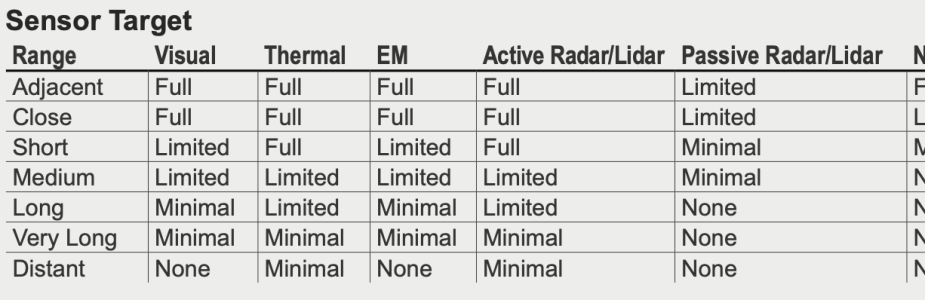
And p 160 of the Core Rules Update. Apparently 'minimal information' (whether or not an object is 'active' in EM) for 'EM sensors' is confined to Very Long range.

There is a huge number of unidentified objects to sift through, and a ship does NOT know their vectors, exact position, or much of anything at all, until the object has been scanned. And scanning an object for information takes time, and is limited in what information can be determined -- and range is a very large factor.

And of course it is left up to the referee to determine what quality of information is required to determine the size of an object, or the class-type of a detected ship, or the probable / positive identification of a particular ship, or sufficient resolution to make a firing solution. To my mind, all of that requires somewhat more than 'minimal' information.
If you have a fleet that is large enough to include BBs, as we have discussed throughout, then they're absolutely going to have "super sensors" as you call them: extended arrays or rapid deployment extended arrays on at least one ship (those are available at only TL11 and extend sensor range). It's not a player ship fighting a peer. It's a BB fleet plus support.

What you quoted does not even disagree with @AnotherDilbert - he said they'll see each other at distant range or longer, and can fight each other starting at distant range. The book agrees. This they can do, and if they use extended arrays they can see each other in greater detail, as well!

Unless, of course, one side or the other uses stealth coating to avoid detection entirely until closer range: pricy but achievable.

I'd entirely agree that there will be a lot of objects to track when facing a large enemy fleet, and that fleets will include pickets and sensor boats performing a bit like Aegis, AN/SPY-1 ships today, probably handing off targeting info using the rules for that to less capable ships.

The sarcasm is a bit unnecessary since he has been very polite.

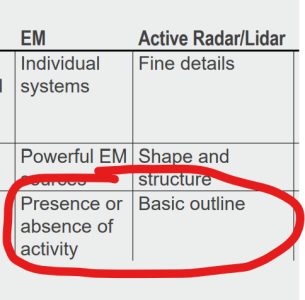
Edit: this is the info you get with extended arrays from EM and active radar/lidar at Distant. You'll get the outline, and you'll know from basic sohcahtoa that this is an (operating) Tigress, for instance, and not a Gailka Megula. You'll also know that this is forty ships and not forty weirdly-organised asteroids!
1766444562727.png
 
Last edited:
Ah, high-tech super sensors. of course! Yes, I had overlooked that!
More or less any sensor has a thermal unit, resolving Minimal detail at Distant range (Core'22, p160):
Skärmavbild 2025-12-22 kl. 23.52.37.png

Distributed Arrays, Extended Arrays, and Extension Nets (HG'22, p55) extends the range of some sensor types.

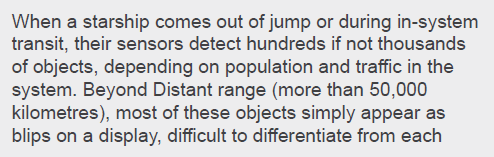
HG'22, p26 outlines how sensors work beyond Distant range, at Very Distant and Far ranges.


Yes, ships can detect each other at Distant range, and warships with good sensors and crew will very likely detect them.
 
I'm not that sure that they are that much of a joke, really. HG is quite focussed on space combat; most of the sensor rules are directly related to having a firing solution (sensor lock) and combat ranges, which may obscure the underlying assumption that it's easy to detect that *something* is way out there, but not what (Thermal, as stated just now while I was typing this).

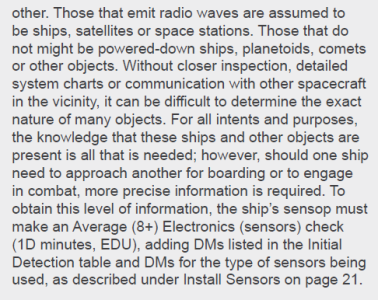
CRB only lists stuff out to distant, but HG does discuss ranges beyond that. And realistically mentions that you can see all the little dots, but sorting out range and detail is not easy.

1766444978000.png
1766445017155.png
 
I'm not that sure that they are that much of a joke, really. HG is quite focussed on space combat; most of the sensor rules are directly related to having a firing solution (sensor lock) and combat ranges, which may obscure the underlying assumption that it's easy to detect that *something* is way out there, but not what (Thermal, as stated just now while I was typing this).

CRB only lists stuff out to distant, but HG does discuss ranges beyond that. And realistically mentions that you can see all the little dots, but sorting out range and detail is not easy.

View attachment 6959
View attachment 6960
Yep and there are several ways to get quite large bonuses to the Electronics (Sensors) check needed to get a firing solution mentioned there, at distant range.
 
There are many weapons that can fire at very long range, if you take the long range advantage then any weapon with a normal range of long becomes very long, and comfortably score hits, therefore weapon targeting sensors are more than capable of detecting objects at very long range with sufficient resolution for a firing solution. It stands to reason that ship sensors should be longer ranged than the Traveller core rule book makes out.

Perhaps the sensor task margin of success should shift the amount of information "up" the core rule book table, say one level for every effect number of 4 or 6; the stacking bonuses of expert programs, skill level, augmentation, advanced sensors, sensor "advantages" makes the DM scale of such things difficult to balance. I wonder what a typical sensor op PC/NPC would have as total DMs on a warship and what a fully augmented sensor op bonus would look like... then there are robots and virtual crew...
 
In real life, you generally need observation time to gather more data. But also, spaceships are small things and you start to run up against the limitations of optics and other wavelength related stuff. If a ship on your scope is a dozen pixels, there's a limit to how much data you can extract from it. And you'll need to observe it over time - at any range - to get its lateral motion. Outside of active sensor range, good luck getting any kind of accurate range value, unless you have a good baseline (which you may well have. A single ship may struggle to determine the range to a bogey, but a pair of them far enough apart can quickly solve that).

Now, I am talking in general. I don't have the background to know if the actual listed ranges do make sense from the point of view of it all. Maybe they should be longer, maybe they should be shorter. But there will be a limit where you're no longer doing target tracking and are now doing astronomy.
 
Now, I am talking in general. I don't have the background to know if the actual listed ranges do make sense from the point of view of it all. Maybe they should be longer, maybe they should be shorter. But there will be a limit where you're no longer doing target tracking and are now doing astronomy.
So, what was the detection range 100 years ago compared to today? What do you think the detection range will be 3500 years in the future?

The answer to the latter is "whatever makes for good gameplay". :D

Traveller makes lots of references to detecting things at longer than distant range but doesn't really support that with the actual mechanics. IIRC, T:NE and T5 have such support, as does 2300.
 
More or less any sensor has a thermal unit, resolving Minimal detail at Distant range (Core'22, p160):
View attachment 6957

Distributed Arrays, Extended Arrays, and Extension Nets (HG'22, p55) extends the range of some sensor types.

HG'22, p26 outlines how sensors work beyond Distant range, at Very Distant and Far ranges.


Yes, ships can detect each other at Distant range, and warships with good sensors and crew will very likely detect them.
Distributed Arrays and Extended Arrays do exactly the same thing; they are not cumulative. In my copy, they allow EM Sensors to gain 'Minimal' information at Distant range; and Passive Radar/Lidar to get 'Minimal' data at Long Range. Active Radar/Lidar already gets 'Minimal' information at Distant range, so that section of the rule can be ignored.

Extension Nets allow 'Full' and 'Limited' information to be acquired at one range band longer for some sensors: Full information is reported by Visual & EM sensors at Short, Thermal & Active Radar at Medium, and (presumably) Passive Radar at Adjacent. Limited information is reported by Visual & EM sensors at Long, Thermal & Active Radar at Very Long, and (presumably) Passive Radar at Short.

I see nothing to support or refute the idea that 'minimal information' is enough to positively identify a ship, nevermind achieve a weapon-lock. A 'basic outline' is insufficient to distinguish between a Tigress, a Broadsword, or a Tequila-class merchant -- they are all roughly spherical, as are some space-rocks. It seems to me that a generous Referee might allow identification & initial lock-on at 'Very Long' with Thermal & Active Radar aided by an Extension Net ('Limited' information), and combat can then be continued even at Distant range by keeping the weapons-lock if the fleets separate.

The rules for 'ranges beyond Distant' make it clear that sensors are greatly degraded -- at 'Far' it is only possible to detect ships that jump in or out; and can only (presumably even after extended observation) approximate the size of a detected object 'to the nearest 10000 dTons'. Is that ~30000 dTon contact a Valiant-class Light Cruiser, or an unarmed Galoof?

Very Distant makes Electonics (Sensor) checks Formidable (14+) -- and presumably no extra information is gained over what is available at 'Distant', although it seems very strange to suppose that even the same information is possible. Again, nothing here indicates that a hostile ship can be identified (or even detected, if it is not revealed by jump-flash) or engaged at these ranges.

If you want to rule at your table that 'Minimal' information (or less) is enough to start shooting, then that is your call -- but I do not think that is the intent of the rules, and it does not seem to be a good way to run it for my table. Honestly, if I was doing fleet battles non-narratively then I would probably start by cribbing something similar to D17.4 ('Levels of Information' for Tactical Intelligence) from Star Fleet Battles.
 
Last edited:
You can detect at any range. I'm talking about signal resolution, and that's constrained by physics.

And please re-read the books. 50,000k isn't the limit on detection. Thermal works at distant, and distant is 50,000km and above, without a stated limit, as it should be. Emitted signals are also detectable at any range.

It's all about gathering enough photons and extracting information from them, but inverse square law is a bitch.
 
You can detect at any range. I'm talking about signal resolution, and that's constrained by physics.

And please re-read the books. 50,000k isn't the limit on detection. Thermal works at distant, and distant is 50,000km and above, without a stated limit, as it should be. Emitted signals are also detectable at any range.

It's all about gathering enough photons and extracting information from them, but inverse square law is a bitch.
I am reading the rules. Page 160 in the Core Rules update:

Under normal circumstances, an Electronics (sensors)
check is all that is required to detect and identify a
target that has moved into range of sensors. What
information can be determined from this depends on
the type of sensors employed.

The kind of sensors a ship possesses depends on the
sensor package installed. Distances between ships and
other objects in space is determined by range bands,
as shown on the Range Bands table.

Once the range has been determined, consult the
Sensor Target and Sensor Detail tables to determine
what information can be gleaned on the target from the
sensors on board.
When the table says 'None', I interpret that to mean 'None'. Sensors report no information; not a detection, not an identification, not a friend-or-foe, not a firing solution. Nothing. That sensor is Out Of Range.

Distant is not 'from 50000 km to infinity'; that is a laughably bad ruling and (as Another Dilbert pointed out) Mongoose saw fit to patch it in HGU on page 26. To wit:

When using these rules, Distant covers ranges up to
300,000km, which is the maximum practical range
that attacks can be made. However, it is possible for
sensors to reach further in order to detect incoming
threats. The following new range bands reflect this.

Very Distant (up to 5,000,000km): All Electronics
(sensors) checks become Formidable (14+).
Far (over 5,000,000km): At these ranges,
sensors can spot the signature of ships making
jumps
(inbound or out) and can determine only
whether a contact is a ship or other similar-sized
astronomical body
. In either case, sensors are
only able to determine the size of the contact to
the nearest 10,000 tons.
The patch was needed because HGU introduced weapons which could realistically get into situations where firing at Distant range was possible, and they needed something to avoid infinite range weapons. Of course, they then go on to define another silly 'infinite range' range band ('Far'), which is something they probably should have avoided.

Notice that the ability of sensors ('what the sensors can spot') at 'Far' are explicitly stated: Only things which create jump flashes & that such a contact is 'something solid'. Nothing else is mentioned. Even if it were, every sensor is out of range (reports 'None') beyond Distant (or even shorter) range anyway.

Physics is all well and good, and appeals to my simulationist sensibilities, but this discussion is about the rules.
 
My free trader just misjumped but thankfully not catastrophically.

We have Basic sensors.

I can’t see anything reliably beyond 50,000 km. Maybe a blip, but I know nothing about it.

But I can see stars that are light-years away?…. And triangulate my position?….

Yep, sensor rules definitely need a rewrite.
 
My free trader just misjumped but thankfully not catastrophically.

We have Basic sensors.

I can’t see anything reliably beyond 50,000 km. Maybe a blip, but I know nothing about it.

But I can see stars that are light-years away?…. And triangulate my position?….

Yep, sensor rules definitely need a rewrite.
No argument there.

On the other hand, step outside & look up. You can certainly see the Sun, which is ~148 million km away & the occupies the same number of milliradians of arc in the sky as the Moon; but sometimes (like at the new moon) the moon -- even much closer -- is extremely difficult to pick out. When it is full, it is easy to see; but just because you can see 'as far as the Moon' (or even 'as far as the sun') does not mean you can actually pick out any arbitrary object at those distances. Take Mons Andre as an example -- with your unaided eye it is nigh-impossible to see, even though it is 10 km across and 7 km tall.

'Length' and 'Distance' can give an approximate 'Visual Size' in milliradians, but how brightly an object is glowing (especially in respect to the background) also plays an important role. Amateur-scale telescopes today, for example, have little trouble (on dark, clear nights) in seeing the quasar 3c 273, and that is ~2.4 billion light-years away. But amateur-scale telescopes are pretty poor for searching for & providing targeting information about previously unknown, arbitrary (potentially moving & hostile) objects; discoveries are possible, but they take more than six minutes.

So sure, your Free Trader can see the stars just as much as a TL-7 star-finder instrument built today can. A (especially 'previously uncharted') kilometer wide asteroid at ~50000 km distant is another matter.
 
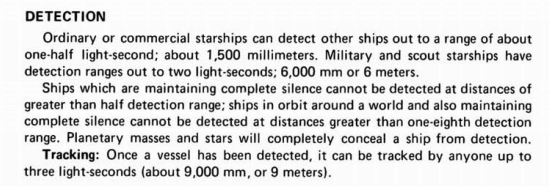
Classic Traveller's rules were this (a light second being ~300,000km):

1766476352372.png

T:NE's rules had Active EMS out to 480,000km and Ladar, passive EMS, and Thermal out to 240,000km. Though depending on TL, those sensors might require too much space or energy for a ship. But by TL14/15, they were pretty reasonable.
 
(I do wonder who had a 6m gaming space for that to matter.... I thought Jutland was insane to actually play :D)

But, yes, ultimately the question is at what point can these two things be distinguished by sensors, not at what point can "something" be spotted:

1766477017506.png
 
If we go by "intent" of the setting then surely the fact there is a navy tends to indicate that engagement at silly ranges is not plausible, otherwise you would just put batteries (or bays) of missile launchers, torpedoes or high end spinal weapons on the cheapest platforms you could get (which would be an asteroid) and eliminate any ship or fleet before it had even worked out where it was. Identifying a Tigress class battleship by its shape might be a thing, but identifying an armed rock vs another rock by its shape sounds implausible.

If you just put a long range missile barbette on hundreds* of otherwise entirely indistinguishable asteroids you could launch several hundred salvos and spam the Sensor Ops attempts at EW and PD. Unless you choose to pre-emptively destroy every suspect rock in sensor range "just in case" then most of them will be able to launch before detection and likely remain undetected from distant sensors even then. If you chose container-launched weapons for ultimate cheapness, once they had launched they would be largely irrelevant anyway, but even the barbette only needs to survive 5 rounds before it exhausts its magazine.

I don't think omniscient ships or system-wide sensor nets or near-infinite range weapons really add anything to the game experience.

I am sure you could build 1000's for far less than the equivalent conventional system defence boats that would be needed to provide a credible threat to a battleship.
 
2 light seconds for military ships is hardly omniscience or a system wide sensor net. The average distance from Earth to Mars is like 180 light seconds, IIRC? Mongoose Traveller's sensors being substantially worse than any other edition of Traveller (to the best of my knowledge, I barely recall anything about Megatraveller or T4 rules wise) does not seem to serve a useful purpose.

There should be sensors here and there, of course, but the sheer volume of space in a solar system makes any kind of sensor net impractical. And missile mines even more so, not to mention the massive hazard they'd produce to legitimate traffic.
 
You can think of it as strategic, operational, and tactical.

Tactical, pinpointing the location of enemy vessels in engagement range.

Operational, spotting an incoming flotilla.

Strategic, detecting interstellar gravity wells.
 
PAWs can hit at very long range, as can pulse lasers, meson guns, ion cannons and fusion guns with the long range advantage.

If a weapon system can achieve a target lock at 50,000km with only minimal information available from sensors why don't they use their targeting sensor more generally? The sensor rules in the core rule book are not fit for purpose when applied to High Guard.
 
2 light seconds for military ships is hardly omniscience or a system wide sensor net. The average distance from Earth to Mars is like 180 light seconds, IIRC? Mongoose Traveller's sensors being substantially worse than any other edition of Traveller (to the best of my knowledge, I barely recall anything about Megatraveller or T4 rules wise) does not seem to serve a useful purpose.
2 light seconds for detection is 600,000 km, distant range under High Guard is only half that. Very distant is put to 5 million km. Detection is a bit harder but still possible, so on that basis Mongoose have extended the range of sensors not reduced them.

Detection is not identification as you point out. The argument here seems to be that engagement should be happening at this distance. My experience is that we limit ranges of weapon system in the real world to that which the human in the loop can identify what they are firing at. The weapon systems themselves are capable of targeting things much further away, but that is a recipe for fratricide and collateral damage. In a target rich environment however you might just take the risk. If it is a ship, and you are expecting no friendly ships detection might be sufficient identification. If it is a suspect ship in the same battlespace as a lot of civilian and friendly traffic more definite identification might be needed. These are all referee calls, not rules.
There should be sensors here and there, of course, but the sheer volume of space in a solar system makes any kind of sensor net impractical. And missile mines even more so, not to mention the massive hazard they'd produce to legitimate traffic.
Not missile mines. Discriminating provincial navy asteroid missile bases under sophont control. You don't need all launch platforms to be manned, you could control dozens from a central hub if they are linked using unidirectional laser comms. That hub only needs a single crewman who designates targets, the missiles themselves conduct all the guidance. Each asteroid could be 70 Dtons and still mount a barbette and only needs station keeping M-Drive and could be run/maintained by a droid (or by a rating if there was a cockpit with 1DTon of barracks attached).
 
Back
Top