Space Combat - Did I miss something?

Ah, high-tech super sensors. of course! Yes, I had overlooked that!

Please point me to the pages where they are defined; I am stuck using p 76 of the HGU 2022:

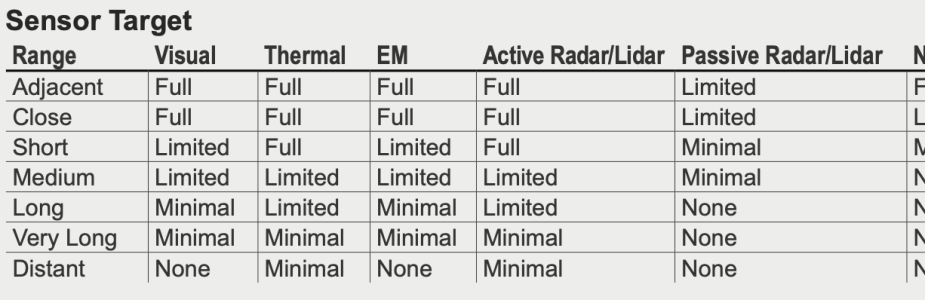
And p 160 of the Core Rules Update. Apparently 'minimal information' (whether or not an object is 'active' in EM) for 'EM sensors' is confined to Very Long range.

There is a huge number of unidentified objects to sift through, and a ship does NOT know their vectors, exact position, or much of anything at all, until the object has been scanned. And scanning an object for information takes time, and is limited in what information can be determined -- and range is a very large factor.

And of course it is left up to the referee to determine what quality of information is required to determine the size of an object, or the class-type of a detected ship, or the probable / positive identification of a particular ship, or sufficient resolution to make a firing solution. To my mind, all of that requires somewhat more than 'minimal' information.
If you have a fleet that is large enough to include BBs, as we have discussed throughout, then they're absolutely going to have "super sensors" as you call them: extended arrays or rapid deployment extended arrays on at least one ship (those are available at only TL11 and extend sensor range). It's not a player ship fighting a peer. It's a BB fleet plus support.

What you quoted does not even disagree with @AnotherDilbert - he said they'll see each other at distant range or longer, and can fight each other starting at distant range. The book agrees. This they can do, and if they use extended arrays they can see each other in greater detail, as well!

Unless, of course, one side or the other uses stealth coating to avoid detection entirely until closer range: pricy but achievable.

I'd entirely agree that there will be a lot of objects to track when facing a large enemy fleet, and that fleets will include pickets and sensor boats performing a bit like Aegis, AN/SPY-1 ships today, probably handing off targeting info using the rules for that to less capable ships.

The sarcasm is a bit unnecessary since he has been very polite.

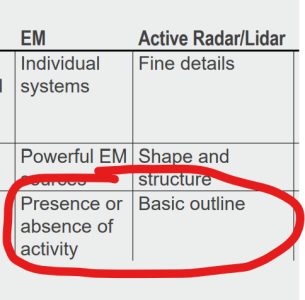
Edit: this is the info you get with extended arrays from EM and active radar/lidar at Distant. You'll get the outline, and you'll know from basic sohcahtoa that this is an (operating) Tigress, for instance, and not a Gailka Megula. You'll also know that this is forty ships and not forty weirdly-organised asteroids!
1766444562727.png
 
Last edited:
Ah, high-tech super sensors. of course! Yes, I had overlooked that!
More or less any sensor has a thermal unit, resolving Minimal detail at Distant range (Core'22, p160):
Skärmavbild 2025-12-22 kl. 23.52.37.png

Distributed Arrays, Extended Arrays, and Extension Nets (HG'22, p55) extends the range of some sensor types.

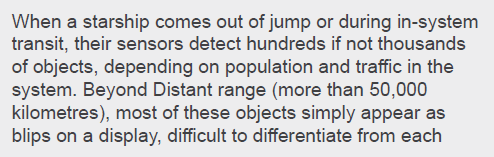
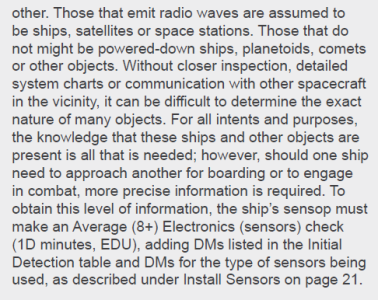
HG'22, p26 outlines how sensors work beyond Distant range, at Very Distant and Far ranges.


Yes, ships can detect each other at Distant range, and warships with good sensors and crew will very likely detect them.
 
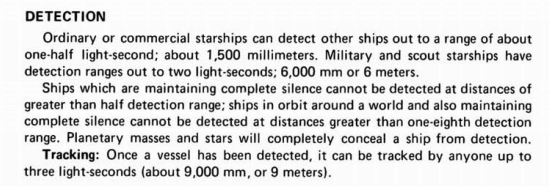
I'm not that sure that they are that much of a joke, really. HG is quite focussed on space combat; most of the sensor rules are directly related to having a firing solution (sensor lock) and combat ranges, which may obscure the underlying assumption that it's easy to detect that *something* is way out there, but not what (Thermal, as stated just now while I was typing this).

CRB only lists stuff out to distant, but HG does discuss ranges beyond that. And realistically mentions that you can see all the little dots, but sorting out range and detail is not easy.

1766444978000.png
1766445017155.png
 
I'm not that sure that they are that much of a joke, really. HG is quite focussed on space combat; most of the sensor rules are directly related to having a firing solution (sensor lock) and combat ranges, which may obscure the underlying assumption that it's easy to detect that *something* is way out there, but not what (Thermal, as stated just now while I was typing this).

CRB only lists stuff out to distant, but HG does discuss ranges beyond that. And realistically mentions that you can see all the little dots, but sorting out range and detail is not easy.

View attachment 6959
View attachment 6960
Yep and there are several ways to get quite large bonuses to the Electronics (Sensors) check needed to get a firing solution mentioned there, at distant range.
 
There are many weapons that can fire at very long range, if you take the long range advantage then any weapon with a normal range of long becomes very long, and comfortably score hits, therefore weapon targeting sensors are more than capable of detecting objects at very long range with sufficient resolution for a firing solution. It stands to reason that ship sensors should be longer ranged than the Traveller core rule book makes out.

Perhaps the sensor task margin of success should shift the amount of information "up" the core rule book table, say one level for every effect number of 4 or 6; the stacking bonuses of expert programs, skill level, augmentation, advanced sensors, sensor "advantages" makes the DM scale of such things difficult to balance. I wonder what a typical sensor op PC/NPC would have as total DMs on a warship and what a fully augmented sensor op bonus would look like... then there are robots and virtual crew...
 
In real life, you generally need observation time to gather more data. But also, spaceships are small things and you start to run up against the limitations of optics and other wavelength related stuff. If a ship on your scope is a dozen pixels, there's a limit to how much data you can extract from it. And you'll need to observe it over time - at any range - to get its lateral motion. Outside of active sensor range, good luck getting any kind of accurate range value, unless you have a good baseline (which you may well have. A single ship may struggle to determine the range to a bogey, but a pair of them far enough apart can quickly solve that).

Now, I am talking in general. I don't have the background to know if the actual listed ranges do make sense from the point of view of it all. Maybe they should be longer, maybe they should be shorter. But there will be a limit where you're no longer doing target tracking and are now doing astronomy.
 
Now, I am talking in general. I don't have the background to know if the actual listed ranges do make sense from the point of view of it all. Maybe they should be longer, maybe they should be shorter. But there will be a limit where you're no longer doing target tracking and are now doing astronomy.
So, what was the detection range 100 years ago compared to today? What do you think the detection range will be 3500 years in the future?

The answer to the latter is "whatever makes for good gameplay". :D

Traveller makes lots of references to detecting things at longer than distant range but doesn't really support that with the actual mechanics. IIRC, T:NE and T5 have such support, as does 2300.
 
More or less any sensor has a thermal unit, resolving Minimal detail at Distant range (Core'22, p160):
View attachment 6957

Distributed Arrays, Extended Arrays, and Extension Nets (HG'22, p55) extends the range of some sensor types.

HG'22, p26 outlines how sensors work beyond Distant range, at Very Distant and Far ranges.


Yes, ships can detect each other at Distant range, and warships with good sensors and crew will very likely detect them.
Distributed Arrays and Extended Arrays do exactly the same thing; they are not cumulative. In my copy, they allow EM Sensors to gain 'Minimal' information at Distant range; and Passive Radar/Lidar to get 'Minimal' data at Long Range. Active Radar/Lidar already gets 'Minimal' information at Distant range, so that section of the rule can be ignored.

Extension Nets allow 'Full' and 'Limited' information to be acquired at one range band longer for some sensors: Full information is reported by Visual & EM sensors at Short, Thermal & Active Radar at Medium, and (presumably) Passive Radar at Adjacent. Limited information is reported by Visual & EM sensors at Long, Thermal & Active Radar at Very Long, and (presumably) Passive Radar at Short.

I see nothing to support or refute the idea that 'minimal information' is enough to positively identify a ship, nevermind achieve a weapon-lock. A 'basic outline' is insufficient to distinguish between a Tigress, a Broadsword, or a Tequila-class merchant -- they are all roughly spherical, as are some space-rocks. It seems to me that a generous Referee might allow identification & initial lock-on at 'Very Long' with Thermal & Active Radar aided by an Extension Net ('Limited' information), and combat can then be continued even at Distant range by keeping the weapons-lock if the fleets separate.

The rules for 'ranges beyond Distant' make it clear that sensors are greatly degraded -- at 'Far' it is only possible to detect ships that jump in or out; and can only (presumably even after extended observation) approximate the size of a detected object 'to the nearest 10000 dTons'. Is that ~30000 dTon contact a Valiant-class Light Cruiser, or an unarmed Galoof?

Very Distant makes Electonics (Sensor) checks Formidable (14+) -- and presumably no extra information is gained over what is available at 'Distant', although it seems very strange to suppose that even the same information is possible. Again, nothing here indicates that a hostile ship can be identified (or even detected, if it is not revealed by jump-flash) or engaged at these ranges.

If you want to rule at your table that 'Minimal' information (or less) is enough to start shooting, then that is your call -- but I do not think that is the intent of the rules, and it does not seem to be a good way to run it for my table. Honestly, if I was doing fleet battles non-narratively then I would probably start by cribbing something similar to D17.4 ('Levels of Information' for Tactical Intelligence) from Star Fleet Battles.
 
Last edited:
You can detect at any range. I'm talking about signal resolution, and that's constrained by physics.

And please re-read the books. 50,000k isn't the limit on detection. Thermal works at distant, and distant is 50,000km and above, without a stated limit, as it should be. Emitted signals are also detectable at any range.

It's all about gathering enough photons and extracting information from them, but inverse square law is a bitch.
 
Back
Top