Space Combat - Did I miss something?

Torpedoes are losers vs point-defense.

A Small Missile Bay launches 12 missiles (1 dTon) per shot; a Small Torpedo Bay launches 3 torpedoes (1 dTon) per shot.
For standard missiles, that is 150 KCr for 12x 4D of damage, and 12 points of Point Defense to shoot them all down.
For standard torpedoes, that is 450 KCr for 3x 6D of damage, and 6 points of Point Defense to shoot them all down.

For Multi-Warhead munitions:
Standard MW-missiles cost 750 KCr for 12x 3x 3D of damage, and 36 points of Point Defense to shoot them all down.
Standard MW-torpedoes cost 1200 KCr for 3x 3x 3D of damage, and 18 points of Point Defense to shoot them all down.

Plus, as you point out, each Anti-Torpedo Missiles destroys 'Effect' of Torpedoes, while Fragmentation Missiles each destroy only one incoming missile. There are no Anti-Torpedo nor Anti-Missile torpedoes at all. Missiles can be fired without penalty at all targets; torpedoes have a -2 vs targets below 2000 dTons.

EW rules also favor missiles; and do not get me started on 'Barbettes'.

It looks like the only advantages that torpedoes have are:
1} that they do not suffer losses after 5 full turns of flight -- which is only a factor (for standard missiles) at ranges beyond 'Very Long'. Even then, halving the number of missiles in flight once only puts missiles at parity with (not a disadvantage to) torpedoes.
2} they do more damage per (non-nuclear) individual, which gives them an advantage vs targets with (especially heavy, about 13+) armor.
 
Last edited:
There may be other factors when you look at the variant ordnance, especially a torpedo that is particularly hard to kill or splits into several missiles. Dunno, I'm not invested enough to check.

It does occur to me, though, that a drone designed to be fired from a standard missile or torpedo launcher might be worth looking at. A torp sized one that maneuvers to (or is launched at) close range and starts shooting a laser or does something else fancy.
 
There may be other factors when you look at the variant ordnance, especially a torpedo that is particularly hard to kill or splits into several missiles. Dunno, I'm not invested enough to check.

It does occur to me, though, that a drone designed to be fired from a standard missile or torpedo launcher might be worth looking at. A torp sized one that maneuvers to (or is launched at) close range and starts shooting a laser or does something else fancy.
These exist.
Multi-warheads and bomb-pumped.
 
These exist.
Multi-warheads and bomb-pumped.
My original post compared Standard Missiles vs Standard Torpedos. Torpedoes were worse. It also compared Multi-Warhead Standard Missiles against Multi-Warhead Standard Torpedoes. Torpedoes were worse.

There are no Multi-Warhead Nuclear Missiles; but Nuclear Missiles are vastly superior to the Multi-Warhead Nuclear Torpedo sub-munitions -- and you get more Nuclear Missile warheads, cheaper, per dTon (12 for 450 KCr) than you get Nuclear sub-munitions in a dTon (9 for 1800 KCr) of Multi-Warhead Nuclear Torpedoes. I also pointed this out in my post.

There are Advanced, Antimatter, Antimatter Bomb-Pumped, Anti-radiation, Bomb-Pumped, Ion, Multi-Warhead Antimatter, Multi-Warhead Standard, Multi-Warhead Nuclear, Nuclear, Ortillery, Plasma, and Standard Torpedoes. Anti-Matter based torps are not available at the usual Technology Levels that the game is played at, so 'Stupid Torpedo Tricks' that missiles cannot duplicate are confined to: Anti-radiation, Bomb-Pumped, Multi-Warhead Nuclear, and Plasma Torpedoes.

Anti-Radiation Torpedoes are (more expensive, higher TL) standard Torpedoes, which get a +6 to hit if the target used EW & auto-miss otherwise. Note that Anti-Radiation Torpedoes are not immune to EW or other counter-measures. This is absolutely not worth it.

Bomb-pumped are interesting, but the in-game mechanical effect is that one additional Torpedo survives Point Defense -- which the does the same amount of damage as a Standard Missile. It is not worth the extra cost, and 'Decoy Missiles' do something very similar.

Multi-Warhead Nuclear are awful; they are not destructive. They are essentially standard torpedoes with the 'Radiation' trait. Not worth it.

Plasma Torpedoes are 1DD and AP 10. This is essentially (but worse than) 1D+1 & Destructive. Again, not worth it compared to Missiles.

On the other hand, 'Stupid Missile Tricks' that Torpedoes cannot duplicate (in High Guard Update) are Anti-Torpedo, Decoy, Fragmentation, Jump-breaker, and Shockwave. Add Dogfight and Interceptor missiles from the Companion. This means that:
Missiles can shoot down Torpedoes and Missiles; Torpedoes cannot.
Missiles can (with a single salvo) attack up to four targets within adjacent range to each other; Torpedoes cannot.
Missiles can seriously disrupt attempts to Jump away; Torpedoes cannot.
Missiles can negate sand for defense; Torpedoes cannot.

Torpedoes are a seriously terrible choice, compared to Missiles. And they are slower. Best-case, they are highly situational -- the target has maximum armor, and the attacker cannot use Nuclear (or Anti-Matter) weapons.
 
Last edited:
My original post compared Standard Missiles vs Standard Torpedos. Torpedoes were worse. It also compared Multi-Warhead Standard Missiles against Multi-Warhead Standard Torpedoes. Torpedoes were worse.
You are making it too simple. Compare ships, not individual systems.


Missiles has Fixed Mounts, torpedo bays are cheaper. I haven't done the maths for HG'22, but in HG'16 a torpedo ship is slightly cheaper, so you get slightly more launchers and slightly more hull points per Cr. And a salvo of nuke torpedoes is much cheaper than a salvo of nuke missiles.


Salvo size of missiles are halved every five rounds, torpedoes unaffected. At Distant range only 25% of missiles reach to attack, but 100% of torpedoes.


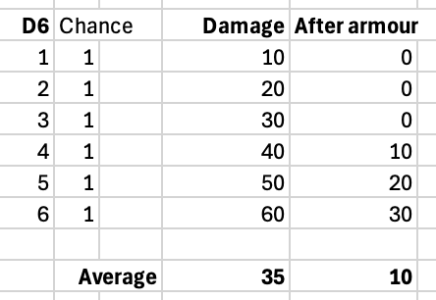
A nuke missile does 1DD damage (average 35 damage or 10 damage vs armour 30).
A nuke torpedo does 2DD damage (average 70 damage or 40 damage vs armour 30).
Only twice the damage before armour, much more after armour.


EW obliterates a salvo of 100 (at Distant range), but is just a nuisance against a salvo of 1000. Size of platform matters for both missiles and torpedoes. Torpedoes are for battleship-sized platforms.


And, of course, the Anti-Torpedo Missile destroys any hope of doing damage with torpedoes.
 
You are making it too simple. Compare ships, not individual systems.
When I am constructing a ship, I evaluate each system on its' own merits. Torpedoes lose.


Missiles has Fixed Mounts, torpedo bays are cheaper. I haven't done the maths for HG'22, but in HG'16 a torpedo ship is slightly cheaper, so you get slightly more launchers and slightly more hull points per Cr.
A Large Torpedo Bay is 15 MCr cheaper than a Large Missile Bay, which is peanuts. This price difference is cancelled out after 75 dTons of Standard ammunition (250 KCr per dTon for Missiles, 450 KCr per dTon for Torpedoes). Likewise 'saving 10 points of Power' on a Large Weapon Bay is fairly insignificant.


And a salvo of nuke torpedoes is much cheaper than a salvo of nuke missiles.
No, a dTon of twelve Nuclear Missiles is 450 KCr -- which is the size (and price) of a salvo from a Small Bay. A Medium Bay launches a salvo of 2 dTons (900 KCr), and a Large Bay a salvo of 10 dTons (4.5 MCr).

A dTon of three Nuclear Torpedoes is 675 KCr -- which is the size (and price) of a salvo from a Small Bay. A Medium Bay launches a salvo of 2 dTons (1350 KCr), and a Large Bay a salvo of 10 dTons (6.75 MCr).


Salvo size of missiles are halved every five rounds, torpedoes unaffected. At Distant range only 25% of missiles reach to attack, but 100% of torpedoes.
True but silly. I have already noted this, and pointed it out. Combat also happens at ranges which are shorter than 'Distant' -- and at all ranges less than 'the last range band' Missiles are far better. Unless you are using exclusively 'Advanced' Torpedoes, they will take 10 rounds to close from Distant range; but a Missile user had a choice of munitions (Advanced, Anti-matter, Anti-Torpedo, Decoy, Fragmentation, Ion, and Long-Range) which move faster than 10G & those will arrive in 7 to 9 rounds (only one halving).

And, since each bay launch is four times as many Missiles, halving the number of missiles in a salvo only gets Missiles down to parity with Topedoes.


A nuke missile does 1DD damage (average 35 damage or 10 damage vs armour 30).
A nuke torpedo does 2DD damage (average 70 damage or 40 damage vs armour 30).
Only twice the damage before armour, much more after armour.
Again you identify a niche case that I have already discussed as if it is something new. The number of published ships with 30 armor is a tiny fraction (in High Guard Update, only the Hadrian Battle-Rider does so).

But just for fun, lets compare a salvo of Nuclear Missiles vs a salvo of Nuclear Torpedoes:

Nuclear Missilesvs Armor 5vs Armor 10vs Armor 15vs Armor 20vs Armor 25vs Armor 30
Small Bay: 12x 1DDMin: 60
Avg: 360
Max: 660
Min: 0
Avg: 300
Max: 600
Min: 0
Avg: 240
Max: 540
Min: 0
Avg: 180
Max: 480
Min: 0
Avg: 120
Max: 420
Min: 0
Avg: 60
Max: 360
Medium Bay: 24x 1DDMin: 120
Avg: 720
Max: 1320
Min: 0
Avg: 600
Max: 1200
Min: 0
Avg: 480
Max: 1080
Min: 0
Avg: 360
Max: 960
Min: 0
Avg: 240
Max: 840
Min: 0
Avg: 120
Max: 720
Large Bay: 120x 1DDMin: 600
Avg: 3600
Max: 6600
Min: 0
Avg: 3000
Max: 6000
Min: 0
Avg: 2400
Max: 5400
Min: 0
Avg: 1800
Max: 4800
Min: 0
Avg: 1200
Max: 4200
Min: 0
Avg: 600
Max: 3600


Nuclear Torpedoesvs Armor 5vs Armor 10vs Armor 15vs Armor 20vs Armor 25vs Armor 30
Small Bay: 3x 2DDMin: 45
Avg: 195
Max: 345
Min: 30
Avg: 180
Max: 330
Min: 15
Avg: 165
Max: 315
Min: 0
Avg: 150
Max: 300
Min: 0
Avg: 135
Max: 285
Min: 0
Avg: 120
Max: 270
Medium Bay: 6x 2DDMin: 90
Avg: 390
Max: 690
Min: 60
Avg: 360
Max: 660
Min: 45
Avg: 330
Max: 630
Min: 0
Avg: 300
Max: 600
Min: 0
Avg: 270
Max: 570
Min: 0
Avg: 240
Max: 540
Large Bay: 30x 2DDMin: 450
Avg: 1950
Max: 3450
Min: 300
Avg: 1800
Max: 3300
Min: 45
Avg: 1650
Max: 3150
Min: 0
Avg: 1500
Max: 3000
Min: 0
Avg: 1350
Max: 2850
Min: 0
Avg: 1200
Max: 2700

Nuclear Missiles do better average (and maximum) through armor up to around rating 23. Considering the prevalence of warship designs with less than 23 armor, Nuclear Missiles are a better bet a vast majority of the time.


EW obliterates a salvo of 100 (at Distant range), but is just a nuisance against a salvo of 1000. Size of platform matters for both missiles and torpedoes. Torpedoes are for battleship-sized platforms.


And, of course, the Anti-Torpedo Missile destroys any hope of doing damage with torpedoes.
EW favors missiles as well. Torpedoes are twice as hard to negate, but there are four times fewer of them -- so EW knocks down a larger fraction of incoming Torpedoes. Once again, at ranges beyond 'Very Long' Torpedoes catch up a little.

Battleships should absolutely be launching & defending vs missiles. Any non-Armor defense vs missiles is as effective or better vs Torpedoes, and high armor involves large trade-offs in performance.
 
Last edited:
Unlike our reality, missiles and torpedoes are secondary weapon systems, in regard to space battles.

So, it's more a question of resources available during the conception, design, and construction phases, in view of expected targets, and their capabilities.

Drinax permits installation of torpedo launchers in fixed mounts, though it appears they require half a tonne physicality.

The Confederation could, in theory, exchange four combined missile/torpedo launchers in place of missile launchers in quad turrets, for plus four tonnes, and extra expense.

Their expected targets are between two and a hundred kilotonnes, or so the doctrine I came up with, dictates.

In the long run, missiles and torpedoes are going to cost more than installing energy weapon systems.

Assuming such weapon systems are allowed to operate that long.
 
My original post compared Standard Missiles vs Standard Torpedos. Torpedoes were worse. It also compared Multi-Warhead Standard Missiles against Multi-Warhead Standard Torpedoes. Torpedoes were worse.

There are no Multi-Warhead Nuclear Missiles; but Nuclear Missiles are vastly superior to the Multi-Warhead Nuclear Torpedo sub-munitions -- and you get more Nuclear Missile warheads, cheaper, per dTon (12 for 450 KCr) than you get Nuclear sub-munitions in a dTon (9 for 1800 KCr) of Multi-Warhead Nuclear Torpedoes. I also pointed this out in my post.

There are Advanced, Antimatter, Antimatter Bomb-Pumped, Anti-radiation, Bomb-Pumped, Ion, Multi-Warhead Antimatter, Multi-Warhead Standard, Multi-Warhead Nuclear, Nuclear, Ortillery, Plasma, and Standard Torpedoes. Anti-Matter based torps are not available at the usual Technology Levels that the game is played at, so 'Stupid Torpedo Tricks' that missiles cannot duplicate are confined to: Anti-radiation, Bomb-Pumped, Multi-Warhead Nuclear, and Plasma Torpedoes.

Anti-Radiation Torpedoes are (more expensive, higher TL) standard Torpedoes, which get a +6 to hit if the target used EW & auto-miss otherwise. Note that Anti-Radiation Torpedoes are not immune to EW or other counter-measures. This is absolutely not worth it.

Bomb-pumped are interesting, but the in-game mechanical effect is that one additional Torpedo survives Point Defense -- which the does the same amount of damage as a Standard Missile. It is not worth the extra cost, and 'Decoy Missiles' do something very similar.

Multi-Warhead Nuclear are awful; they are not destructive. They are essentially standard torpedoes with the 'Radiation' trait. Not worth it.

Plasma Torpedoes are 1DD and AP 10. This is essentially (but worse than) 1D+1 & Destructive. Again, not worth it compared to Missiles.

On the other hand, 'Stupid Missile Tricks' that Torpedoes cannot duplicate are Anti-Torpedo, Decoy, Fragmentation, Jump-breaker, and Shockwave. This means that:
Missiles can shoot down Torpedoes and Missiles; Torpedoes cannot.
Missiles can (with a single salvo) attack up to four targets within adjacent range to each other; Torpedoes cannot.
Missiles can seriously disrupt attempts to Jump away; Torpedoes cannot.
Missiles can negate sand for defense; Torpedoes cannot.

Torpedoes are a seriously terrible choice, compared to Missiles. And they are slower. Best-case, they are highly situational -- the target has maximum armor, and the attacker cannot use Nuclear (or Anti-Matter) weapons.
Ok. I didn't read the whole thread (mea culpa- too much gluhwein). I was to excited to jump into a conversation with one of the most prolific TAS creators out there, and fumbled.

I agree- standard CSC missiles far outweigh standard fare CSC torpedoes.

Between Special Supplement 3 and the Robot Handbook, (and maybe even Star Trek VI) I started playing with missiles and torpedoes. Replacing warheads, upgrading the brains, etc. Based on this one statement from SS3: "..a typical missile is a 5G5 limited burn, radio sensing, proximity detonator, high explosive warhead missile (all produced at their standard tech level) costing Cr16,200 and massing 50 kg."
 
When I am constructing a ship, I evaluate each system on its' own merits. Torpedoes lose.
You can't really compare missile bays against torpedo bays directly. Build a missile BB and a Torpedo BB and fight them for a fair comparison.


A Large Torpedo Bay is 15 MCr cheaper than a Large Missile Bay, which is peanuts.
Yes, I said slight, but noticeable difference when you have 100 tech upgraded bays.


This price difference is cancelled out after 75 dTons of Standard ammunition (250 KCr per dTon for Missiles, 450 KCr per dTon for Torpedoes).
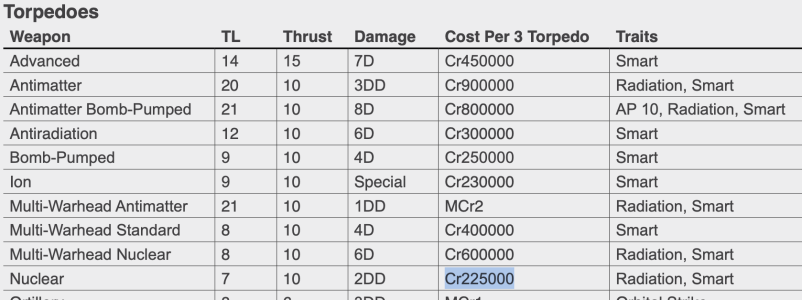
A Dton of nuke missiles is kCr450 (HG'22, p36), a Dton of nuke torpedoes is kCr225 (HG'22, p39).

A full load of torpedoes for a bay is half the price of the full load of a missile bay. A slight cost compared to the BB, but still.


A dTon of three Nuclear Torpedoes is 675 KCr -- which is the size (and price) of a salvo from a Small Bay. A Medium Bay launches a salvo of 2 dTons (1350 KCr), and a Large Bay a salvo of 10 dTons (6.75 MCr).
HG'22, p39 seems to disagree:
Skärmavbild 2025-12-20 kl. 23.49.12.png


True but silly. I have already noted this, and pointed it out.
Still a severe problem for missiles...


Combat also happens at ranges which are shorter than 'Distant' --
Yes, at least if you can close the range. If a torpedo-heavy fleet meets a missile-heavy fleet, how will the missile fleet close the range, short of Referee fiat?


and at all ranges less than 'the last range band' Missiles are far better. Unless you are using exclusively 'Advanced' Torpedoes, they will take 10 rounds to close from Distant range; but a Missile user had a choice of munitions (Advanced, Anti-matter, Anti-Torpedo, Decoy, Fragmentation, Ion, and Long-Range) which move faster than 10G & those will arrive in 7 to 9 rounds (only one halving).
Sure, but they will not penetrate heavy armour. Nukes penetrates anything, with some margin.
Advanced missiles are fast (great!) but struggle to penetrate armour 15.


And, since each bay launch is four times as many Missiles, halving the number of missiles in a salvo only gets Missiles down to parity with Topedoes.
Yes, but torpedoes do more damage and are more difficult to PD, so more of them will hit.
An equal amount of missiles and torpedoes reaching the target is a clear win for torpedoes.


Again you identify a niche case that I have already discussed as if it is something new. The number of published ships with 30 armor is a tiny fraction (in High Guard Update, only the Hadrian Battle-Rider does so).
Given that you could not have armour 30 at TL-15 in HG'16, that is hardly surprising.
Only the new ship in HG'22 has it, the old ships copied from ineffective designs in CT FS does not.


But just for fun, lets compare a salvo of Nuclear Missiles vs a salvo of Nuclear Torpedoes:
Median isn't average for a non-symmetric distribution, which is good for your argument.
A nuke missile does an average of 10 damage through armour 30, even if the median is 5.
Skärmavbild 2025-12-21 kl. 00.20.08.png
A full half of all nuke missile salvoes does no damage at all, half of all damage comes from the lucky rolls of 6.


A nuke torpedo does four times as much average damage through armour 30 and three times through armour 20. With the distance effect torpedo salvoes does something like four times the damage at Distant range, depending on the defences used.

If we don't want to use nukes, the plasma torpedo offers decent armour penetration, unlike any other missile.


Nuclear Missiles do better average (and maximum) through armor up to around rating 23. Considering the prevalence of warship designs with less than 23 armor, Nuclear Missiles are a better bet a vast majority of the time.
Unless we are at Distant range, where combat begins...
At Distant range most missiles get lost and the same number of missiles and torpedoes arrive, before EW and PD.
With each torpedo doing a lot more damage, the salvo does a lot more damage.


EW favors missiles as well.
Quite, by a lot. But for battleship-sized salvoes it isn't all that significant, as you can only target a salvo once per round.

Salvoes of less than a few hundred missiles or torpedoes will be completely countered by EW at Distant range, or less than say one hundred missiles/torpedoes at VLong.


All of this is of course purely academic as torpedoes are completely nerfed by anti-torpedo missiles, and missiles are severely limited in HG'22 compared to HG'16, or possibly nerfed by PD missiles. Particle and meson bays are the new hotness...


Battleships should absolutely be launching & defending vs missiles. Any non-Armor defense vs missiles is as effective or better vs Torpedoes, and high armor involves large trade-offs in performance.
Battleships has to defend against many different attack vectors, missiles are just one of them.
Armour is very expensive, but protects against everything but mesons.

If we are only considering missiles and torpedoes, active defences would be much cheaper, but when even bays can reach Distant range that is a bit risky.


At Very Long range direct fire bays will do more damage than missiles immediately rather than four rounds from now...

Even at Distant a large particle bay can do something like 1000 damage through heavy armour, or 4000 damage against no armour. More than a torpedo bay, much more than a missile bay, and immediately.
 
You can't really compare missile bays against torpedo bays directly. Build a missile BB and a Torpedo BB and fight them for a fair comparison.

Yes, I said slight, but noticeable difference when you have 100 tech upgraded bays.
A viable warship whose primary armament is Torpedo bays can usually be fairly compared to the exact same design with Missile bays. I am sure folks who enjoy doing ship design will have no trouble coming up with several examples.


A Dton of nuke missiles is kCr450 (HG'22, p36), a Dton of nuke torpedoes is kCr225 (HG'22, p39).

A full load of torpedoes for a bay is half the price of the full load of a missile bay. A slight cost compared to the BB, but still.

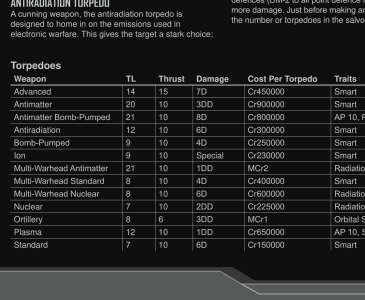
HG'22, p39 seems to disagree:
View attachment 6939
It seems there has been an Errata that I missed; thank you! Now I have to get a replacement for my HGU 2022. Here is what I have (please excuse the 'Night Mode'), note the 'Cost per Torpedo':

HGU Torpedoes.png

Still a severe problem for missiles...

Yes, at least if you can close the range. If a torpedo-heavy fleet meets a missile-heavy fleet, how will the missile fleet close the range, short of Referee fiat?
Anti-Torpedo, Interceptor, or Dogfight Missiles. Plus, perhaps, some Point Defense Batteries -- although if we are putting those into the mix, then combat with Missiles and Torpedoes rapidly becomes pointless. Ditto for Large Particle Beam Bays, which averages (70-Armor) x 100 damage for every one of the ten rounds it takes for the Torpedoes to close.

Sure, but they will not penetrate heavy armour. Nukes penetrates anything, with some margin.
Advanced missiles are fast (great!) but struggle to penetrate armour 15.

Yes, but torpedoes do more damage and are more difficult to PD, so more of them will hit.
An equal amount of missiles and torpedoes reaching the target is a clear win for torpedoes.
Advanced missiles average 17.5 damage x# of Missiles; they routinely penetrate armor 15. And sure, and 'equal number of Torpedoes reaching the target' is a win for Torpedoes -- but since that never happens, it really is not relevant. At the very least, this is the point you are trying to prove, so sneaking it in as a given is not constructive.

Given that you could not have armour 30 at TL-15 in HG'16, that is hardly surprising.
Only the new ship in HG'22 has it, the old ships copied from ineffective designs in CT FS does not.

Median isn't average for a non-symmetric distribution, which is good for your argument.
A nuke missile does an average of 10 damage through armour 30, even if the median is 5.
View attachment 6940
A full half of all nuke missile salvoes does no damage at all, half of all damage comes from the lucky rolls of 6.
72 salvos means 720 points of damage -- before multiple. Missiles start with a multiple (and to-hit bonus) four times higher than Torpedoes.

A nuke torpedo does four times as much average damage through armour 30 and three times through armour 20. With the distance effect torpedo salvoes does something like four times the damage at Distant range, depending on the defences used.

If we don't want to use nukes, the plasma torpedo offers decent armour penetration, unlike any other missile.
Again, I made a couple tables that covered this -- they are in the post to which you are replying. Above armor 23, Nuclear Torpedoes have the edge. Why do you think I will be surprised by this? Carrying Armor 30 requires 1} TL-15, 2} Military Hull, 3} Bonded SuperDense Armor, and 4} 24% of the volume of the ship. This is an extreme expense, in credits, in dTons, and in opportunity cost for lost capability. I will concede that in a Large-Ship universe (where Battleships are hundreds of thousands or millions of dTons, and money is ignored) these requirements are less important.

Unless we are at Distant range, where combat begins...
At Distant range most missiles get lost and the same number of missiles and torpedoes arrive, before EW and PD.
With each torpedo doing a lot more damage, the salvo does a lot more damage.
There is not a single ship in the game with a Spinal-Mount Weapon that relies on conducting combat at 'Distant' range. Your obsession with 'Distant' is a little weird, and seems to be dominating how you think about combat. HGU 2022, p 115 says this:
Most encounters start at Very Long or Distant ranges,
when the combatants first detect one another. However,
actual combat starts when one of the fleets moves into
range of their opponents’ weapons, typically Long range.
And the Core rules also talk about encounters often beginning at Very Long range -- with some starting much closer.

Quite, by a lot. But for battleship-sized salvoes it isn't all that significant, as you can only target a salvo once per round.

Salvoes of less than a few hundred missiles or torpedoes will be completely countered by EW at Distant range, or less than say one hundred missiles/torpedoes at VLong.

All of this is of course purely academic as torpedoes are completely nerfed by anti-torpedo missiles, and missiles are severely limited in HG'22 compared to HG'16, or possibly nerfed by PD missiles. Particle and meson bays are the new hotness...

Battleships has to defend against many different attack vectors, missiles are just one of them.
Armour is very expensive, but protects against everything but mesons.

If we are only considering missiles and torpedoes, active defences would be much cheaper, but when even bays can reach Distant range that is a bit risky.

At Very Long range direct fire bays will do more damage than missiles immediately rather than four rounds from now...

Even at Distant a large particle bay can do something like 1000 damage through heavy armour, or 4000 damage against no armour. More than a torpedo bay, much more than a missile bay, and immediately.
I think we agree on much of this. My own point of view is probably influenced by my preference for Small-Ship universes, where the upper limit on (the very largest, and eye-wateringly expensive) ships is below 50000 dTons, and most Naval assets are ~5000 dTons. Your point about Large Bays is well taken.
 
Last edited:
Sadly much of this conversation confirms why I don't have "space combat" in my game. I am sure is can be diverting as a wargame, but for an RPG it is reading as a rock paper scissors exercise with too many chances of instant and irrevocable death for the entire crew or complete financial evisceration if they just decide to bailout.

This might work as a climax to a campaign that you don't mind the characters dying, or you are purposefully removing a ship from a campaign to set up a plot, but it isn't coming across as particularly appealing for a number of players round a table as a semi-random encounter for example to add a bit of spice.

I think the core issue is that in individual combat you can suffer casualties but as long as the player win then that is generally recoverable, either their characters recover over time or the majority of the group survive and the replacement characters have a nucleus to form on. In ship combat they all go together. There is less opportunity for genuine peril without significant risk of TPK. Maybe if each player had their own ship it would be less of an issue, but that is seldom the case. In a naval campaign you could put them aboard different ships, but would they then not tend to just become just another crewman?

Now I have to ask, "Am I missing something?"
Do you stack the odds in the players favour so that a pirate is just an economic inconvenience (repairs and replenishment) or do you actually send peer opponents against them and just keep your fingers crossed? Is there a level where peer opponents just have a knock about where limping away is credible for both parties?
 
There is not a single ship in the game with a Spinal-Mount Weapon that relies on conducting combat at 'Distant' range. Your obsession with 'Distant' is a little weird, and seems to be dominating how you think about combat. HGU 2022, p 115 says this:
Combat is not “shooting”. Combat - and this very much applies in the real world naval examples MM based Traveller on as well - begins when the two sides detect each other and comprises sensor warfare, ECM, positional warfare etc as well as shooting.

I find it extremely hard to come up with a situation in which near-peer adversary fleets that involve battleships can approach closer than distant range without detection having occurred. So the ship that can engage effectively at that range and maintain that range for as long as possible is at an advantage.

(Except that anti-torpedo missiles exist).
 
Anti-Torpedo, Interceptor, or Dogfight Missiles. Plus, perhaps, some Point Defense Batteries -- although if we are putting those into the mix, then combat with Missiles and Torpedoes rapidly becomes pointless. Ditto for Large Particle Beam Bays, which averages (70-Armor) x 100 damage for every one of the ten rounds it takes for the Torpedoes to close.
Yes, anti-torpedo missiles and PD missiles will destroy incoming missiles, but will not let close the range with an uncooperative enemy. You have to manoeuvre closer by thrust.


Advanced missiles average 17.5 damage x# of Missiles; they routinely penetrate armor 15.
At two damage per missile they will barely inconvenience the enemy before your magazines run dry...
It would take 33 000 missiles reaching the target, i.e. 67 000 missiles launched, i.e. 3300 Dt missiles launched, without any defences, to kill a 100 kDton ship. Not combat effective...


And sure, and 'equal number of Torpedoes reaching the target' is a win for Torpedoes -- but since that never happens, it really is not relevant. At the very least, this is the point you are trying to prove, so sneaking it in as a given is not constructive.
You brought it up:
And, since each bay launch is four times as many Missiles, halving the number of missiles in a salvo only gets Missiles down to parity with Topedoes.
It is the default case at Distant range.


72 salvos means 720 points of damage -- before multiple. Missiles start with a multiple (and to-hit bonus) four times higher than Torpedoes.
?


Again, I made a couple tables that covered this -- they are in the post to which you are replying.
As I was trying to explain, the tables are wrong:
But just for fun, lets compare a salvo of Nuclear Missiles vs a salvo of Nuclear Torpedoes:
Nuclear Missilesvs Armor 30
Small Bay: 12x 1DDMin: 0
Avg: 60
Max: 360

Nuclear Torpedoesvs Armor 30
Small Bay: 3x 2DDMin: 0
Avg: 120
Max: 270

Nuclear Missiles do better average (and maximum) through armor up to around rating 23. Considering the prevalence of warship designs with less than 23 armor, Nuclear Missiles are a better bet a vast majority of the time.
You are calculating median damage, not average damage, if all missiles reach the target.

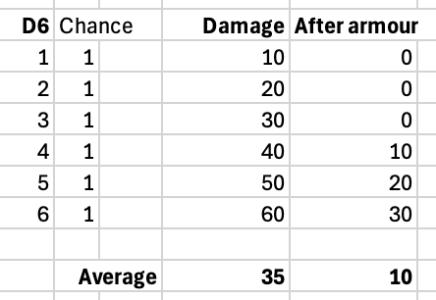
Average damage, per nuke missile against armour 30:
Skärmavbild 2025-12-21 kl. 00.20.08.png

At Distant range a quarter of the missiles will reach the target, doing an average of ¹⁄₄ × 12 × 10 = 30 damage for a small bay.
Under the same conditions, torpedoes would do 3 × 40.3 = 120.9 damage.
Damage parity is reached at armour 0.

Shorter range is a different case.


There is not a single ship in the game with a Spinal-Mount Weapon that relies on conducting combat at 'Distant' range.
You can't design such a ship, so that is hardly surprising. And that is kind of the point of missiles, they out-range everything else (but large particle bays).


Your obsession with 'Distant' is a little weird, and seems to be dominating how you think about combat. HGU 2022, p 115 says this:
Yes, let me emphasise differently:
Core'22, p165:
Most hostile encounters in space will start at Very Long or Distant ranges, when the combatants first detect one another. However, actual combat will start when one of the combatants manages to move into range of their weapons, typically Long or Medium range.
HG'22, p115:
Most encounters start at Very Long or Distant ranges, when the combatants first detect one another. However, actual combat starts when one of the fleets moves into range of their opponents’ weapons, typically Long range.
High tech warships will see each other at Distant range or longer.
If any ship can fire at Distant range, combat starts at Distant range.
Missiles and torpedoes (and large particle bays) have range Distant.

Hence, high tech warship combats generally starts at Distant range.
Low tech ACS fights generally starts at shorter ranges.

If the enemy navy is prepared to fight at Distant range, and you are not, you lose...


I think we agree on much of this. My own point of view is probably influenced by my preference for Small-Ship universes, where the upper limit on (the very largest, and eye-wateringly expensive) ships is below 50000 dTons, and most Naval assets are ~5000 dTons.
With 5000 Dt ships, torpedoes are not for you. Such tiny salvoes would be neutralised by EW.
 
I find it extremely hard to come up with a situation in which near-peer adversary fleets that involve battleships can approach closer than distant range without detection having occurred. So the ship that can engage effectively at that range and maintain that range for as long as possible is at an advantage.

(Except that anti-torpedo missiles exist).
Quite...

Anti-torpedo missiles neutralises torpedoes, PD missiles neutralises missiles, but large particle bays are effective.
 
Hmm. The suggestion I was actually making was a missile or torpedo that has a shooty laser, not a bomb pumped one shot.

Launches normally and homes in on the target, then instead of exploding, stats shooting.

I realise it cannot be a standard space laser, because of the much smaller size of the ordnance compared to small craft, and that it likely has a limited number of shots. But something that's capped at close or adjacent range, fires with a little worse stats than a beam or pulse laser (maybe 1D damage without any to hit mods?) and whose payload has enough battery for 5 shots... I'm not seeing any game breaking issues there. Could be a handy point defense option for missile armed ships, especially for engaging fighters, with any deployed in that role close to the ship being something the gunner can hand off to a remote ops crew.
 
There is not a single ship in the game with a Spinal-Mount Weapon that relies on conducting combat at 'Distant' range. Your obsession with 'Distant' is a little weird, and seems to be dominating how you think about combat. HGU 2022, p 115 says this:

And the Core rules also talk about encounters often beginning at Very Long range -- with some starting much closer.
J.L. Brown, you seem to be thinking more about small groups or single small-ish ships than large navy ships in large fleets with lots of scouts and support. That's fine, but many of us have to contend with larger ships and the issues they raise. When I say "many of us," I mean me, so maybe not actually that many people. Probably very few other referees actually run big ship combats, but I am running a DNR campaign. The DNR doesn't mount torpedoes, but it does have missiles. However, its interlocutors have used torpedoes. ( Distant range missile launches have not ended up doing damage against near-peers, but neither have the torpedoes. Torpedoes did not work out well, because of EW mostly, which is really effective against torpedoes. And then there was the PD at the end, which shot down the few lonely torpedoes that made it that far. TL 11 vs. TL 15 battles also tend not to go well for the TL 11 side anyways, so I didn't think much of it; once the DNR's spinal mount came into play things quickly went downhill for the other side. )

As Endie points out, probably most major naval engagements start when major combatants are well beyond distant range - not the major shooting, but the positioning - meaning depending on the cost/benefit analysis, ships might start shooting already at distant range (this has been my experience with DNR and its subsidiary ships - there tend to be scouting missions rather than diving head on into a situation because why would you risk your main ship if you don't have to?). This is not to say that it always conclusively makes sense to stay at Distant, merely that it might be an effective combat distance for some ships in some situations, and if it is, it is something that ship designers should consider.

Distant range is big and therefore can take a lot of time to fly through. If you have capabilities that can cause significant damage out there, those become disproportionally important since you get to shoot them off first and therefore cause damage before the other side responds. So torpedoes cannot be excluded when considering the relative advantages of different weapon systems, at least not on the basis that Distant range is irrelevant, because it isn't.

Obviously, getting through PD & EW, let alone anti-torpedo missiles requires a mass attack, so you really have to commit to it when designing ships - unless it is just meant for catching fleeing merchantmen and other special situations other than slugfests. Since the enemy will be prioritizing shooting down the torpedoes over missiles, it does not make sense to combine missile and torpedo batteries: do one or the other and go all in. The one you choose determines whether you'll want to stay at Distant range, or close in as quick as possible.

I'm not really trying to make a case for torpedoes, nor against them, but rather to suggest that their usefulness seems to be situational. If this is the case, some navies might use them, in which case creating the kinds of situations which make torpedoes useful will be part of their doctrine, and the other characteristics of their ships will reflect this. (In which case, their torpedo attacks will probably be very effective, until their enemies figure this out and go all-in on anti torpedo missiles and EW. )
 
Asymmetrical.

Most obvious use is to have them to present a threat to major starwarships, such as cruisers, when massed.

When not, planetary bombardment, destroyers (since canon has them at three kilotonnes), and big freighters.
 
High tech warships will see each other at Distant range or longer.
If any ship can fire at Distant range, combat starts at Distant range.
Missiles and torpedoes (and large particle bays) have range Distant.
Ah, high-tech super sensors. of course! Yes, I had overlooked that!

Please point me to the pages where they are defined; I am stuck using p 76 of the HGU 2022:
When a starship comes out of jump or during in-system
transit, their sensors detect hundreds if not thousands
of objects, depending on population and traffic in the
system. Beyond Distant range (more than 50,000
kilometres), most of these objects simply appear as
blips on a display, difficult to differentiate from each
other. Those that emit radio waves are assumed to
be ships, satellites or space stations. Those that do
not might be powered-down ships, planetoids, comets
or other objects. Without closer inspection, detailed
system charts or communication with other spacecraft
in the vicinity, it can be difficult to determine the exact
nature of many objects.
And p 160 of the Core Rules Update. Apparently 'minimal information' (whether or not an object is 'active' in EM) for 'EM sensors' is confined to Very Long range.

There is a huge number of unidentified objects to sift through, and a ship does NOT know their vectors, exact position, or much of anything at all, until the object has been scanned. And scanning an object for information takes time, and is limited in what information can be determined -- and range is a very large factor.

And of course it is left up to the referee to determine what quality of information is required to determine the size of an object, or the class-type of a detected ship, or the probable / positive identification of a particular ship, or sufficient resolution to make a firing solution. To my mind, all of that requires somewhat more than 'minimal' information.
 
Back
Top