
You are using an out of date browser. It may not display this or other websites correctly.
You should upgrade or use an alternative browser.
You should upgrade or use an alternative browser.
Military ships and crew
- Thread starter tytalan
- Start date
You do realize that you made my point?First define Time-Limited some of the troops going to FFW traveling from Corridor were on ship for close to a year. Plus Marines assigned to ships are routinely placed in Barracks in Traveller ship designs. Then you have ships like the Mercenary Cruiser where the ship is home and they spend years on ship going from mission to mission. Plus if they are passengers and only on ship for short duration doing nothing but waiting for drop why have training facilities? Your logic doesn’t work.
Troops traveling for a year in barracks-style accommodations while crew get cabins? Mercenary troops relegated to being stacked like cordwood as their living quarters while other ships crew get 2 man cabins? Even for volunteers this will engender poor morale amongst the cannon fodder.
The interpretation of the rules like this runs smack into the reality that such things are highly unlikely to exist. Bad rules are just that - bad rules - and when they are contraindicated by common sense they should be revised. Troops assigned to serve aboard a ship should have the same cubeage as anyone else of their same rank. Troops being transported by the ship (temporarily) should be the only ones occupying barracks.
Assigned and transported by are two entirely different issues. My logic works quite well because it's, yanno, logic.
Like in my original post I see this as an option only on military vessels it takes more discipline for it to be viable than most civilian crews have.I would certainly not object if the rules were re-written to say that only basic passengers (such as embarked troops) could use Barracks, but once you explicitly include marines and "ships troops" and vague comments about "other function" it all becomes a bit random.

Terry Mixon
Emperor Mongoose
One thing that has to be taken into account, and that has been mentioned earlier, is that the restricted space of a barracks is suitable for military ground pounders and needs to come with expansive other spaces for them to spread out in. The barracks are simply rack space, not living space.You do realize that you made my point?
Troops traveling for a year in barracks-style accommodations while crew get cabins? Mercenary troops relegated to being stacked like cordwood as their living quarters while other ships crew get 2 man cabins? Even for volunteers this will engender poor morale amongst the cannon fodder.
The interpretation of the rules like this runs smack into the reality that such things are highly unlikely to exist. Bad rules are just that - bad rules - and when they are contraindicated by common sense they should be revised. Troops assigned to serve aboard a ship should have the same cubeage as anyone else of their same rank. Troops being transported by the ship (temporarily) should be the only ones occupying barracks.
Assigned and transported by are two entirely different issues. My logic works quite well because it's, yanno, logic.

Fluffy Bunny Feet
Emperor Mongoose
What about crews manned by little people? They need less volume. Now imagine PC's trying to invade a ship in battle armour and finds the corridors are narrow and the ceilings 4' high.Like in my original post I see this as an option only on military vessels it takes more discipline for it to be viable than most civilian crews have.
Terry Mixon
Emperor Mongoose
What about crews manned by little people? They need less volume. Now imagine PC's trying to invade a ship in battle armour and finds the corridors are narrow and the ceilings 4' high.

Here’s the part your missing the concept of troops being ‘transported and temporarily’ doesn’t exist a year about ship is not temporary that just doesn’t make common sense. Travel times in Traveller prevent to concept of temporary.The interpretation of the rules like this runs smack into the reality that such things are highly unlikely to exist. Bad rules are just that - bad rules - and when they are contraindicated by common sense they should be revised. Troops assigned to serve aboard a ship should have the same cubeage as anyone else of their same rank. Troops being transported by the ship (temporarily) should be the only ones occupying barracks.
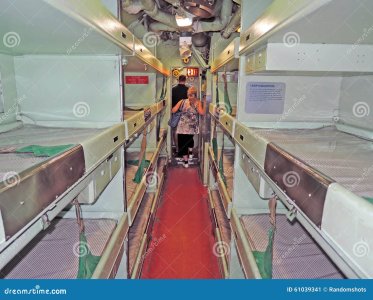
In Submarines E-4 and below are housed in barracks style housing they don’t get private rooms or two to a room. While on ship you have a bunk and a locker nothing else. Yes it’s an aster way of living but subs don’t have a ton of extra room just like navel starships. You have to earn the rank to live more comfortably.
Also historically Mercs tend to live more comfortably than actual military it has to do with the ability to leave anytime instead of having to work out a term of service.
Tell that to mongoose. Yes troops assigned to a ship should have the same cubeage as sailors and transported troops barracks just like in the real navy just like on a submarine. Common sense says they should be revised so all E-4 and below are housed in Barracks just like real life.The interpretation of the rules like this runs smack into the reality that such things are highly unlikely to exist. Bad rules are just that - bad rules - and when they are contraindicated by common sense they should be revised. Troops assigned to serve aboard a ship should have the same cubeage as anyone else of their same rank. Troops being transported by the ship (temporarily) should be the only ones occupying barracks.
Attachments
Barracks are suitable as temporary berthing space. A marine assigned to a ship for a 6 month deployment of said ship would be considered a passenger, albeit a longer-term one. I have no issue with them being assigned barracks. If a Marine is assigned as crew (not temporary) then they should be treated exactly like the naval crew of similar rank.One thing that has to be taken into account, and that has been mentioned earlier, is that the restricted space of a barracks is suitable for military ground pounders and needs to come with expansive other spaces for them to spread out in. The barracks are simply rack space, not living space.
I don't think we are on the same wavelength for the discussion here. I posted up-thread an example of crew quarters aboard the BB-Texas - it was very similar to the pic above.Tell that to mongoose. Yes troops assigned to a ship should have the same cubeage as sailors and transported troops barracks just like in the real navy just like on a submarine. Common sense says they should be revised so all E-4 and below are housed in Barracks just like real life.
I've tried to explain where the difference is, and where the rules are not well written to reflect what should be normalcy. I will try one more time, and if this doesn't work I don't see there being any more utility in discussing further as we don't seem to be communicating our points well.
To explain it better I'm going to set up a scenario - We have the good ship Lollipop, a planetary assault ship. There are three individuals, all of the same rank - Bob, Mary and Larry.
Bob is assigned as a cook. He cooks every watch and has damage control duties during combat.
Mary is assigned as a shipboard Marine for the Lollipop. Her duties can include shipboard security, security in port, boarding actions, or damage control party assignments during combat.
Larry is also a Marine, but he's being transported by the Lollipop to invade some dastardly enemy of the Imperium.
Bob has a cabin and has regular duties/watches aboard the ship. He is full-time naval crew.
Mary has a cabin and has regular duties/watches aboard the ship. She is full-time Marine crew.
Larry is in a barracks space with the other Marines being transported on the ship. Upon arrival at their destination he'll leave the ship.
Bob and Mary, being crew and equal rank, should have equal quarters aboard the ship. Larry, not being crew, only needs the barracks because he's essentially living cargo.
The duties of Bob and Mary are different, however both are assigned to the ship and go where the ship goes and will remain as crew until they are transferred to a new duty station. Larry isn't assigned to the ship and leaves when the ship reaches its destination. These are two entirely different crewing scenarios - assigned to the ship vs being transported by the ship.
Under the rules as written, Larry and Mary would both get barracks as Marines, but Bob gets a cabin. And this is where I take issue with the rules. Crew is crew, passengers are passengers. Treating Larry and Mary the same is illogical - one is assigned to the ship and one is not. Treating Bob and Mary the same is logical - both are assigned as crew and neither is a passenger.
The above explanation holds true today for submariner crews, and used to hold true for ships that actually embarked Marines permanently as regular crew - they received equal treatment as far as cubeage goes based on their rank - not their job function.
Crew is crew, and passengers are passengers. Doesn't matter what their job functions are, if they are assigned to the ship then all crew of similar rank should be treated the same regardless of their job functions aboard the ship.
Travel times, for crew at least, are irrelevant insofar as a ship having the necessary capabilities to support and entertain its crews for long periods between ports. I referred to a year in reply to your statement about troops being transported from Core to the Marches.

MarcusIII
Emperor Mongoose
On navy amphibious carriers (LHDs/LHAs) sailors have better, less crowded berthing than do the embarked US Marines. Nature of the beast. For the sailors that is their permanent living space. Not so for the embarked Marines.Tell that to mongoose. Yes troops assigned to a ship should have the same cubeage as sailors and transported troops barracks just like in the real navy
Condottiere
Emperor Mongoose
What's sauce for the Mongoose, is sauce for the gander.

In other words, if one human can berth there, all humans can.
Individually, of course.
In other words, if one human can berth there, all humans can.
Individually, of course.
The pic I showed was literally crew quarters on a submarine for enlisted E-4 and under. The whole ideal that crew gets the same living quarters no matter what the rank is just not true and the fact that not a one of you have addressed this just shows you don’t understand the military. You can say troops are passengers and get no space because they are on the ship temporarily but that doesn’t actually fit the game. Travel time makes this unrealistic if you can keep troops in a barracks for months even years at a time while moving them from one system to the next keeping crew in the same sort of environment for the same amount of time only makes sense.Barracks are suitable as temporary berthing space. A marine assigned to a ship for a 6 month deployment of said ship would be considered a passenger, albeit a longer-term one. I have no issue with them being assigned barracks. If a Marine is assigned as crew (not temporary) then they should be treated exactly like the naval crew of similar rank.
I don't think we are on the same wavelength for the discussion here. I posted up-thread an example of crew quarters aboard the BB-Texas - it was very similar to the pic above.
I've tried to explain where the difference is, and where the rules are not well written to reflect what should be normalcy. I will try one more time, and if this doesn't work I don't see there being any more utility in discussing further as we don't seem to be communicating our points well.
To explain it better I'm going to set up a scenario - We have the good ship Lollipop, a planetary assault ship. There are three individuals, all of the same rank - Bob, Mary and Larry.
Bob is assigned as a cook. He cooks every watch and has damage control duties during combat.
Mary is assigned as a shipboard Marine for the Lollipop. Her duties can include shipboard security, security in port, boarding actions, or damage control party assignments during combat.
Larry is also a Marine, but he's being transported by the Lollipop to invade some dastardly enemy of the Imperium.
Bob has a cabin and has regular duties/watches aboard the ship. He is full-time naval crew.
Mary has a cabin and has regular duties/watches aboard the ship. She is full-time Marine crew.
Larry is in a barracks space with the other Marines being transported on the ship. Upon arrival at their destination he'll leave the ship.
Bob and Mary, being crew and equal rank, should have equal quarters aboard the ship. Larry, not being crew, only needs the barracks because he's essentially living cargo.
The duties of Bob and Mary are different, however both are assigned to the ship and go where the ship goes and will remain as crew until they are transferred to a new duty station. Larry isn't assigned to the ship and leaves when the ship reaches its destination. These are two entirely different crewing scenarios - assigned to the ship vs being transported by the ship.
Under the rules as written, Larry and Mary would both get barracks as Marines, but Bob gets a cabin. And this is where I take issue with the rules. Crew is crew, passengers are passengers. Treating Larry and Mary the same is illogical - one is assigned to the ship and one is not. Treating Bob and Mary the same is logical - both are assigned as crew and neither is a passenger.
The above explanation holds true today for submariner crews, and used to hold true for ships that actually embarked Marines permanently as regular crew - they received equal treatment as far as cubeage goes based on their rank - not their job function.
Crew is crew, and passengers are passengers. Doesn't matter what their job functions are, if they are assigned to the ship then all crew of similar rank should be treated the same regardless of their job functions aboard the ship.
Travel times, for crew at least, are irrelevant insofar as a ship having the necessary capabilities to support and entertain its crews for long periods between ports. I referred to a year in reply to your statement about troops being transported from Core to the Marches.
Also apparently you not paying attention that what I’m saying, my point from the beginning has been that the rule that barracks are only for passengers should be changed in the case of military ships. On a military ship the rule should be that crew and troops can both be housed in barracks since that’s actually how it’s done in real life. Quoting the rules over and over again mean nothing when we are talking about rule changes.
Last edited:
Surface vessels that carrier troops for at the most two weeks is not a realistic comparison, the pic I posted was literally crew quarters on a submarine which is the closest we have to space ships.On navy amphibious carriers (LHDs/LHAs) sailors have better, less crowded berthing than do the embarked US Marines. Nature of the beast. For the sailors that is their permanent living space. Not so for the embarked Marines.
"All accommodations listed in this book other than low berths and acceleration benches and seats include a fresher while all staterooms and barracks include a small food preparation area. Laundry facilities are usually located in a common area." HG2022 p50One thing that has to be taken into account, and that has been mentioned earlier, is that the restricted space of a barracks is suitable for military ground pounders and needs to come with expansive other spaces for them to spread out in. The barracks are simply rack space, not living space.
Barracks provide all the essentials to living on a ship. Staterooms provide the same but just have more space and privacy. Because they are notionally single occupancy they need more access space (in the deck plan section it suggests 2 squares = 1 DTon is purely access ways). 1 DTon per person is sufficient to accommodate all the basic needs for the average sophont on board.
If cooped up for weeks at a time you need space to move around (walks, changes of scenery etc.) and some space to entertain yourself. If you are crew you can roam the whole ship and the majority of your waking time you don't need to be entertained, because you are working. If you a passenger (or embarked troops) that is not true. If anything it is those people that need the extra 3 DTons of space a stateroom provides as that circumscribes the entirety of their liberty on the ship.
Common areas are an attempt to provide that extra space without allocating it exclusively to any specific individual and the rules state it should be in the order of 1 Dton per stateroom (with vague consequences for failing to do so). It is this aspect that is probably too woolly. The allocation talks about it being per stateroom, but really it should be per person on board with arguably a greater allocation to anyone who is not in a sole-occupancy stateroom. The consequences will be more significant for long term crew who need to endure any deficiency over a longer period (but also are being paid for it and have more chance of getting used to it)
If we follow the standard stateroom model then for crew in shared staterooms, 1 DTon each is essential space. The remaining 2 DTons of the stateroom plus the 1 Dton common space requirement* means the per person requirement for crew is 1.5 DTons per person (which fits well with Cabin Space). Barracks accommodated crew could therefore expect 1.5 DTons of common space in addition to their 1 Dton of allocated bunk space. Under this model Barracks would still be cheaper to install and have lower ongoing life support costs but would not save any space over shared staterooms.
If we use a 3 shift system then crew sleep 1 shift, work 1 shift and therefore only require 1 shift for leisure. This also applies if embarked troops/marines have the space to conduct a duty shift (e.g. there are training or briefing rooms on board). Passengers with no duty shift have effectively 2 shifts for leisure and should require double the common space of crew. The adverse effects of failing to meet this requirement are however temporary if they will leave the ship in a few weeks and could be mitigated by extra stewards. For long voyages (e.g. scientific missions or long distance troop deployments) additional passenger stress needs to be accommodated in some way.
Common space can just be empty squares and that includes corridors or empty "cargo" space (as long as you have paid the cost for common space to enable it to perform that fucntion), but I would expect the dedicated entertainment facilities listed on HG2022 p59-60 to count as some modifier in addition to the effect of their raw tonnage. If this were implemented then Barracks could become more space efficient than staterooms. Similarly rarely used areas (secondary bridges, gunrooms, hangars etc) could do double duty as recreation facilities part of the time and contribute to common space.
This analysis assumes that the stateroom space is never unused. In theory if both occupants sleep and work on the same shift pattern then for 2/3rds of the time their leisure space allocation is unused and effectively wasted. Shared common space is less likely so constrained as shifts can be interleaved so it could count as a multiple of the equivalent dedicated space in a stateroom. The exact amount would depend on how much of the leisure space was actually inside the stateroom. At a minimum assuming a 3Dton deck plan footprint 2 crew share 1 Dton of private leisure space which goes unused 2 shifts in 3. If this were a common leisure space instead it could be shared by 6 crew. This would make barracks more space efficient compared to staterooms as the leisure space could be fully utilised.
For those that opine that barracks is like a prison we can dispense with that argument as we actually have the stats for a prison in HG2022 in the form of the Brig. This can accommodate up to 12 in only 4 Dtons (sleeping in shifts with absolutely no privacy and no facility to prepare meals). This provides something like 0.5 DTons per bed space and 1DTon for access and a single fresher for all. Long term stays in accommodation of that type would certainly result in morale issues (but would still permit survival).
*This also could be viewed as 1 DTon shared space in the stateroom plus 1 DTon of access (per the deck plan rules) plus 1 DTon common space but it still ends up as a 3 DTons shared between 2 people.
Last edited:
Real world fact Submarines enlisted and jr NCOs live in barracks when on the subs, Sr NCOs and Officers have cabins mostly double occupancy except for the higher rank Officers who have single occupancy cabins. This is how it is in the real world and is how it should be in Traveller, this is only in the military. If you think a O-1 would have the same Quarters as a E-1 then you do not know anything about the military.

Sigtrygg
Emperor Mongoose
The real world of 21st century subs is not a useful analogy for a TL9+ culture in the 57th, it is akin to comparing modern berthing with that of coracles.
in a near future game i can see why you would have limited berthing volume, but as the TLs advance the amount of living space increases.
Compare the early Earth Force ships in B5 with Minbari, or the cramped interiors of early Star Fleet vessels with the luxury of the Galaxy class.
Environmental machinery is subsumed within stateroom allocation.
in a near future game i can see why you would have limited berthing volume, but as the TLs advance the amount of living space increases.
Compare the early Earth Force ships in B5 with Minbari, or the cramped interiors of early Star Fleet vessels with the luxury of the Galaxy class.
Environmental machinery is subsumed within stateroom allocation.
Condottiere
Emperor Mongoose
What actually would work out, is clever interior design, on both of the maximum utilization of minimal space, and human psychology.
Comparing a coracle to a modern ship is unhelpful as they don't perform the same purpose. If you compare the accommodation of a medieval coracle and a modern coracle you will see that the accommodation provision is identical i.e. none.The real world of 21st century subs is not a useful analogy for a TL9+ culture in the 57th, it is akin to comparing modern berthing with that of coracles.
in a near future game i can see why you would have limited berthing volume, but as the TLs advance the amount of living space increases.
Compare the early Earth Force ships in B5 with Minbari, or the cramped interiors of early Star Fleet vessels with the luxury of the Galaxy class.
Environmental machinery is subsumed within stateroom allocation.
TV shows and movies of space ships often have large living quarters to accommodate camera movements. Star Treks increased quarters has more to do with set budgets and a social work in space ethic rather than a supposed semi-military exploration vessel. The Star Trek Federation doesn't use money and is post-scarcity.
Traveller requires you to pay for ships, living costs and passage. If there were no capital or recurrent cost difference between crews using small accommodation vs large accommodation then it might be reasonable to attribute luxury sized living spaces on military and civilian ships.
It however costs more in capital costs, life support costs, fuel costs, plus bigger drives and powerplants to move extra Dtonnage etc. Where there is more cost there is a drive to reduce those costs. Private citizens can spend their money how they want, but commercial organisations and those who answer to an administration will always seek to drive costs down.
Last edited:
Funny the Whitestars which are higher tech than the standard Minbari ship use barracks for all the crew.Compare the early Earth Force ships in B5 with Minbari,
Submarines run a similar environmental requirements as a space ship which makes it a very realistic comparison. Tech level doesn’t eliminate the fact that space on a warship is limited or the fact that part of military discipline is rank has its advantages which you want to eliminate.
Similar threads
- Replies
- 137
- Views
- 6K

- Replies
- 25
- Views
- 1K

- Replies
- 69
- Views
- 2K
