Imperial Battleships

Ships fought in a line for reasons. During the age of sail cannons were direct-fire and you had almost zero ability to shoot at anything other than next to you.

Once turrets and ballistics became a thing, ships still tended to fight in a line for gunnery purposes. But in this era being able to cross the 'T' because a thing that every captain sought out, if possible. Now ships at the front or back, or even in the secondary lines, could all potentially range on the same target. Never quite worked out that way in naval battles usually. After WW1 we didn't see a lot of surface task forces attacking each other except for a few instances in the Pacific between major IJN and USN combatants. Other than the chase for Bismark the Atlantic really didn't have major surface battles. DD's and torpedo boats would skirmish, but they aren't capital ships.

As far as class names go, I agree that things have changed from age of sail up to the digital age. Very few navies are building 'cruisers' anymore, it's all destroyers or carriers it seems. But I think the mission of a cruiser remains constant, as would the other classes, so I'm ok with keeping the names tied to the missions.

One interesting question is how exactly would a 52nd century task force fight its opponents? Since space is 3-D I'd expect you would stack your ships vertically and horizontally in order to clear firing lanes for energy and missile weapons. Because missiles have to live in newtonian space like the rest of us it's impractical to fire weapons from the side of the ship that's not facing the enemy. I wouldn't say impossible, but it would require missiles to essentially be small space craft in their maneuvers. Traveller doesn't really model firing arcs anymore, but some ship configurations would lend themselves to better being able to bring the majority (or all) of their weapons to bear to a target in front of them as opposed to say a spherical ship. Pro's and con's to this as a sphere could rotate and bring undamaged weapons and armor to bear during the fight - though I think I'd prefer to have all my weapons to start and get as much damage as quickly as possible than hanging around longer. However since we have no actual data all we can do is duel with theories as to which is best.
Crossing the T of an enemy was not common, but it's a slight exaggeration to say it never worked out. It was rare because of how cautious both sides would be about allowing it to happen (edit: plus other elements like the growth of air scouting and the impact of greater engagement ranges lessening the impact of manuevre), but Togo accomplished it at Tsushima, and Jellicoe achieved it not one but twice at Jutland, although weather and impressive German manuevring prevented complete disaster each time.

It happened a couple of times in WWI, despite the growing dominance of aircraft carriers: Oldendorf managed it at Surigao Strait, although he was rather gifted it by the Japanese force and by geography. Leyte Gulf in general was a mixture of the Japanese pushing on when they should have fled and fleeing when they should have pushed forward.

It was so devastating in Napoleonic naval warfare because of the disparity between the hitting power of the weapons and the relative frailty of the ships. A single first-rater marshalled a weight of broadside (when firing on both sides, as happened at Trafalgar) equivalent to two thirds of the entire artillery forces of both sides engaged at Waterloo. The Santisima Trinidad very nearly matched it, if counting both sides.

Plus, if I understand, their cannon were much more accurate in azimuth than in range. Cross the T on someone and their is a good chance your broadside will devastate them.

(I read that in the instructions for *Wooden Ships and Iron Men*, if I recall.)

Indeed. Not least because of the rolling motion of the ship, but also because of varying powder quality and condition (more marked on French and Spanish ships of the Napoleonic era, due to Britain's access to Indian saltpetre in virtually limitless quantities) and the overall simplicity of sighting the line compared to an abstract arc.
 
Last edited:
As a term, as with the older "ship of the line", it's most useful in terms of opposing forces.

If the ship in question is able to operate as part of the main battle fleet in opposition to similar main battle fleet, it's probably fair to use the term battleship.

"Cruiser" for that matter was not originally a class of ship, but a mission statement. Cruisers could be frigates, or ships of the line (often third rates). What made them cruisers was operating away from a fleet. In the 19th century the mission became a ship type, as the powerful ships became less and less likely to operate on independent cruises and purpose built cruiser ships evolved.
. . .
As far as class names go, I agree that things have changed from age of sail up to the digital age. Very few navies are building 'cruisers' anymore, it's all destroyers or carriers it seems. But I think the mission of a cruiser remains constant, as would the other classes, so I'm ok with keeping the names tied to the missions.

. . .

You could keep names broadly associated with mission type or connotation (they change, as the term "Frigate" vanishing after becoming identified with the mission-type "Cruiser", and then being reintroduced later as a smaller ship with different mission demonstrates, or the terms become broad through colloquial civilian usage - e. g. "Cruiser" and "Clipper"). The term (Torpedo-Boat) Destroyer was very mission specific before broadening, and then later becoming milti-mission, and has a very generically applicable combat name ("Destroyer").

But it is also possible that the official class-types are entirely future-mission descriptive and bear no names that resemble modern nautical class names at all ("Space Dominance Vessel", "Capital Vessel", "Primary/Secondary/Tertiary Line Combat Vessel, etc), but are simply by tradition associated with older terms in casual colloquial usage (e.g. everybody knows that a USN "Littoral Combat Ship" (LCS) is pretty much a fancy name for a "Corvette", the general class now getting uprated to "Frigates").
 
Ultimately "crossing the T" is just a special case of maximising your firepower while minimising the opposition's

In space, ranges are vast and relative movement is low. It does pretty much come down to a blob of ships shooting at the ships of another blob, although concentration of firepower is especially easy where every gun that counts can target every ship that matters.
 
All things being equal, the equivalent of crossing the tee, would be the incidence where one of the opposing starwarships is caught in a crossfire by two or more enemy peers, possibly, the crossfired vessel also has its primary armament masked.
 
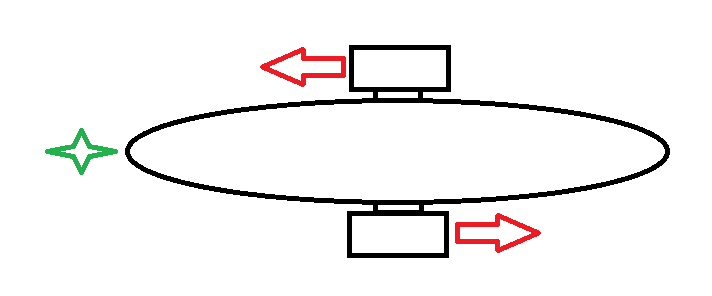
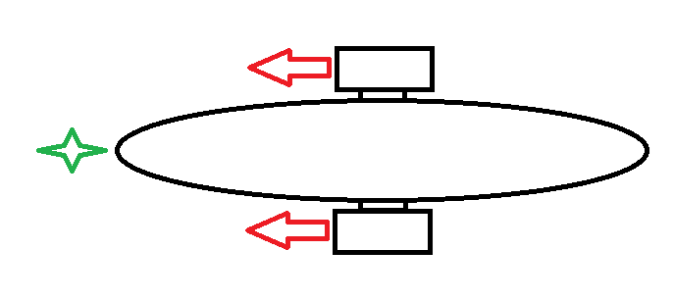
In fact, in my experience playing Traveller fleet combat, you actually want to reverse the traditional Wet Navy crossing the T - because most Traveller battlewagons rely on spinal mounts.

You want to be the fleet with your noses facing the enemy, while they have their broadsides facing you and can't use their deadly spinal mounts.

(this is in rule systems where you can maneuver - obviously in abstract systems like CT/High Guard crossing the T has no relevance)
 
There's a fair case for spinal mount ships having auxiliary M-Drives mounted to thrust laterally, so they can still point towards the target and better evade. Condottiere mentioned something like that, but with the spinal mounted laterally. In a sphere it wouldn't make much difference, though the traditional ship-is-a-gun setup is a long thin hull with business up front and party at the back. Space death mullet.

Although I guess M-Drives are meant to be able to generate 25% thrust laterally, so maybe it's just a matter of enhancing that effect in warships. Certainly there would seem to be little reason to have M-4 main and lateral M-1 aux.

In practice all ships are applying main thrust at all kinds of bearings, and the spinal mount guns probably need a bit of a chargeup time, so only need to point at the target for small amounts of time.
 
It probably comes down to how often fleets engage while acelerating towards the target.

Certainly thruster aft and weapon fore advantages a pursuit. Maybe that is enough for a fleet that is expected to mostly turn up and chase down weaker opponents? It's less likely that a major navy (especially the Imperium, as the biggest gorilla in the room)) would design major warships on the assumption that they'd be outclassed and need to thrust away while firing aft, but there may be some aspect of far future space combat I'm overlooking. The objective is ALWAYS to engage with local superiority.

I guess if the ships are expecting to engage while in deceleration, it may make sense to fit aft firing weapons.
 
Further thought... mount the M-drives on rotatable pods at the ship's midpoint. They don't even need to be fast rotation... the ship would usually be either thrusting towards the target or away from it, but a combat turn or two to change over seems practical.
might be more of a raider or patrol cruiser idea than a battleship, though.

The pods oriented one fore and one aft would give greater agility for half the raw thrust.

1772428480504.png
1772428595976.png

1772428631132.png


Not exactly a new concept for spacecraft.

I had considered this years ago, and decided this was one of the times you had to use hardpoints, since considering the amount of thrust involved, drives not only have to be firmly anchored to the hull, but also balanced.

Use two five hundred tonne bay turret, and replace each bay weapon system with a five hundred tonne manoeuvre drive, or rocket, depending on taste.
 
It's not so much the "fighting in a line" thing as "fighting in a group".

Age of sail ships adopted line tactics because their cannon were mostly firing to broadside.

Late 19th and early 20th century ships retained line formations mostly for the same reasons, although turrets provided a bit more flexibility. But pre-radio, ships still needed to sail in close formation as all signals were still visual.

By WW2, battle groups no longer needed to sail in line; radio communications meant command could direct individual ships and looser fighting formations were practical. Aircraft had also shaken things up, so looser formations were better for defense.

In space, unless you go out of your way to impose technology that requires some kind of line formation (i.e. David Drake's Honor Harrington books), it's not really a thing. There's no reason to have ships close enough to each other for them to get in each other's way, and in any case they're assumed to be in constant secure communication with each other, so if one does need to move to the side a bit, that is easy to adjust.
I suppose the question becomes what sort of formation a fleet or a group of ship fights in. Staying close to one another to provide shared defensive fire remains a truism as it has since defensive fire became a thing. Ships outside support of one another are easy pickings to get overwhelmed with saturation fire. A ships evasive maneuvers rely upon it to be somewhere else when the incoming fire comes in, and if you fill all possible space with fire than a ship's evasive capabilities are effectively nullified.

WW2 ships still sailed in a formation, with the main ships at the core and escorts at the edge. So would that still be an issue or not depends on multiple things - none of which the game rules take into account.

In the HH universe (David Weber by the way... David Drake did Hammer's Slammers and Ensign O'Leary series) ships used broadsides for combat since their missile tubes used grav accelerators to impart a greater launch speed. And HH-universe ships could not engage any targets at their top or bottom due to their drive mechanisms. I'm sure the tech design lent itself to explaining WHY broadsides-in-space were a thing in his books, especially since it was supposed to be space version of Hornblower. However to give Weber credit, he did lay out a bible of sorts that he didn't really violate too much till later in the series when missiles all of a sudden became off-bore capable firing, but still evidently retained their grav-accelerations - two things that don't function well together in a newtonian universe. Games and books get to take such liberties that reality cannot.

Space gives you full 3-D options, regardless of the technology. Missiles and beam weapons function the same in naval combat as they do in space - they will fly in a trajectory (ballistic vs. straight line) and try to impact with the enemy. Your options are to do nothing if they are going to miss, dodge if it looks like they might hit, shoot them down short of their targets, lure them away with ECM, or rely upon passive defenses like sand and armor and shrug it off. With full 3-D capabilities you can place your heavier ships in the front, your better armored ones, or your escorts. Enemies may expend fire to destroy your screen, or ignore it and focus on the main units.

Someone like Mahan argued for decisive battles, so I'd suspect he'd ignore the shrimp and go for the main line of battle. One could take a balanced approach and have escorts fight escorts (they would be equivalents), cruisers against cruisers and capital ships against capital ships. Of course that assumes fleets are of roughly equal size and capabilities - which often they are not. This is, of course, a purely academic and theoretical discussion as nobody has any real data or tech to model this from. Game rules often don't incorporate the sillier things like reality into their mechanics.
 
You could keep names broadly associated with mission type or connotation (they change, as the term "Frigate" vanishing after becoming identified with the mission-type "Cruiser", and then being reintroduced later as a smaller ship with different mission demonstrates, or the terms become broad through colloquial civilian usage - e. g. "Cruiser" and "Clipper"). The term (Torpedo-Boat) Destroyer was very mission specific before broadening, and then later becoming milti-mission, and has a very generically applicable combat name ("Destroyer").

But it is also possible that the official class-types are entirely future-mission descriptive and bear no names that resemble modern nautical class names at all ("Space Dominance Vessel", "Capital Vessel", "Primary/Secondary/Tertiary Line Combat Vessel, etc), but are simply by tradition associated with older terms in casual colloquial usage (e.g. everybody knows that a USN "Littoral Combat Ship" (LCS) is pretty much a fancy name for a "Corvette", the general class now getting uprated to "Frigates").
Very true. 30 centuries from now the labels could greatly vary as everyone, their brother and the Emperor's cousin wants to put their imprint upon naval forces and come up with a new ship name/type because they can.

For a game setting though I'm more comfortable taking the current class names/types and projecting them out to the future. Makes it much easier for a comprehension and implementation perspective in my mind.
 
For human space, the Imperium would likely define starwarship categories, which would include the Darrians, Swordies, Solomani, and so on, but exclude the Zhodani, since likely they've come up with their terminology.

With other alien races, they have their own philosophies regarding this, which might not be neatly expressed as battleships, cruisers, or frigates.
 
Back
Top