Crossing the T of an enemy was not common, but it's a slight exaggeration to say it never worked out. It was rare because of how cautious both sides would be about allowing it to happen (edit: plus other elements like the growth of air scouting and the impact of greater engagement ranges lessening the impact of manuevre), but Togo accomplished it at Tsushima, and Jellicoe achieved it not one but twice at Jutland, although weather and impressive German manuevring prevented complete disaster each time.Ships fought in a line for reasons. During the age of sail cannons were direct-fire and you had almost zero ability to shoot at anything other than next to you.
Once turrets and ballistics became a thing, ships still tended to fight in a line for gunnery purposes. But in this era being able to cross the 'T' because a thing that every captain sought out, if possible. Now ships at the front or back, or even in the secondary lines, could all potentially range on the same target. Never quite worked out that way in naval battles usually. After WW1 we didn't see a lot of surface task forces attacking each other except for a few instances in the Pacific between major IJN and USN combatants. Other than the chase for Bismark the Atlantic really didn't have major surface battles. DD's and torpedo boats would skirmish, but they aren't capital ships.
As far as class names go, I agree that things have changed from age of sail up to the digital age. Very few navies are building 'cruisers' anymore, it's all destroyers or carriers it seems. But I think the mission of a cruiser remains constant, as would the other classes, so I'm ok with keeping the names tied to the missions.
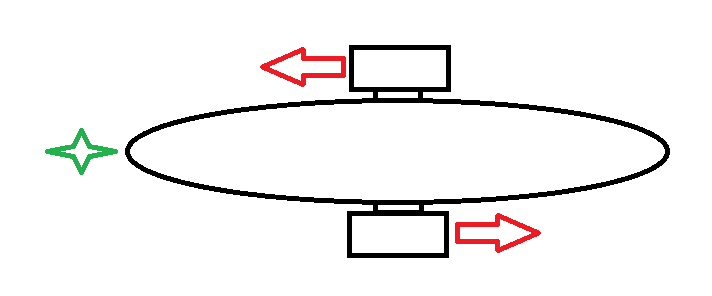
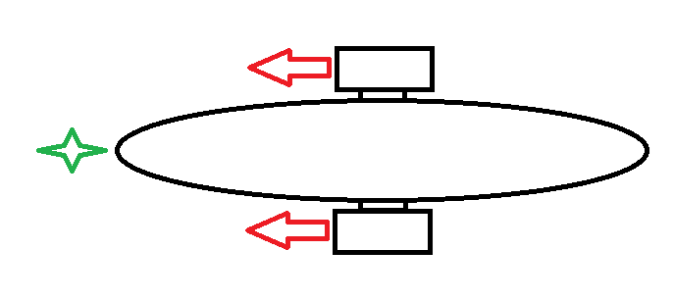
One interesting question is how exactly would a 52nd century task force fight its opponents? Since space is 3-D I'd expect you would stack your ships vertically and horizontally in order to clear firing lanes for energy and missile weapons. Because missiles have to live in newtonian space like the rest of us it's impractical to fire weapons from the side of the ship that's not facing the enemy. I wouldn't say impossible, but it would require missiles to essentially be small space craft in their maneuvers. Traveller doesn't really model firing arcs anymore, but some ship configurations would lend themselves to better being able to bring the majority (or all) of their weapons to bear to a target in front of them as opposed to say a spherical ship. Pro's and con's to this as a sphere could rotate and bring undamaged weapons and armor to bear during the fight - though I think I'd prefer to have all my weapons to start and get as much damage as quickly as possible than hanging around longer. However since we have no actual data all we can do is duel with theories as to which is best.
It happened a couple of times in WWI, despite the growing dominance of aircraft carriers: Oldendorf managed it at Surigao Strait, although he was rather gifted it by the Japanese force and by geography. Leyte Gulf in general was a mixture of the Japanese pushing on when they should have fled and fleeing when they should have pushed forward.
It was so devastating in Napoleonic naval warfare because of the disparity between the hitting power of the weapons and the relative frailty of the ships. A single first-rater marshalled a weight of broadside (when firing on both sides, as happened at Trafalgar) equivalent to two thirds of the entire artillery forces of both sides engaged at Waterloo. The Santisima Trinidad very nearly matched it, if counting both sides.
Plus, if I understand, their cannon were much more accurate in azimuth than in range. Cross the T on someone and their is a good chance your broadside will devastate them.
(I read that in the instructions for *Wooden Ships and Iron Men*, if I recall.)
Indeed. Not least because of the rolling motion of the ship, but also because of varying powder quality and condition (more marked on French and Spanish ships of the Napoleonic era, due to Britain's access to Indian saltpetre in virtually limitless quantities) and the overall simplicity of sighting the line compared to an abstract arc.
Last edited: