FFW doing it my way

I think you need to learn the difference between the art and the rules. Or do you think Aslan are 12' tall now?
I'm trying to engage you and be civil, but you continue to make snide remarks like this.

The art reflects the ships and the rules. If the art isn't a fair representation of the ship they either the descriptions are wrong or the art is. The artwork has been more or less consistent since it first debuted. So I'm going to use common sense and say the artwork is a fair representation of what the ships would look like.

The rules are the rules, doesn't mean they were written well or correctly, just means someone though spaceships can fly at Mach 30+ and wrote them down without actually thinking what that means (or perhaps they didn't care, it sounded too cool).

Happy to debate, but if you want to snipe let me know and I'll put you on ignore.
 
They aren't flying bricks, but they are also not streamlined enough to make the speeds that MasterGwydion posted.

The first issue is one of materials science - we already know Traveller hulls are magically strong.

The second issue is how airflow works. Even the smallest protrusion or surface change can produce a lot pressure and airflow shocks - and the faster you go the worse it gets. These 'streamlined' ships are fine at lower atmospheric speeds, but they'd have to expend so much energy and effort to maintain control that it's not practical - even if it was possible (and since they have no magical field surrounding their craft other than the magic of anti-grav) they are still subject to the laws of aerodynamics. The only one they get a pass on is lift since they don't need it. They still have to deal with drag and the other forces that would be fighting them for just flying in a straight line.
At around an altitude of 40km there is no air density, so no friction. Just a smoothly accelerating M-Drive. To go 1,000km straight up and come to a complete stop only takes 365 seconds with a 3G drive. They only need 40km to be out of the atmosphere. So, your airflow argument is pointless since they are where there is no air to flow. Only have to go slower on take-off and landing. Easy.
 
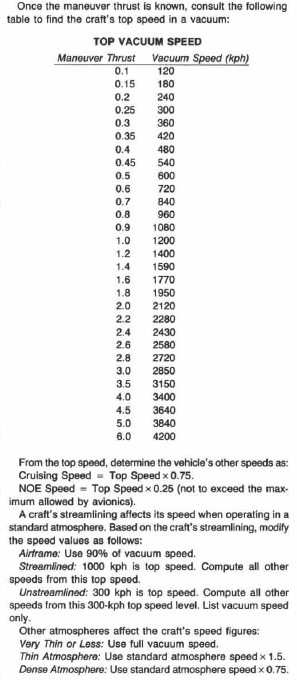
For convenience, there's a formula for lift off and atmospheric reentry, based on local gravity and sustained acceleration.

For Terran norm, with maximum acceleration factor three, one six minute term, plus another half six minute turn to leave orbit.

Spinward Extents, I think.

If you want to go faster, even streamlined and manoeuvre driven, you have to add heat shields.
 
I'm trying to engage you and be civil, but you continue to make snide remarks like this.

The art reflects the ships and the rules. If the art isn't a fair representation of the ship they either the descriptions are wrong or the art is. The artwork has been more or less consistent since it first debuted. So I'm going to use common sense and say the artwork is a fair representation of what the ships would look like.
Art reflects "artistic license" as always. Rules represent the reality of the game world.
The rules are the rules, doesn't mean they were written well or correctly, just means someone though spaceships can fly at Mach 30+ and wrote them down without actually thinking what that means (or perhaps they didn't care, it sounded too cool).
You are correct. It does not mean that they were written well or correctly, but they are the rules. You can change them IYTU, as always, Rule Zero, but saying a ship doesn't do what the rules say it does is just...? I am not even sure what the word I am looking for is. You can't play the game without rules. You can play it without art. The rules determine how a game is played, not the picture on the box.

Happy to debate, but if you want to snipe let me know and I'll put you on ignore.
I am not sure how to say it any nicer than this. Traveller still exists without art. Traveller doesn't exist without rules. Maybe someone else can help as I seem to be doing poorly?
 
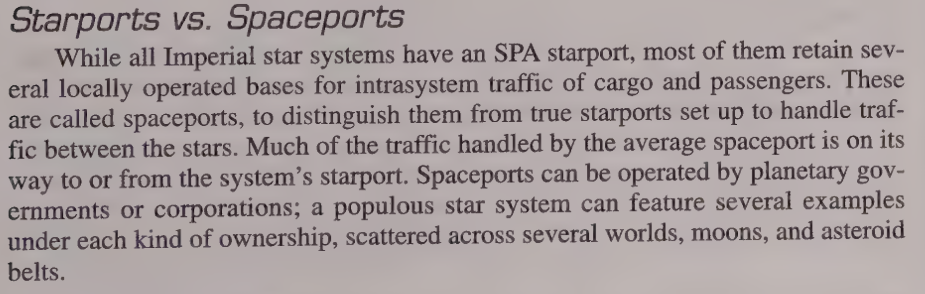
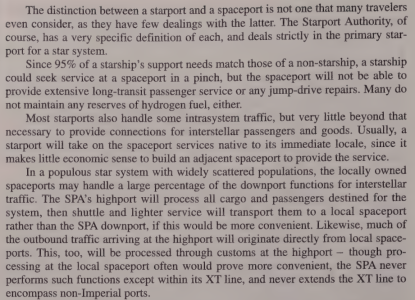
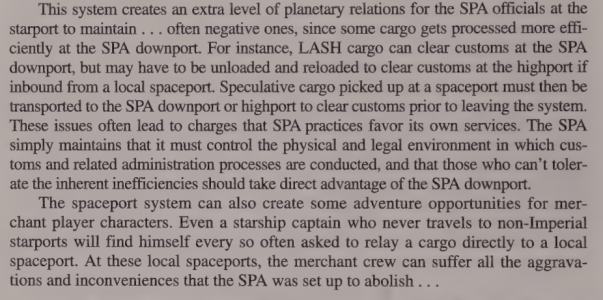
How starports actually function, and what their perquisites are, may actually be rather individualized outside the Imperium.

Exceptionally, the Consulate, since they seem rather organized.
 
At around an altitude of 40km there is no air density, so no friction. Just a smoothly accelerating M-Drive. To go 1,000km straight up and come to a complete stop only takes 365 seconds with a 3G drive. They only need 40km to be out of the atmosphere. So, your airflow argument is pointless since they are where there is no air to flow. Only have to go slower on take-off and landing. Easy.
Craft must go up and must go down. And if you had read you'll have seen I spoke of altitude and density. By the rules, as written, a 6G ship is capable of Mach 30. Nowhere does it speak of a ballistic course. It gives a simple time and distance chart. My argument remains on point because you've yet to show where in the rules it's speaking of the interpretation you are stating as fact. There is no need for a starship to reach such speeds in an atmosphere, not to mention the stress and heat it would put on an airframe.
Art reflects "artistic license" as always. Rules represent the reality of the game world.
The art reflects the description. Since the art is apparently matching the description the default argument would be that it's not "artistic license" but artistic illustration. Show me where in the many decades of artwork across multiple versions it's reflecting something different.

As has been pointed out many times throughout the history of the game - rules are not absolutely correct as you are making them. A prime example - the violation of the rules, as written in the reality of the game world, of the Gazelle. It violated the rules from its inception.
You are correct. It does not mean that they were written well or correctly, but they are the rules. You can change them IYTU, as always, Rule Zero, but saying a ship doesn't do what the rules say it does is just...? I am not even sure what the word I am looking for is. You can't play the game without rules. You can play it without art. The rules determine how a game is played, not the picture on the box.
Yes, we are all able to update/modify/delete the game rules we use. My argument has always been to make the ships behave within the rules as written. A starship that is definitely not streamlined to the point of even an airliner that routinely travels at Mach 30 is rather silly. With anti-grav it already ignores the rules of lift and weight, so it just has to live with thrust and drag. Drag affects control, it affects thrust, it affects a lot of things. Starships are built to live in the vacuum of space. Being streamlined means they can enter the atmosphere with relative ease and do things far easier than say a cube-based ship. The speeds, as written, are silly. If you recall CT, computers took up large amounts of space because at the time of the game being designed computers were much more massive than they are today. Yet that was accepted - until people continued to point out that this needed to change to reflect how computing power had changed, and they got changed. I've never advocated for playing without rules - I've advocated for adopting better rules.

I have yet to see anyone buy a game with zero artwork in it. Art heavily influences a buyers decision to buy a game. Or at least it has in my experience with being a game purchaser across the many RPG's and board games (even books) I've bought. And, based on the amount of art in RPG's of various publishers I would wager that they believe art impacts sales.
I am not sure how to say it any nicer than this. Traveller still exists without art. Traveller doesn't exist without rules. Maybe someone else can help as I seem to be doing poorly?
I have no issue with disagreement or differing points of view. I would say that the history of Traveller, even going back to the CT books, says otherwise. The initial books were rather plain, but artwork started getting added as soon as it was practical. The initial starship explanations were short, but they still had pictures. As early printing got better we started seeing more frequent and better artwork. Some of the early illustrations by the Keith brothers have been replicated (with your aforementioned artistic license) across many versions and publishers - yet one can easily trace them back to the first one.

Probably at this point we can call fin to this as I think we are just agreeing to disagree on a few points and agreeeing on others.
 
Craft must go up and must go down. And if you had read you'll have seen I spoke of altitude and density. By the rules, as written, a 6G ship is capable of Mach 30. Nowhere does it speak of a ballistic course.
You are able to decide whatever course you want, but if you want to go fast, you have to get out of the atmosphere, as I said.
It gives a simple time and distance chart. My argument remains on point because you've yet to show where in the rules it's speaking of the interpretation you are stating as fact. There is no need for a starship to reach such speeds in an atmosphere, not to mention the stress and heat it would put on an airframe.
and none of this matters once you clear 40km worth of atmpsphere.
The art reflects the description. Since the art is apparently matching the description the default argument would be that it's not "artistic license" but artistic illustration. Show me where in the many decades of artwork across multiple versions it's reflecting something different.
Really? Show me where on the pics of the Shuttle you see aerofins? I see no moveable control surfaces for in atmosphere flight, yet the rules say it has aerofins. I see on the deckplans that anywhere you could have control surfaces, it is taken up by fuel tanks.
As has been pointed out many times throughout the history of the game - rules are not absolutely correct as you are making them. A prime example - the violation of the rules, as written in the reality of the game world, of the Gazelle. It violated the rules from its inception.
Then what is to stop a writer of published material from putting Warp Drives in Charted Space if the rules don't matter? The Gazelle is an error and has always been an error created by someone who didn't follow the rules, as opposed to just changing the rules to fit what they wanted to do.
Yes, we are all able to update/modify/delete the game rules we use.
Us. End-users. Not publishers.
My argument has always been to make the ships behave within the rules as written.
That is a lie. The shuttle says it is Streamlined and has Aerofins, yet you trust the art, which has no rules attached to it, as opposed to the rules in direct opposition to you saying that your argument is to make the ships behave within the rules as written. The art is not the rules.
A starship that is definitely not streamlined to the point of even an airliner that routinely travels at Mach 30 is rather silly. With anti-grav it already ignores the rules of lift and weight, so it just has to live with thrust and drag. Drag affects control, it affects thrust, it affects a lot of things. Starships are built to live in the vacuum of space. Being streamlined means they can enter the atmosphere with relative ease and do things far easier than say a cube-based ship. The speeds, as written, are silly. If you recall CT, computers took up large amounts of space because at the time of the game being designed computers were much more massive than they are today. Yet that was accepted - until people continued to point out that this needed to change to reflect how computing power had changed, and they got changed. I've never advocated for playing without rules - I've advocated for adopting better rules.
You may advocate that, but in this conversation, you seem to be advocating art over rules.
I have yet to see anyone buy a game with zero artwork in it. Art heavily influences a buyers decision to buy a game. Or at least it has in my experience with being a game purchaser across the many RPG's and board games (even books) I've bought. And, based on the amount of art in RPG's of various publishers I would wager that they believe art impacts sales.
Original Traveller. First Printing. Almost zero art. It doesn't happen often, but the fact that you can have a game with no art but not a game with no rules, kind of makes my point for me. I have never said that art doesn't impact sales. I said you can't make rules calls based on art and not based on the rules. If you do, you are the one ignoring the RAW, which at your own table is fine. It is not fine for publishers.
I have no issue with disagreement or differing points of view. I would say that the history of Traveller, even going back to the CT books, says otherwise. The initial books were rather plain, but artwork started getting added as soon as it was practical. The initial starship explanations were short, but they still had pictures. As early printing got better we started seeing more frequent and better artwork. Some of the early illustrations by the Keith brothers have been replicated (with your aforementioned artistic license) across many versions and publishers - yet one can easily trace them back to the first one.

Probably at this point we can call fin to this as I think we are just agreeing to disagree on a few points and agreeeing on others.
You may be just disagreeing to disagree, but I can't even remotely understand your viewpoint. Art is not rules. Games cannot exist without rules. Therefore, you can't make rules calls based on art, as you so clearly are.

Let Me guess, you think a teddy bear is a real bear and not an anthropomorphized artistic representation of a real bear? That is how your argument sounds to me. That is why I am having so much trouble understanding it. So, I keep thinking that I must be misunderstanding your viewpoint.

 
No offence to the artists but most of the art (especially ships) is pretty cartoonish and doesn't have the details one would expect if it was trying to actually be a realistic representation. It is mostly at least in the "good enough" category which is all it needs.

Do any of the artistic images show the "gas cap" that has to open to fuel the ship? Lots of things you don't see. Mostly there are no visible radar dishes for example, no way to load those missiles in the turrets. And so on. They are just "assumed" but somehow streamlined isn't streamlined because of the art?
 
No offence to the artists but most of the art (especially ships) is pretty cartoonish and doesn't have the details one would expect if it was trying to actually be a realistic representation. It is mostly at least in the "good enough" category which is all it needs.

Do any of the artistic images show the "gas cap" that has to open to fuel the ship? Lots of things you don't see. Mostly there are no visible radar dishes for example, no way to load those missiles in the turrets. And so on. They are just "assumed" but somehow streamlined isn't streamlined because of the art?
Thank you. Maybe this is better than my explanation.
 
Most of the MgT ship art shows a rocket plume exhaust from the back of the ship...

point of order for the Gazelle - it is a perfectly legitimate LBB:5 '79 design. Like the xboat the changes to the ship design rules made it broken, but it worked under the rules it was designed for.
 
Most of the MgT ship art shows a rocket plume exhaust from the back of the ship...

point of order for the Gazelle - it is a perfectly legitimate LBB:5 '79 design. Like the xboat the changes to the ship design rules made it broken, but it worked under the rules it was designed for.
I don't quite agree with the "perfectly legitimate" LBB-79 design rules. I think it remains questionable under the 79 rules. Here's why I think that:

Hardpoint calculation - The rule for calculation of hardpoints is "Each hardpoint created during construction requires one ton of interior space allocated to it; a ship may have up to one hardpoint per 100 tons of ship not otherwise used for bays." The ships stated tonnage is 300 tons, with a 100 ton disposable fuel tank. When attached the ship displaces 400 tons and thus should have 4 hard points. When detached the ship displaces 300 tons but still has 4 hardpoints.

The ship's papers show it to be Jump 4, 4G and powerplant 4. The computer is listed as a Model 3. HG-79 refers back to Book 2 for more details on the Computer. Book 2 states "In addition, the model number indicates the highest level of jump which can be achieved by the ships. For example, a ship must have a Model14 conputer before it can perform jump-4, in addition to the proper size jump drive." A model 3 computer is incapable of Jump-4 unless it is a BIS model. The ships papers indicate it's a standard Model 3. That's not to mention that the computer is a bit underpowered to run all the necessary programs to fly and fight at the same time effectively (but, to be fair, nobody said the accountants always pay for what you need).

And there is also the description in the L-Hyd section that states "The two longitudinal fuel tanks of the Gazelle class ship are engineered to be droppable in extreme circumstances. The ship has high capacity accumulators in its jump drive, and can completely burn its fuel prior to jump, storing the energy while the tanks are then jettisoned. The decrease in tonnage for the ship results in greater efficiency, and the ship can jump farther (J-6). Addi- tional fuel tankage within the ship allows maneuver, but the tanks must be replaced before the ship can again jump." In HG-79 the requirements for fuel state "A ship requires fuel for its jump drives and for its power plant; the power plant converts fuel to energy for housekeeping functions and for the maneuver drives. Fuel tankage must be sufficient to contain a full load for the power plant and the jump drive." Arguably one could say that the internal tanks are sufficient for a shorter jump (it's VERY arguable as the L-Hyd tank description has very little detail to it for this).

The Gazelle first shows up in JTAS4. In the original design by Miller, he states that the barbettes are drawn from High Guard and 'grafted' on to Book 2 designs. The text calls for the PA barbettes or treat them as triple laser turrets.

It's probably way too generous to say it's "perfect legitimate". I think it's more highly speculative - but it sounded cool when it first came out and it was fun to design the ships at the time, so a lot of leeway was offered. The sad thing was that as the L-hyd tanks got updates, this ship never got corrected - MGT v1 just makes the ship 400 tons and drops any reference to disposable fuel tanks.
 
I don't quite agree with the "perfectly legitimate" LBB-79 design rules. I think it remains questionable under the 79 rules. Here's why I think that:

Hardpoint calculation - The rule for calculation of hardpoints is "Each hardpoint created during construction requires one ton of interior space allocated to it; a ship may have up to one hardpoint per 100 tons of ship not otherwise used for bays." The ships stated tonnage is 300 tons, with a 100 ton disposable fuel tank. When attached the ship displaces 400 tons and thus should have 4 hard points. When detached the ship displaces 300 tons but still has 4 hardpoints.

The ship's papers show it to be Jump 4, 4G and powerplant 4. The computer is listed as a Model 3. HG-79 refers back to Book 2 for more details on the Computer. Book 2 states "In addition, the model number indicates the highest level of jump which can be achieved by the ships. For example, a ship must have a Model14 conputer before it can perform jump-4, in addition to the proper size jump drive." A model 3 computer is incapable of Jump-4 unless it is a BIS model. The ships papers indicate it's a standard Model 3. That's not to mention that the computer is a bit underpowered to run all the necessary programs to fly and fight at the same time effectively (but, to be fair, nobody said the accountants always pay for what you need).

And there is also the description in the L-Hyd section that states "The two longitudinal fuel tanks of the Gazelle class ship are engineered to be droppable in extreme circumstances. The ship has high capacity accumulators in its jump drive, and can completely burn its fuel prior to jump, storing the energy while the tanks are then jettisoned. The decrease in tonnage for the ship results in greater efficiency, and the ship can jump farther (J-6). Addi- tional fuel tankage within the ship allows maneuver, but the tanks must be replaced before the ship can again jump." In HG-79 the requirements for fuel state "A ship requires fuel for its jump drives and for its power plant; the power plant converts fuel to energy for housekeeping functions and for the maneuver drives. Fuel tankage must be sufficient to contain a full load for the power plant and the jump drive." Arguably one could say that the internal tanks are sufficient for a shorter jump (it's VERY arguable as the L-Hyd tank description has very little detail to it for this).

The Gazelle first shows up in JTAS4. In the original design by Miller, he states that the barbettes are drawn from High Guard and 'grafted' on to Book 2 designs. The text calls for the PA barbettes or treat them as triple laser turrets.

It's probably way too generous to say it's "perfect legitimate". I think it's more highly speculative - but it sounded cool when it first came out and it was fun to design the ships at the time, so a lot of leeway was offered. The sad thing was that as the L-hyd tanks got updates, this ship never got corrected - MGT v1 just makes the ship 400 tons and drops any reference to disposable fuel tanks.
JTAS 4 was written before HG'80, it used HG'79 rules. It clearly states a 400t hull.

The twin barbettes are descriptive, they actually represent a 10t particle bay. It is likely that this is where the 5t barbette for HG'80 came from.

You are quoting '81 revised LBB:2 computer rules, there was no such restriction under '77 rules. Unless MWM had a time machine of course.

Drop tanks are allocated from the total tonnage of the ship, the Gazelle is a 400t ship with jump fuel in drop tanks.

Fuel for the Gazelle using HG79 is 160t jump fuel plus 16t for the power plant, droppiong the jump fuel tanks leaves only 16t of fuel tankage, which is insufficient for the ship to achieve even jump 1.

The HG'79 USP is part of the JTAS data sheet, the ship can be reverse built using HG'79 rules, certainly within the tolerance of other GDW HG ship designs. Quite how MWM decided to USP rate the particle weapons is something for him to explain.
 
Last edited:
JTAS 4 was written before HG'80, it used HG'79 rules. It clearly states a 400t hull.

The twin barbettes are descriptive, they actually represent a 10t particle bay. It is likely that this is where the 5t barbette for HG'80 came from.

You are quoting '81 revised LBB:2 computer rules, there was no such restriction under '77 rules. Unless MWM had a time machine of course.

Drop tanks are allocated from the total tonnage of the ship, the Gazelle is a 400t ship with jump fuel in drop tanks.

Fuel for the Gazelle using HG79 is 160t jump fuel plus 16t for the power plant, droppiong the jump fuel tanks leaves only 16t of fuel tankage, which is insufficient for the ship to achieve even jump 1.

The HG'79 USP is part of the JTAS data sheet, the ship can be reverse built using HG'79 rules, certainly within the tolerance of other GDW HG ship designs. Quite how MWM decided to USP rate the particle weapons is something for him to explain.
I don't think I quoted the wrong texts - I was using my FFE DVD info. The JTAS article calls for a 400 ton hull with drop tanks - thus making it less than 400 tons (it doesn't state it's 400 tons PLUS the drop tanks). If the ship is 400 tons PLUS drop tanks then they will have degraded performance with them attached. But the data clearly provides performance info for a max 400 ton ship. How do you account for the variances you are stating?

The article clearly states that the barbettes are from HG and not the core book. Here's the exact quote from JTAS-04 "The barbettes, and their particle accelerator weapons are not specifically covered in Traveller Book 2. They are a variant drawn from the material in High Guard, and grafted onto Book 2. Specifically, the barbettes are 5 tons each. The particle accelerators should be treated as heavy lasers as in Traveller Book 2, subject to an advantageous DM of +2 to hit." So, technically, these are unique and not covered in any of the books. They are "inspired" I suppose.

JTAS 04 was published in 1980. The original 77 Book 2 says this about computers and jump - "Jump: The jump programs are each required to allow the ship to perform a jump through interstellar space. The specific program for the jump distance required must be used." HG:80 states "Computer model indicates the size of the jump which the computer can control. A model/1 computer can is required on a ship which makes a jump-1; a model/5 computer is required on a ship which makes jump-5" The ship violates the stated rules in HG:80. Miller is credited with design of HG:80.

The drop tanks are meant to be part of the ship, as evidenced by the "...engineered to be droppable in extreme circumstances." Routine dropping of the tanks violates the idea of the definition of the word "extreme".

I 100% agree with you this ship was build within the same mindset of many of the early ships (and many of the ones afterwards) in as much that the designers didn't always follow the rules as laid out in the books. Traveller is replete with many examples of ship designs that cannot be built using published rules. However the initial JTAS design still violates multiple rules as published at the time.
 
I don't think I quoted the wrong texts - I was using my FFE DVD info. The JTAS article calls for a 400 ton hull with drop tanks - thus making it less than 400 tons (it doesn't state it's 400 tons PLUS the drop tanks). If the ship is 400 tons PLUS drop tanks then they will have degraded performance with them attached. But the data clearly provides performance info for a max 400 ton ship. How do you account for the variances you are stating?
You quoted the computer rules from 81 revised CT, go and check the 77 edition there is no such restriction...

Under the HG79 construction system you designate the hull size and drop tanks are taken from that tonnage, this changed in HG.80 where you can add the drop tanks to the hull.

using HG 70 rules the Gazelle puts its 160t of jump fuel in tanks that can be dropped, which reduces the ship to only 240t hence the increase to jump 6 but not further jumps possible.
The article clearly states that the barbettes are from HG and not the core book. Here's the exact quote from JTAS-04 "The barbettes, and their particle accelerator weapons are not specifically covered in Traveller Book 2. They are a variant drawn from the material in High Guard, and grafted onto Book 2. Specifically, the barbettes are 5 tons each. The particle accelerators should be treated as heavy lasers as in Traveller Book 2, subject to an advantageous DM of +2 to hit." So, technically, these are unique and not covered in any of the books. They are "inspired" I suppose.
You are quoting it yourself, they are adapted from the rules in HG, the version of HG available at the time was '79. Note nowhere in CT canon is a "heavy laser" defined either.
JTAS 04 was published in 1980. The original 77 Book 2 says this about computers and jump - "Jump: The jump programs are each required to allow the ship to perform a jump through interstellar space. The specific program for the jump distance required must be used." HG:80 states "Computer model indicates the size of the jump which the computer can control. A model/1 computer can is required on a ship which makes a jump-1; a model/5 computer is required on a ship which makes jump-5" The ship violates the stated rules in HG:80. Miller is credited with design of HG:80.
HG 80 would not be in production until after JTAS 4 was written, using HG79 rules. The computer rules referencing LBB:2 refer to the && edition since the 81 revision is still a year away at least. The USP is the '79 format.
The drop tanks are meant to be part of the ship, as evidenced by the "...engineered to be droppable in extreme circumstances." Routine dropping of the tanks violates the idea of the definition of the word "extreme".
The oroginal design sequence in HG'79 has you designating fuel as being in drop tanks, this volume is accounted fo from the hull size selected initially, you do not design a 300t ship and add 100t of drop tanks under HG79, you design a 400t hull and designate 160 tons of jump fueal as being in drop tanks.
I 100% agree with you this ship was build within the same mindset of many of the early ships (and many of the ones afterwards) in as much that the designers didn't always follow the rules as laid out in the books. Traveller is replete with many examples of ship designs that cannot be built using published rules. However the initial JTAS design still violates multiple rules as published at the time.
There are differences from HG 79 that I can not reconcile - how MWM determined the USP rating of the particle accelerators being the main one.

But using HG'79 you can reverse engineer the JTAS 4 Gazelle and get a lot closer than most of the HG designs in S:9. The nuclear damper, the armoured hull all match the 79 USP.
 
Back
Top