Space Combat - Did I miss something?

The radiation effect from a particle beam is the result of nuclear decay effects. And dampers are specifically referred to in several cases as being used to clean up radiation and radioactive material after the fact.
The particle beam IS radiation.
Dampers can stop the nuclear decay that causes radiation, not the radiation from decays that have already happened.


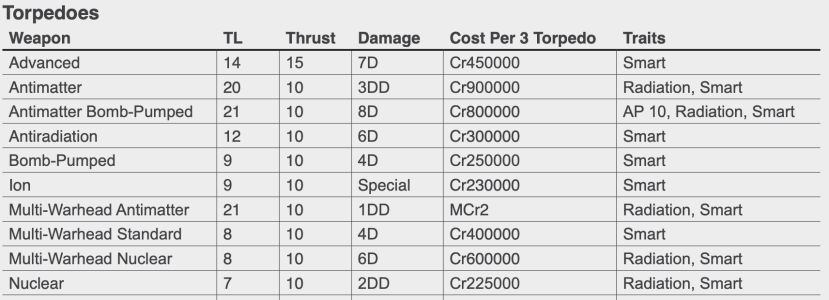
Please provide an example of a non-Destructive 'Nuclear Warhead' for ship to ship combat.

Skärmavbild 2025-12-12 kl. 17.47.27.png
MWNuke: Non-destructive nuke.
Nuke torpedo: Destructive nuke.


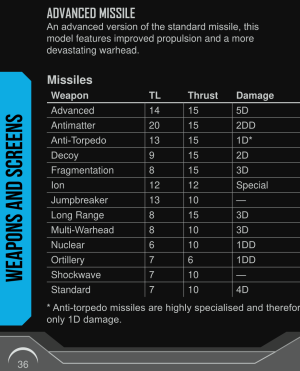
And also please explain how 'Nuclear Missiles' (1DD damage, High Guard Update, p 36) and 'Nuclear Torpedoes' (2DD damage, High Guard Update, p 39) -- both of which are mentioned explicitly in the first section -- are NOT treated as 'Destructive' weapons.
They are nukes and they are Destructive.

They are nukes, so can be affected by dampers.
They are Destructive, so require five damper units to remove the Radiation trait.
 
Some thoughts:
1. rinku meant to say Mayday not Snapshot?
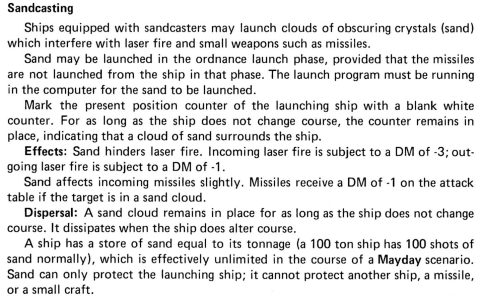
2. missiles are affected by sandclouds in CT
3. to get all the rules for sand you have to look in several places, LBB:2, Mayday, SS:3 Missiles
4. the only place I can recall using props were the guidelines in T2300 about making ship counters from stands, table tennis balls, golf tees and black paint

1765534274085.png

"Sand Effects: Any missile which passes through sand may be incapacitated by that sand. For each 25 millimeters of sand that a missile passes through, throw 12+ for the missile to be incapacitated by it. If incapacitated, the missile ceases to function."
 
More thoughts.
dampers affect the strong (and weak) force to manipulate nuclear reactions, a particle beam is nothing to do with the strong force at all. I have a hard time accepting the Mongoose take on fusion weapons too.

The radiation from a particle beam hit is x rays and the like produced from the particle beam interaction with the target material. there is no strong force interaction.

As for fusion guns in every other version of Traveller the plasma is held in the weapon until it is undergoing fusion and then it is released, the fusion reaction would end as soon as it leaves the weapon's reaction chamber and thus the plasma bolt no longer has strong force interactions therefore the damper tech would not affect it at all. Mongoose is proposing a model where the unconstrained plasma is still undergoing fusion...
 
The particle beam IS radiation.
Dampers can stop the nuclear decay that causes radiation, not the radiation from decays that have already happened.

The particle beam is presumably a stream of neutrons, but maybe not. Neutrons have a half-life of around 10 minutes; and they make the target radioactive by interacting with the nucleus -- either splitting it, or combining with it to make it heavier. All of these interactions ought to be affected by Nuclear Damper space-magic.


View attachment 6886
MWNuke: Non-destructive nuke.
Nuke torpedo: Destructive nuke.

They are nukes and they are Destructive.

They are nukes, so can be affected by dampers.
They are Destructive, so require five damper units to remove the Radiation trait.

Cool find; where is that from? I did not see it in the Core Rules, and High Guard Update p 36 has this:

1765566495122.png
 
The particle beam is presumably a stream of neutrons, but maybe not. Neutrons have a half-life of around 10 minutes; and they make the target radioactive by interacting with the nucleus -- either splitting it, or combining with it to make it heavier. All of these interactions ought to be affected by Nuclear Damper space-magic.


Cool find; where is that from? I did not see it in the Core Rules, and High Guard Update p 36 has this:

View attachment 6887
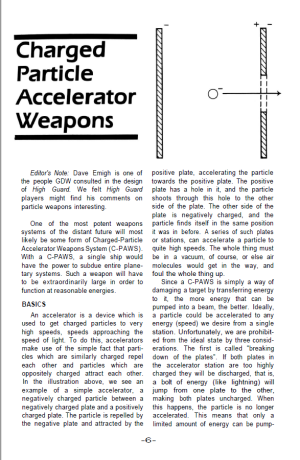
I've always assumed that the particle accelerator is - as is the case with our current PAs - a stream of charged particles (ionising radiation) like alpha (effectively a charged helium atom) or beta particles, which would explain why they interact so strongly with armour and would be terrifying to be on the receiving end of. It could be like modern medical PAs, such as proton beams.

None of these are necessarily the sort of unstable nuclei where manipulating the strong nuclear force will cause them to decay, as with nuclear dampers. As AnotherDilbert says, they're downstream from that: they're the radiation itself, not the pre-fissile material. We know that using a nuclear damper on a stable atomic particle like a helium atom, for instance, does not cause it to decay because you couldn't use it on a world that way: you'd be breaking down all the stable atoms around your target as well, and that does not sound healthy. It's canon that you can use a damper on a world to remove actinides and the like without reducing everything around them to quarks.
 
I've always assumed that the particle accelerator is - as is the case with our current PAs - a stream of charged particles (ionising radiation) like alpha (effectively a charged helium atom) or beta particles, which would explain why they interact so strongly with armour and would be terrifying to be on the receiving end of. It could be like modern medical PAs, such as proton beams.

None of these are necessarily the sort of unstable nuclei where manipulating the strong nuclear force will cause them to decay, as with nuclear dampers. As AnotherDilbert says, they're downstream from that: they're the radiation itself, not the pre-fissile material. We know that using a nuclear damper on a stable atomic particle like a helium atom, for instance, does not cause it to decay because you couldn't use it on a world that way: you'd be breaking down all the stable atoms around your target as well, and that does not sound healthy. It's canon that you can use a damper on a world to remove actinides and the like without reducing everything around them to quarks.
Charged particles are a possibility, but difficult to keep tightly focused since they repel each other. Particle beams out-ranging lasers would tend to undermine support for that supposition. Also, beams of charged particles are easy to steer -- ie, to defend against with simple magnetic or electrical fields.

I agree that Nuclear Dampers should have little to no effect on Gamma rays or X-Rays (those are just photons, and covered under the topic of 'lasers'), and that particle beams are unlikely to be streams of paired quarks (ie, mesons). That leaves us a pretty small pool of 'particle' candidates.
 
Charged particles are a possibility, but difficult to keep tightly focused since they repel each other. Particle beams out-ranging lasers would tend to undermine support for that supposition. Also, beams of charged particles are easy to steer -- ie, to defend against with simple magnetic or electrical fields.

I agree that Nuclear Dampers should have little to no effect on Gamma rays or X-Rays (those are just photons, and covered under the topic of 'lasers'), and that particle beams are unlikely to be streams of paired quarks (ie, mesons). That leaves us a pretty small pool of 'particle' candidates.
We already use particle accelerators that use beams of charged particles. We first built them in the 1930s, so by the heights of TL11 I assume that we've got the hang of them. Particle accelerators need the particles to be charged in order to accelerate them: the clue is very deeply embedded in the name. So presumably the eV involved by TL11 is so high that "I'll point a magnet at it" is impractical or some other handwavy reason. We know this because they are in the rules and they work and you can't counter them with a big magnet, or else those, too, would be in the rules.
 
The particle beam is presumably a stream of neutrons, but maybe not. Neutrons have a half-life of around 10 minutes; and they make the target radioactive by interacting with the nucleus -- either splitting it, or combining with it to make it heavier. All of these interactions ought to be affected by Nuclear Damper space-magic.
The induced radiation is presumably rather tiny, and can be killed by dampers.

The particle beam itself is ionising radiation that has nothing to do with dampers.


Cool find; where is that from? I did not see it in the Core Rules, and High Guard Update p 36 has this:
HG'22, p36.
 
Dampers affect the strong force (and the weak force) - the radiation produced by a particle beam impact that is EMR can not be affected by damper technology.

The particle beam causes secondary radiation effects:


basically the particle beam ionises the hull material that it strikes and drills into it and through it, these stray hull material ions and electrons have a huge amount of energy transferred to them which is re-radiated as EMR of high frequency - you get a burst of xrays, UV. Damper tech can not stop this as the strong force is not involved. The damper tech can prevent the disintegration of nuclei that would produce a much more intense burst of gamma rays, neutrons, pions and all sort of other subatomic nasties.

For maximum radiation effect you want to fire a beam of electrons, a beam of protons or neutral atoms will have a much lower radiation effect but greater impact potential.


Last edited:
Dampers affect the strong force (and the weak force) - the radiation produced by a particle beam impact that is EMR can not be affected by damper technology.

The particle beam causes secondary radiation effects:


basically the particle beam ionises the hull material that it strikes and drills into it and through it, these stray hull material ions and electrons have a huge amount of energy transferred to them which is re-radiated as EMR of high frequency - you get a burst of xrays, UV. Damper tech can not stop this as the strong force is not involved. The damper tech can prevent the disintegration of nuclei that would produce a much more intense burst of gamma rays, neutrons, pions and all sort of other subatomic nasties.

For maximum radiation effect you want to fire a beam of electrons, a beam of protons or neutral atoms will have a much lower radiation effect but greater impact potential.


As is always the case, if you have to have EMR interact with you, you want it to be gamma, then beta, then oh God please don't let it be alpha.
 
We already use particle accelerators that use beams of charged particles. We first built them in the 1930s, so by the heights of TL11 I assume that we've got the hang of them. Particle accelerators need the particles to be charged in order to accelerate them: the clue is very deeply embedded in the name.
So there are portable, simple magnets reliable enough to accelerate & steer the beams, and to keep them focused over tens of thousands of kilometers; but there are not magnets capable of deflecting them by even a tenth of a milliradian? As you point out, we do this with magnets and particles today -- and even earlier, TL-6 or TL-7. But Particle Beams (Bays and Spinals) do not appear until TL-11, so maybe they are neutral particle beams created, aimed, and focused by some (non-EM) process we do not use today.

So presumably the eV involved by TL11 is so high that "I'll point a magnet at it" is impractical or some other handwavy reason. We know this because they are in the rules and they work and you can't counter them with a big magnet, or else those, too, would be in the rules.
Sure, we can agree 'space-magic' -- lots of Traveller is like that -- but it kind of sucks that that is the go-to explanation for so much. And if you are evoking 'space magic, therefore charged particles', then 'space-magic, therefore neutral particles' makes exactly as much sense.

HG'22, p36.
It is not that way in my HGU 2022. I provided a screen shot of page 36.
 
So there are portable, simple magnets reliable enough to accelerate & steer the beams, and to keep them focused over tens of thousands of kilometers; but there are not magnets capable of deflecting them by even a tenth of a milliradian? As you point out, we do this with magnets and particles today -- and even earlier, TL-6 or TL-7. But Particle Beams (Bays and Spinals) do not appear until TL-11, so maybe they are neutral particle beams created, aimed, and focused by some (non-EM) process we do not use today.


Sure, we can agree 'space-magic' -- lots of Traveller is like that -- but it kind of sucks that that is the go-to explanation for so much. And if you are evoking 'space magic, therefore charged particles', then 'space-magic, therefore neutral particles' makes exactly as much sense.


It is not that way in my HGU 2022. I provided a screen shot of page 36.
Sure, you can call it space magic since it deals with physics at TL above the level at which we have hypotheses for at the current time, what with us being hundreds of years behind those levels. When we reach TL 11 we may have to change the rules of Traveller and I look forward to having to buy the new rulebooks. But for now, the rules do just fine. If you want to do YTU instead of OTU then you can do whatever you like. But in OTU, particle accelerators work and are not significantly affected by Big Magnets. Imagining that they should be is space wankery.
 
Mongoose appears to have redefined particle beams in Traveller as using subatomic particles - so you are restricted to electron beams or proton beams unless you invoke handwavium.

In previous editions space capable particle beams accelerated ions electromagnetically and then neutralised them as they leave the ship, thus the now neutral atoms will spread less and no longer be affected by an EM field. The neutral beam will ionise on impact causing a small amount of secondary radiation compared with an electron beam, but a high amount of kinetic/thermal and there would still be a burst of xrays, UV etc.

The atom of choice was hydrogen since the ship has a huge store, it is easily ionised and accelerated to near c speeds.

By TL11 in universes that have gravitic technology (T2300 has particle beams but not gravitics for example) then perhaps it is a gravitic field that accelerates the particles, you could then use any atom you want.

A beam of neutrons is problematic - you can't accelerate them electromagnetically, not to mention where are you going to get all those free neutrons from in the first place.
 
Thanks for clearing up the page reference!

Of course, this opens up a whole new can of worms. Notice the Multi-Warhead Standard Torpedo carries (in the same volume as four Standard Missiles) three sub-munitions, each of which does exactly the same damage as a Standard Missile -- but the Multi-Warhead Nuclear Torpedo sub-munitions do less damage than the Nuclear Missile. The way torpedoes are currently written makes them a seriously bad choice compared to missiles.

But never mind all that; I'm tired. My opinion on Mongoose play-testing and editing is already a known quantity.
 
Notice the Multi-Warhead Standard Torpedo carries (in the same volume as four Standard Missiles) three sub-munitions, each of which does exactly the same damage as a Standard Missile -- but the Multi-Warhead Nuclear Torpedo sub-munitions do less damage than the Nuclear Missile.
Multi-warhead missiles/torps can be devastating; they are presumably balanced for damage through defences, rather than what looks good at first glance.


The way torpedoes are currently written makes them a seriously bad choice compared to missiles.
For complete ship, inflicting damage through defences and armour, I believe they work as intended: For large ships launching thousands.

And then the Anti-Torpedo Missile wrecked everything...
 
Back
Top