
Number of staff in Commercial Zones on Space Stations

Sageryne

Emperor Mongoose
Hi all,

I have been working on a space station design and have come up with another quandary. How many people work in a Commercial Zone?
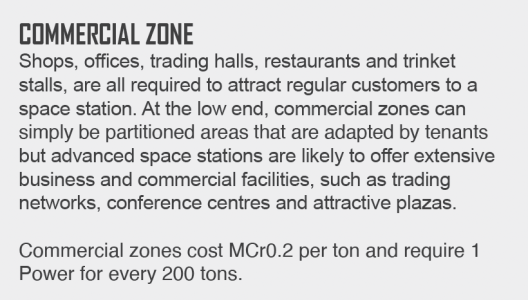
Screenshot 2026-03-13 at 10.28.09 AM.png

The rules detail tonnage and power requirements, but how many people work there.

The best I could come up with is a store being 20-dTons and 2 employees per store, for 1 person per 10 dTons of Commercial Zone.

Any thoughts, perhaps other references that could improve that?

- Kerry
 
Labor is an expense, so for some things you'd expect automation and vending machines to be used where it made most sense. Small shops will run the gamut of 1-person operations, to multi-person operations. Your biggest driver is going to be how much credits the store might be able to make and what the shop is selling. A place selling clothing might have a single merchant in his stall. A location selling higher-priced items like jewelry may have 3-5.

Does the shop sell something that needs/benefits from having more people present (i.e. sales or some sort of customer service needs)? Or can a single person run the cash register equivalent and stock the store? Another example is a store front that sells weapons, missiles and components. You won't be taking a shopping cart in to pick up your 12 pack of missiles. You'll have a counter, and maybe small meeting areas where you can discuss your armament needs, close the deal and the equipment gets delivered to your ship at the docks.

Best way to address this is think about how you would like to be served in a shop of that sort. Use real-world examples of stores you've been to and how many people you saw in there, how many employees were about, and you'll have a start to your model. There are also many good books or tv shows out there showing the same thing.

As with your other question, don't rely upon straight formulas. You are building a setting, so make it a setting. Babylon 5 makes for a good example of station life - it's high tech, but no food converters or things like that. People (and aliens) shopped, played, gambled and worked there. You wouldn't be far off using fantasy (aka D&D) examples of shops or floorplans of things like that. Similar issues - cramped but workable conditions.
 
Hi phavoc,

You make several good points. At this point, I haven't reached the point of figuring out what will be for sale in the commercial zone. I am currently just "grossing up" the space station to get an idea of how many people live there so I can calculate how many residential units I will need.

I am using Babylon 5 and Deep Space 9 as examples.

- Kerry
 
Hi hopsnbaer,

I was thinking they would be open 16 hours a day, with each person working an 8 hr shift. Like phavoc suggested, I think a lot of places would have vending machines and robots to provide 24 hour service.

Arkathan said:
I go with the four dton professional space. One person per four tons allocated.

That could work. If you assume a store of 20-dTons, that is 5 staff, if the store was open 24 hrs a day, that is three 8-hr shifts, plus leave, training, management, etc.

- Kerry
 
Hi hopsnbaer,

I was thinking they would be open 16 hours a day, with each person working an 8 hr shift. Like phavoc suggested, I think a lot of places would have vending machines and robots to provide 24 hour service.


That could work. If you assume a store of 20-dTons, that is 5 staff, if the store was open 24 hrs a day, that is three 8-hr shifts, plus leave, training, management, etc.

- Kerry
Yeah, I like the reduced service for at least part of the day. It works better for me. Maybe a busy Type A on a hub would be like Vegas that never closes.
 
Could be cultural, and business model.

Amazon ran an experiment where the customer walked in, and just took what they wanted, while monitored, in theory, by an artificial intelligence stock keeping programme, that charged them automatically on exit.
 
Rank according to density (staff per dTon):
Trinket Stall = Highest
Offices = Higher
Retail Shops = High
Restaurants = Nominal
Warehouse / Wholesale Shops = Low
Conference Centre = Lower
Plazas = Lowest

Also would be dependent on size of commodity being showcased/exchanged.
Commodity sizes:
Smallest
Very Small
Small
Smaller
Average
Larger
Large
Etc.

Then chose numbers to reflect these qualities.
 
Hi hopsnbaer,

I was thinking they would be open 16 hours a day, with each person working an 8 hr shift. Like phavoc suggested, I think a lot of places would have vending machines and robots to provide 24 hour service.


That could work. If you assume a store of 20-dTons, that is 5 staff, if the store was open 24 hrs a day, that is three 8-hr shifts, plus leave, training, management, etc.

- Kerry
If it’s a space station with people coming and going constantly (a ship jumping in from another system whose primary has a different day length and different reference time zone is unlikely to be working the same 9-5 as you!) then anyone not serving 24 hours a day is simply passing up trade.

Obviously, a mom and pop place might well work a shorter day, but are they really going to have space on an orbital?
 
Hi hopsnbaer,

I was thinking they would be open 16 hours a day, with each person working an 8 hr shift. Like phavoc suggested, I think a lot of places would have vending machines and robots to provide 24 hour service.


That could work. If you assume a store of 20-dTons, that is 5 staff, if the store was open 24 hrs a day, that is three 8-hr shifts, plus leave, training, management, etc.

- Kerry
Stations, like starships, would work on a 24/7 model. I though Cherryh's DownBelow Station did a good job on the station side explaining things. They used a Mainday/Alterday cycle (12/hrs each), with the Mainday corresponding to normal 'day' and Alterday being 'night'. Operations were shift-based, but the station itself would have more business and such open during Mainday.

The book also had the station more or less physically designed so that the docks, or the outer hull of the station, were more likely to be opened for longer stretches, some as many as 18hrs/day (with some places open 24hrs) to accommodate ships and their crews who would be possibly docking and working much different times than the station itself. The areas that serviced station personnel primarily adapted to their schedules.

So that's something also to keep in mind. Busy transit hubs will have shops open 24/7 because traffic to/from station knows no closing times. Smaller stations with less ship transient traffic are more likely to adopt a set of regular hours. Just like regular stores you would have shifts of labor so long as it made economic sense to keep them staffed. Having off-hours for a station also allows for some downtime for maintenance and cleaning when having people around or systems online would interfere.
 
If you want some really good descriptions and designs for stations I would highly recommend the Age of the Solar Clippers stories by Nathan Lowell, as they are all about trade and interacting with different stations. I don't recall if he ever discusses hard numbers, but you should at least get some good ideas from them.
 
I would staff it based on similar criteria to residential housing. Lower status commercial districts would have (roughly) 1 staffer per 2 dT of commercial zone, Medium status would mean 1 staffer per 4 dT, High class would be 1 staffer per 6 dT, and Luxury shops would have 1 staffer per 10 dT. (The higher-class and more exclusive a shop/office/whatever is, the more they use the space to show off for clients/customers.) It's a working rule of thumb and largely an average across the entirety of the commercial spaces of the station; some people will prefer a smaller, cozier footprint, but they'll be counterbalanced by those who a flashier and splashier presentation.
 
Depending on the purpose of a station, it might be deader than Archduke Dulinor after 2200 Zulu, with just the legally mandated man and dog [1] standing watch in ops. A starport, on the other hand, is a station that never sleeps, because incoming traffic arrive at whatever time the gods of jumpspace see fit to drop them in system, and the crew will want their Astroburgers now (and a hotel room right after that).

[1] The man is there to feed the dog and the dog is there to bite the man if he tries to touch the controls.
 
Only tangentially related to the original post, but how much would commercial areas bring in per dton? Swank boutique stores would have higher costs to build and run (looking at you, luxury spaces) but would rake in lots of cash for the expensive clothes, jewelry, and such.
 
Cherryh's The Company Wars books have some developed space station settings in them; if you want them to be interesting places it makes sense to do what she does and give them unique character and little micro-societies of their own. There's the original design and intention as a starting point, but like a city the people that live there will make it their own. So start with the original design and then decide how things have gone since it was built; the answer to "how many people work there" depends on the history for it you invent.
 
The opening times will establish the character of the port. Many cities are "open" 24/7. That means you can get a burger at 5am, however that does not mean every restaurant needs to be open at 5am. Many hyper markets open 24/7 but they are often described as characterless. With fabricator technology, auto chefs etc. there will be a lot more vending machines to cater for that 5am trade.

Some places need a sophont. There will probably always be a bar open (unless local regulations limit opening times for some reason) and many public service desks (library, hotels, brokerage etc) will have at least a skeleton staff 24/7. If you want to talk to a manager though you might be limited to a specific shift.

For services with sufficient 24/7 demand you might find different providers offering complimentary opening times to reduce the impact of competition. You can get a "karfee" from a sophont barista at any time, but "Sunbucks" is open from "0700-1700 local" and "Constellation" is open "1700-0700 local".

Swanky trade tends to aspire to exclusivity and that might mean they open at specific times as a style decision. If you can't arrange your schedule to align with one of their consultants then you are not the sort of customer they are interested in (their schedule will be more flexible for a sector duke that some rando murder-hobo Travellers of course).

Many craftsmen might operate on an appointment only basis to maximise their effective earning time. I know plenty of specialist shops that open when the owner feels like it. Some are destination shops that don't appear to generate enough trade to stay open (often they are more of a warehouse for online trading that you are allowed to browse in occasionally).

Even in a 24 hour station there may be ebbs and flows (if the station is geostationary then it might still have a natural day/night schedule). New York City is the city that never sleeps. I am sure there are still plenty of businesses that run 9-5 (or 7-11) hours and plenty that open really quirky opening hours. Whilst passengers may arrive at any time in a space station the day/night cycle of the planet might still influence the operation of anything that needs to interact with planet-side suppliers, workforce etc. Conforming to this notional day/night cycle might also be a style (or power saving) choice. The "park" for example might only be open during hours of natural daylight, and the astrotarium might only be open at local night. Some facilities will be catering to dirtsiders who are just visiting the port as a day out as well as off-worlders.

If there are only 2-3 customers per day needing your services then it is more efficient to limit your opening hours. Being closed only impacts passing trade and there probably isn't much of that for a bespoke tailor for example. If you need a suit you will make appropriate arrangements.

So generally the stack it high and sell it cheap places might be open all hours (and will have more shelf stacking robots than sophonts to interact with to minimise overheads (sophonts demand wages, droids just need power). "Marco's bespoke hair styling" will have very specific opening times and other shops will be somewhere on the spectrum.

Traditions that developed on the world might permeate the station through habit (or religious enforcement). Not all of these traditions will translate to advancing technology in ways an outsider might consider logical. If your religion has defined that you must pray for an hour at sunset, the interpretation of that rule on a space station might be complex (and interesting). These things will make the station unique to the players.

As with any question the key decision is not what are the rules (as there aren't any) or even what is credible (since many of our current assumptions will not hold in a space setting with robots and print on demand), but what helps the story you are trying to tell. The space port is a living entity and the shopping district is one of it's vital organs.
 
Earnings for a commercial space will depend on market, who you're trying to sell to, throughput, how often you can expect to encounter someone interested in what you're selling, and the available income that clientele has.
A small diner catering to station personnel may be open only around shift changes, but it has a reliable client base and a good idea of how much they have to spend on the convenience of good food they didn't have to prepare themselves. You'll probably find this sort of cafe/diner on any free trade station and if it's a busy station they'll could easily be open 24/7 and make a steady income that keeps a half dozen to several dozen people employed with income sufficient for each to support a small family in minimal comfort.
A bespoke jeweler and their partner on the other hand may only be open by appointment at the workshop/office, which may only be standard salon sized at 4 dTons, but every time a high liner docks they can pull in enough income from the rich folks needing to be trendy while in the system that they live well enough to take a vacation themselves every year and not worry about the time the salon is idle.
So in response to your question, it really varies depending on the volume of traffic, the wealth of said traffic, and the needs of the station itself. As a general rule, perhaps say 1 unit of yearly income sufficient to support 1 person per dTons of commercial space multiplied by a value based on the quality of the space and trade value of the station, starting at basic level spaces with average trade value being x1 up to luxury spaces in very high value stations being x10 or more.
 
Back
Top