Military ships and crew

Sure. Knock yourself out providing basic passage.
You missed the point. It is a one man ship. No passengers, maximum cargo. The owner/operate lives in the single ton of barracks during flight.

One thing I didn't mention is the fuel tank only includes fuel for J-1 but the other half is in a mountable 20 dton fuel tank so it can be operated as a Far Trader with 124 tons of cargo or a Free Trader with 144 tons if the tank is removed.
 
No, I did see that as well, and commented on it.

The operator is deliberately subjecting themselves to what amounts to a prison cell for their living space. But as I also mentioned, they might find it tolerable if they basically live on the bridge... unless you've gone with a Small Bridge as well. That would end up something like being locked in a sleeper cab for a week, repeatedly, with only a couple of day's respite every fortnight. Unpleasant, but I guess doable.
 
No, I did see that as well, and commented on it.
You also said:

Knock yourself out providing basic passage. But last time I checked basic passengers are less profitable than freight, once you take into account life support requirements (Cr500 per ton of Barracks plus 1k general life support cost per person actually on board

When it is only 1 ton of barracks, no passengers at all.
 
I was just covering all bases and checking my numbers. But don't get me wrong. I'm not saying it's wrong or that you shouldn't do it. Just pointing out why it's probably not a popular starship design in general.

But I could see it being more tolerable and common for short to medium haul system craft. A couple of days in flight from one inner system planet to another. Very much like a long haul trucker.
 
Last edited:
Some people like confined spaces just as some can't tolerate them. I don't see this as a major ship category, more of an outlier. I've worked on them for 100, 200, 300 and 400 tons with a straight J-1 design that would compete with the Subsidized Merchant for runs that didn't need passengers carried (they might need more cargo capacity but have 1 or more conventional ships carrying passengers already).

I have a different solo ship with a high stateroom and some luxuries for a pilot who does like comfort but also likes his solitude (and doesn't want to cater to passengers). Owned by an NPC that will likely never be used.
 
Some people like confined spaces just as some can't tolerate them.
Yep. I can relate to that.

Even if you do compare it to being in prison, some first world prisons until quite recently considered that to be perfectly acceptable. Oxford prison for example had cells 3.35m x 2.4m (just under 2 DTon). This was a shared cell and in some wings prisoners might spend 23 hours in their cell. They also didn't have access to 21st century entertainment.

As long as you can go for a walk down the access corridors to engineering, through the cargo bay and the like and there are things to do I think you could stand it for the normal jump cycle of a few days off every 10 days or so. It is like working deployed, 8-10 hours in a cubicle then a drive to the hotel, eating takeout while watching tv in a tiny room and then sleep until breakfast when the cycle starts again. I've done that for three weeks at a stretch and whilst I got cabin fever in the third week I am not used to it.

I see nothing to say that converting between functions of the fuel/cargo container requires a dockyard. If they can be re-configured in space then once you had jumped you could use the additional space for recreation. So a few days (or hours) after take off you could have an extra 20 DTons to spread out into. Even if it takes you a day to reconfigure it, you have not much else to do in Jump-space. It could be a squash court, running track, or by allocating some space to collapsible furniture you could turn it into a proper rec/dining room. You only need put it all back when you are dirtside refuelling.

That would make a small barracks style staterooms even more tolerable. It might also improve the quality of passage for Basic Passengers who could also use that space (though servicing the area before refuelling might be more involved).
 
Another thought.

Standard 21st C vehicles are set up with a passenger seat next to the driver, often with a middle seat option if it's a bench design. Even on vehicles like trucks that are only expected to be operated by one operator. It just makes more commercial sense in most cases to use that design and offer the possibility of a plus one, rather than using a single operator cab - those only really get used on specialist equipment, or small vehicles like bikes where balance is critical.

So yeah. It does make sense that by default, full staterooms are used instead of barracks or half-size staterooms (which are a 2 ton thing, worth considering if you want to save space but retain comfort, or to increase privacy). And certainly on any Standard Design.

I'd also want to see if there really are any savings here. If the single barracks ship is a bespoke design, it's going to be more 10% more expensive, ton for ton, than a standard design, although obviously in YTU you can designate any design Standard. But if this is meant to be a niche appeal ship, it should probable remain bespoke or uncommon, IMHO.

If you're renovating a standard design by replacing staterooms with cargo, you would only profit from that over time; the staterooms were paid for when you bought the ship, and you may not get much back for them. And of course there would be costs involved in ship alteration.

It might work out better to retain one stateroom than to rip it out and replace it with a barracks.
 
Last edited:
It might work out better to retain one stateroom than to rip it out and replace it with a barracks.
It depends if you actually rip it put or just put in another partition or just store 3 DTons of breakbulk at one end.

Lets say you remove the stateroom and cannot reuse any of it. This costs nothing to tear out but you effectively lose KCr500 worth of value. You fit a small 1DTon barracks and use the rest for 3DTon cargo. I normally rule that retrofitting costs an extra 10% so that is another KCr55 for the barracks but the cargo space is free.

If we take out another mortgage for the refit we can insulate the calculation from the rest of the ships monthly costs (the ripped out stateroom is a sunk cost as the original mortgage doesn't change). That new KCr55 mortgage is going to cost us a shade under Cr230 per month. We should be able to make at least 2 jumps per month and those 3 extra DTons of cargo will each get us a minimum of Cr1000 per jump. So before it gets too complex we are over Cr5750 per month up on the deal. We are also saving the maintenance costs on the difference between a stateroom and a barracks. That 1% of the KCr450 difference while not much still saves Cr450 per year. We also save Cr500 per month or another Cr6000 per year on the room life support costs (the Cr1000 per person doesn't change). Overall that gives us over KCr75 extra per year.

When we decide to sell the ship it might be deemed worth MCr0.5 less than it would have been but we would probably only get 80% of its value anyway* so it is really only MCr0.4 by that point.

So after just over 5 years the change will have paid for itself. Over a 40 year trade career it will have made an extra MCr2.5 over the stateroom version.

The costs won't get higher, but your 3 Dtons of extra cargo might well bring in more than Cr6000 per month if you are making longer jumps or using it for speculative trade (or low berths) and thus that MCr2.5 might be higher.

* A 40 year old star ship can be bought for 80% but it would have quirks (maybe the barracks would be one of those quirks). Whether you could actually sell one for 80% of its purchase cost is another matter. The difference in second hand-values of the two variants might be marginal.
 
Last edited:
Yeah, I agree with no costs and piling up crates in the stateroom. I'd expect you could get away with a couple of tons that way (maybe not three, given the geometry of a standard 2 by 3 stateroom. The two squares allocated to access space probably should be kept clear). Someone prepared to put up with barracks would probably be fine with that.

Finding a buyer might also be a challenge, at least one willing to pay nominal value.
 
Last edited:
If the design is amicable is the key. If the walls and doors are left in place, you start running into awkward cargo handling issues, so normally you'd remove those as part of it.
 
Internal partitions and bulkheads (other than for some specific components) are not part of the design rules and entirely at the whim of the designer when drawing the deck plan. Nothing gets in the way (or protects you from decompression) unless you want it to. Deck plans have varied from edition to edition so arguing a design is "standard" is a bit arbitrary as well. If you are building your own ship rather than using the default ships from the books (which are often not that efficient - or sometimes even correct) then you are not saving that 10% anyway so you might as well build it in from the get go.

As for retrofitting, HG p70 is quite explicit. Staterooms are a minor refit. Changing them costs 110% of the NEW component so removing a stateroom to fit a barracks and 3 cargo costs 110% of the cost of the barracks and cargo space. There is also the opportunity cost from lost availability while the refit is conducted, but for most small ships it will be around a week. As a new-to-you purchase that is just wait time.
 
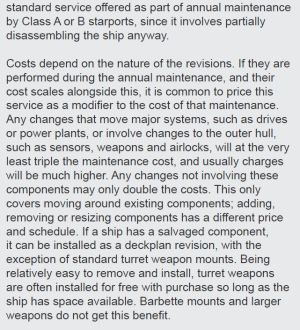
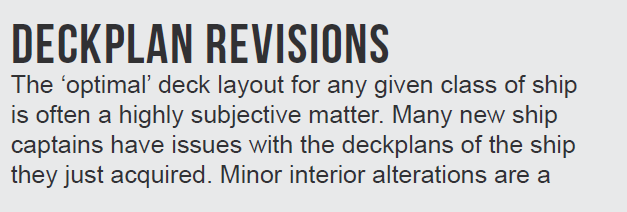
SOM discusses this a bit too. Since annual maintenance involves a lot of stripping systems down and putting them back together, it's a good time to reorganise rooms, strip out components and such.

1768951326248.png
1768951301861.png

Note that that is only talking about moving things around rather than adding new stuff. But it would be a good opportunity to do that stuff, at the HG prices. If you were to swap a 4t stateroom for a 4t lab that's just the HG rule. But if you wanted to move the low berth bay to the cargo area and turn the low berth area into cargo, or to change the location of an airlock, use this. If the refit involved both things, use both.
 
Last edited:
SOM discusses this a bit too. Since annual maintenance involves a lot of stripping systems down and putting them back together, it's a good time to reorganise rooms, strip out components and such.

View attachment 7246
View attachment 7245

Note that that is only talking about moving things around rather than adding new stuff. But it would be a good opportunity to do that stuff, at the HG prices. If you were to swap a 4t stateroom for a 4t lab that's just the HG rule. But if you wanted to move the low berth bay to the cargo area and turn the low berth area into cargo, or to change the location of an airlock, use this. If the refit involved both things, use both.
And you could sell the removed components at some fraction of the base price.
 
Possibly. The p72 HG rules give a 10% cost to remove a minor component... the contractor may well get the salvageable parts of the old component as a customary perk, same as building contractors often do. If the crew does their own refit, I guess they get the spares. But it's very much in YTU, or even world to world variance.

For example, Efate might enshrine ownership of removed fittings as a normal part of the refit contract, needing it to be renegotiated if the owner wants to retain them; while the way they do things at Mora is that the owner is obliged to handle fitting disposal out of their own pocket (the robot mechanics don't care).

If you remove a stateroom, you're probably left with a couple of disassembled walls, a fresher, a bed and a console, a whole lot of cables and plumbing and several odd parts. Some of them may be significantly worn and unsuitable for reuse. Other parts, especially life support and hygiene related may be due for replacement anyway. It will all likely need significant cleaning and decontamination.

But you may be able to find a buyer, maybe in the Estuary Cluster... ;)

(Full disclosure - we had our bathroom and toilets replaced last year, so I may have that experience in mind)
 
Last edited:
For the specific example of replacing a stateroom with a barracks many of the fittings could be re-used if the customer is content with that. Depending on the layout of the stateroom you might not even have to remove some of them at all and simply move the partition closer to them).
 
IF your ship is a troop transport, or say an assault transport, the use of barracks is ok. BUT, that concept has it's limits. A transport is going from point A to point B. It's also supposed to be time-limited.

I disagree with the idea that ships marines/ships troops who are stationed aboard a ship should be classified different than ships crews. They shouldn't be considered the same as troops that the ship is temporarily transporting as passengers. Marines assigned to a ship have a function - they just aren't performing it all the time. Kind of the same as a ship's pilot, gunner or navigator - once the ship is in jump space then they too could be considered having no other function aboard the ship. After all, you can't pilot, navigate or shoot while in jump space. You CAN, however, train, maintain or do other tasks - the same is true for the non-passenger contingents of ships troops / marines.
First define Time-Limited some of the troops going to FFW traveling from Corridor were on ship for close to a year. Plus Marines assigned to ships are routinely placed in Barracks in Traveller ship designs. Then you have ships like the Mercenary Cruiser where the ship is home and they spend years on ship going from mission to mission. Plus if they are passengers and only on ship for short duration doing nothing but waiting for drop why have training facilities? Your logic doesn’t work.
 
I would certainly not object if the rules were re-written to say that only basic passengers (such as embarked troops) could use Barracks, but once you explicitly include marines and "ships troops" and vague comments about "other function" it all becomes a bit random.

Alternatively provide some actual rules as to the effects of cramped accommodation on people. Basic passengers can be carried in 2 DTons of empty space of any kind (corridors, common space, cargo etc.).

You are still paying Cr500 per trip in life support for every passenger. You are only charging Cr2000 per jump per basic passenger. If you need to allocate 2 Dtons for each of them it is more cost effective to carry cargo at Cr1000 per DTon and have no life support cost.

A low berth / medical chamber takes up only 0.5 DTon so that is how much space a bunk should take up. I am also pretty sure I read somewhere about crew niches (1 Dton accommodations for regular crew) but that might have been an unofficial rule and I cannot recall where I read it.
 
Back
Top