Imperial Battleships

The concept wasn't exactly secret.

The first one to conceive of it was an Italian, the Japanese Satsuma and American South Carolina classes could be considered competitors, except that Fisher had the resources to push his vision first and fastest.

Hindsight says that if the British had developed a triple turret, they could have with a broken deck, had placed the turrets at positions A, X, Y, with nine guns, along the centre line, without really requiring superfiring.

Traveller predreadnoughts, could be armed with a mass driver or railgun spinal mount.
 
The same Christmas (1980) that I got Traveller, I received Avalon Hill's Jutland, so how about that? (I'd asked for either, was more enthusiastic about Jutland but got both and... the rest is history.)

Things moved so rapidly, that Dreadnaught (which was a single ship class) was only the best battleship in the world for 17 months, when its near-sister ship HMS Bellerophon was launched (followed by the other two ships in THAT class over the next few months. Though admittedly, the differences between the two classes were fairly minor). And that basically continued, with the RN adding about four ships a year for some time, each class being fairly similar but making changes.

By the battle of Jutland in 1916 which involved 28 battleships and 9 battlecruisers, HMS Dreadnaught was not exactly obsolete, but was well outclassed by more modern designs (especially the likes of the Queen Elizabeth class). As it happens, Dreadnaught was being refitted at the time of the battle and missed it.

Nine years is all there was between the launching of Dreadnaught and the battle of Jutland.
 
I kept my pedantic daemon under control so far, but since there seems to be a 50-50 split in what people are saying in this thread: it was HMS Dreadnought. The Dreadnaught was an American tug which totally failed to redefine the balance of naval warfare between the great powers in the first half of the 20th century.
 
I kept my pedantic daemon under control so far, but since there seems to be a 50-50 split in what people are saying in this thread: it was HMS Dreadnought. The Dreadnaught was an American tug which totally failed to redefine the balance of naval warfare between the great powers in the first half of the 20th century.

Thanks for the correction. I had them reversed. 👍
 
You want to talk about being sold a fake bill of Dreadnought goods... I bought Massie's Dreadnought thinking it was going to be over 1,000 pages on the ship itself.

Nerp...

I got a CHAPTER on the ship itself. The rest was all about the tow-headed cousins in Europe who were playing the Game of Thrones and couldn't be bothered to be peaceniks.

It actually was a fairly good book, though it took me a while to get over my buyer's remorse. Eventually I did and bought the sequel, Castles of Steel.
 
Whups. My apologies. I'll leave my posts uncorrected to expose my shame regarding the spelling.

Maybe if it had been at Jutland I might get it right. But I can't reliably spell Bellerophon or Temeraire without checking either... ;)
 
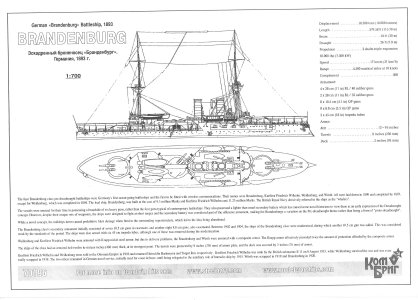
is70196_Brandenburg-1.jpg


You'll note three turrets of same calibre, though one set is shortened.
 

Attachments

  • is70196_Brandenburg-1.jpg
    is70196_Brandenburg-1.jpg
    886.8 KB · Views: 0
Historically, light battleships, as opposed to battlecruisers, are second class.

Depending which version you are familiar with, the Sylea class battleships are supposedly a hundred kilotonnes.

Classical understanding is that a frontline battleship is two hundred kilotonnes.

If convention is that first class is a previous generation of frontline battleships, than you're looking at something upto two hundred kilotonnes, manoeuvre drive factor/five, jump factor/three drive, and likely minimum factor/ten armoured hull.
 
Last edited:
Historically, light battleships, as opposed to battlecruisers, are second class.

Depending which version you are familiar with, the Sylea class battleships are supposedly a hundred kilotonnes.

Classical understanding is that a frontline battleship is two hundred kilotonnes.

If convention is that first class is a previous generation of frontline battleships, than you're looking at something upto two hundred kilotonnes, manoeuvre drive factor/five, jump factor/three drive, and likely minimum factor/ten armoured hull.
Depends in the era. The US built 'light' South Dakota class battleships, and then built the follow-on Iowa class. South Dakota class was notably inferior in armor protection, but had same guns and speed as Iowa.

Historically light battleships were built for various reasons - cost and speed being the main. One could argue that the WW1 era battle cruisers were essentially light battleships, or at least some like the RN were. As they discovered, ships with battleships class main guns and enhanced cruiser level armor don't belong in the line of battle fighting battleships.

Traveller is different though since the weapons technology is so much different. Rather than having bigger guns they simply add more guns. So aside from a spinal mount your 50k dton heavy cruiser may be a dupe of a 150k dton battleship except for having few weapons.

To the ops question, there doesn't really exist a ships book for 1st class battleships. For the Imperium I'd expect 1st class ships to be TL15, but they may differ from that depending on their planned missions. A 'light' Imperial battleship might trade armor for jump factor, but anything is possible in the game.
 
It's always a rather controversial discussion, if the Iowa class are actually battlecruisers.

Having had a number of years to consider the issue, I've come to the conclusion that a battleship is a balanced equation of speed, protection, and firepower, whereas a battlecruiser emphasizes speed and firepower, and compromises protection.

As far as I can tell, most (current) light battleships have the same balance, but scaled down, in order to fit into rather niche roles or environments, whereas mainstream battlecruisers would have the same tonnage as the current battleships, but with less protection, though substantially faster.

Since this is a game, with made up technology, it's hard to be definitive as to what would constitute exactly the qualifications of starwarships categories.

However, by technological level fifteen, speed can be equivalent for battleships, without requiring the compromises that would have split capital ship classes up, since it tends to hinge on percentages being more efficient.

The thirty five kilotonne Scharnhorst class of the Great Patriotic War era, built in the mid Thirties, despite being at the upper end of existing Treaty tonnage limits, would be considered as light battleships.
 
It's always a rather controversial discussion, if the Iowa class are actually battlecruisers.

Having had a number of years to consider the issue, I've come to the conclusion that a battleship is a balanced equation of speed, protection, and firepower, whereas a battlecruiser emphasizes speed and firepower, and compromises protection.

As far as I can tell, most (current) light battleships have the same balance, but scaled down, in order to fit into rather niche roles or environments, whereas mainstream battlecruisers would have the same tonnage as the current battleships, but with less protection, though substantially faster.

Since this is a game, with made up technology, it's hard to be definitive as to what would constitute exactly the qualifications of starwarships categories.

However, by technological level fifteen, speed can be equivalent for battleships, without requiring the compromises that would have split capital ship classes up, since it tends to hinge on percentages being more efficient.

The thirty five kilotonne Scharnhorst class of the Great Patriotic War era, built in the mid Thirties, despite being at the upper end of existing Treaty tonnage limits, would be considered as light battleships.
Insofar as USN designs went, I think it's safe to say the South Dakota and Iowa classes are true battleships, while the Alaska class was the never-to- be-called battlecruiser class, similar to Scharnorst class. Generally speaking the design's for various navies battlecruisers varied. They were cruiser killers but none could stand up to a full-up battleship of the same era.

Like any ship, naval architects have to balance cost and capabilities against intended mission of the vessel. Most naval architects don't have the luxury of min-max designs like gamers tend to make.
 
As a term, as with the older "ship of the line", it's most useful in terms of opposing forces.

If the ship in question is able to operate as part of the main battle fleet in opposition to similar main battle fleet, it's probably fair to use the term battleship.

"Cruiser" for that matter was not originally a class of ship, but a mission statement. Cruisers could be frigates, or ships of the line (often third rates). What made them cruisers was operating away from a fleet. In the 19th century the mission became a ship type, as the powerful ships became less and less likely to operate on independent cruises and purpose built cruiser ships evolved.
 
Last edited:
As a term, as with the older "ship of the line", it's most useful in terms of opposing forces.

If the ship in question is able to operate as part of the main battle fleet in opposition to similar main battle fleet, it's probably fair to use the term battleship.

"Cruiser" for that matter was not originally a class of ship, but a mission statement. Cruisers could be frigates, or ships of the line (often third rates). What made them cruisers was operating away from a fleet. In the 19th century the mission became a ship type, as the powerful ships became less and less likely to operate on independent cruises and purpose built cruiser ships evolved.
Ships fought in a line for reasons. During the age of sail cannons were direct-fire and you had almost zero ability to shoot at anything other than next to you.

Once turrets and ballistics became a thing, ships still tended to fight in a line for gunnery purposes. But in this era being able to cross the 'T' because a thing that every captain sought out, if possible. Now ships at the front or back, or even in the secondary lines, could all potentially range on the same target. Never quite worked out that way in naval battles usually. After WW1 we didn't see a lot of surface task forces attacking each other except for a few instances in the Pacific between major IJN and USN combatants. Other than the chase for Bismark the Atlantic really didn't have major surface battles. DD's and torpedo boats would skirmish, but they aren't capital ships.

As far as class names go, I agree that things have changed from age of sail up to the digital age. Very few navies are building 'cruisers' anymore, it's all destroyers or carriers it seems. But I think the mission of a cruiser remains constant, as would the other classes, so I'm ok with keeping the names tied to the missions.

One interesting question is how exactly would a 52nd century task force fight its opponents? Since space is 3-D I'd expect you would stack your ships vertically and horizontally in order to clear firing lanes for energy and missile weapons. Because missiles have to live in newtonian space like the rest of us it's impractical to fire weapons from the side of the ship that's not facing the enemy. I wouldn't say impossible, but it would require missiles to essentially be small space craft in their maneuvers. Traveller doesn't really model firing arcs anymore, but some ship configurations would lend themselves to better being able to bring the majority (or all) of their weapons to bear to a target in front of them as opposed to say a spherical ship. Pro's and con's to this as a sphere could rotate and bring undamaged weapons and armor to bear during the fight - though I think I'd prefer to have all my weapons to start and get as much damage as quickly as possible than hanging around longer. However since we have no actual data all we can do is duel with theories as to which is best.
 
It's not so much the "fighting in a line" thing as "fighting in a group".

Age of sail ships adopted line tactics because their cannon were mostly firing to broadside.

Late 19th and early 20th century ships retained line formations mostly for the same reasons, although turrets provided a bit more flexibility. But pre-radio, ships still needed to sail in close formation as all signals were still visual.

By WW2, battle groups no longer needed to sail in line; radio communications meant command could direct individual ships and looser fighting formations were practical. Aircraft had also shaken things up, so looser formations were better for defense.

In space, unless you go out of your way to impose technology that requires some kind of line formation (i.e. David Drake's Honor Harrington books), it's not really a thing. There's no reason to have ships close enough to each other for them to get in each other's way, and in any case they're assumed to be in constant secure communication with each other, so if one does need to move to the side a bit, that is easy to adjust.
 
Approach depends on velocity, weapon systems, and orientation.

Since Traveller starwarships of the line tend to be armed with a spinal mount, orientation would be mostly frontal facing, with, presumably, a forty five degree off bore leeway.

Somewhat analogous to ramming, or jousting, with the vessels in constant movement, to maximize their evasion.

Velocity and direction indicates how long the encounter will last.

Of course, you could design a battleship with the manoeuvre drive installed at a right angle to the spinal mount, which would constitute a broadside.

Barring an installed spinal mount, and assuming that bays aren't constricted in their arcs of fire, could easily fly parallel to the enemy formation for broadsides.

You could also flip the ship, and coast sideways, to do the same for a frontal facing spinal mount, though I would suppose evasive manoeuvres are going to be crimped.

As regards to ship category terminology, likely a political question.
 
Age of sail ships adopted line tactics because their cannon were mostly firing to broadside.
Plus, if I understand, their cannon were much more accurate in azimuth than in range. Cross the T on someone and their is a good chance your broadside will devastate them.

(I read that in the instructions for *Wooden Ships and Iron Men*, if I recall.)
 
Back
Top