And a few additional tweaks (including raising the tonnage) for the Emperor Hiroshi.
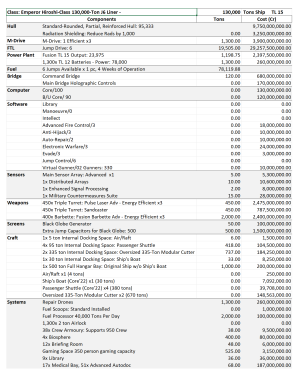
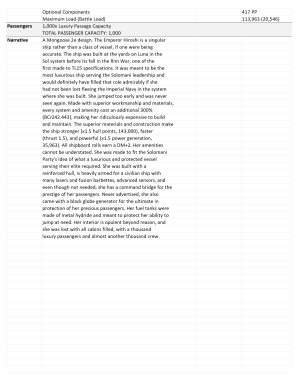
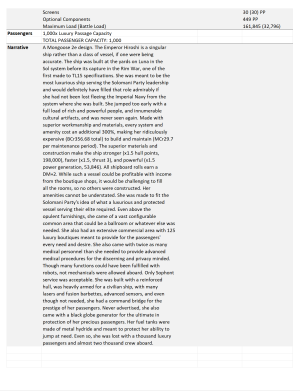
A Mongoose 2e design. The Emperor Hiroshi is a singular ship rather than a class of vessel, if one were being accurate. The ship was built at the yards on Luna in the Sol system before its capture in the Rim War, one of the first made to TL15 specifications. She was meant to be the most luxurious ship serving the Solomani Party leadership and would definitely have filled that role admirably if she had not been lost fleeing the Imperial Navy from the system where she was built. She jumped too early with a full load of rich and powerful people, and innumerable cultural artifacts, and was never seen again.
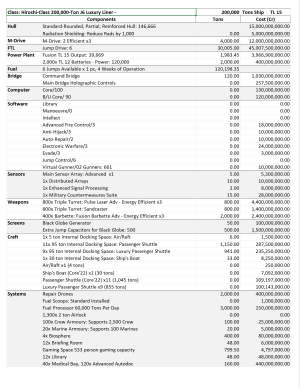
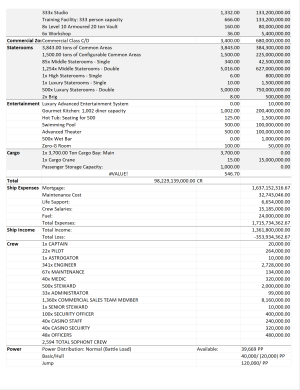
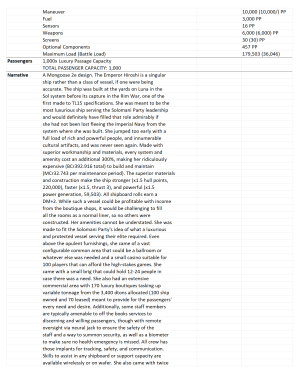
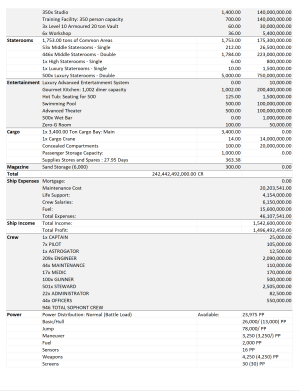
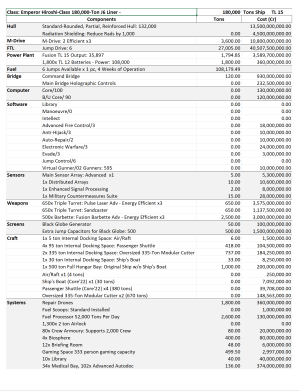
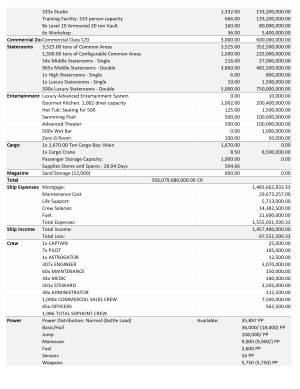
Made with superior workmanship and materials, every system and amenity cost an additional 300%, making her ridiculously expensive (BCr392.917 total) to build and maintain (MCr32.743 per maintenance period). The superior materials and construction make the ship stronger (x1.5 hull points, 220,000), faster (x1.5, thrust 3), and powerful (x1.5 power generation, 59,503). All shipboard rolls earn a DM+2.
While such a vessel could be profitable with income from the boutique shops, it would be challenging to fill all the rooms as a normal liner, so no others were constructed. Her amenities cannot be understated. She was made to fit the Solomani Party's idea of what a luxurious and protected vessel serving their elite required. Even above the opulent furnishings, she came of a vast configurable common area that could be a ballroom or whatever else was needed and a small casino suitable for 100 players that can afford the high-stakes games. She came with a small brig that could hold 12-24 people in case there was a need.
She also had an extensive commercial area with 170 luxury boutiques tasking up variable tonnage from the 3,400 dtons allocated (100 ship owned and 70 leased) meant to provide for the passengers' every need and desire. Additionally, some staff members are typically amenable to off the books services to discerning and willing passengers, though with remote oversight via neural jack to ensure the safety of the staff and a way to summon security, as well as a biometer to make sure no health emergency is missed. All crew has those implants for tracking, safety, and communication. Skills to assist in any shipboard or support capacity are available wirelessly or on wafer. She also came with twice as many medical personnel than she needed to provide advanced medical procedures for the discerning and privacy minded.
Though many functions could have been filled by robots, no mechanicals were allowed aboard. Only sophont service was acceptable. She came with 11 passenger shuttles (with acceleration benches) to get the crew moved in one trip) and 9 luxury passenger shuttles (with 120 acceleration seats) to get the passengers moved in one trip.
She was built with a reinforced hull, was heavily armed for a civilian ship, with many pulse lasers, sandcasters, fusion barbettes, advanced sensors, and even though not needed, she had a command bridge for the prestige of her passengers. Never advertised, she also came with a black globe generator for the ultimate in protection of her precious passengers. Her fuel tanks were made of metal hydride and meant to protect her ability to jump at need. Even so, she was lost with a thousand luxury passengers and twenty-five hundred crew aboard.