Common Areas on Space Stations

Sageryne

Emperor Mongoose
Hi all,

I am looking for some clarification on the High Guard rules about common area tonnage on space stations.

On page 66, it says:
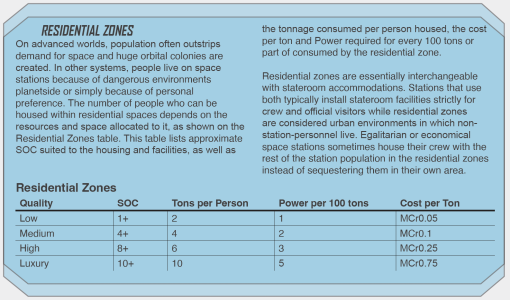
Screenshot 2026-03-12 at 5.20.18 pm.png

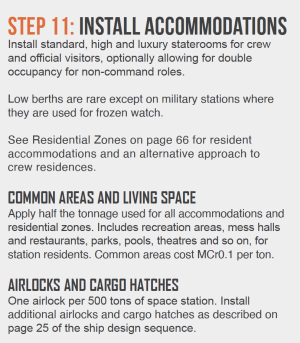
On page 65, it says:

Screenshot 2026-03-12 at 5.19.59 pm.png

So, according to page 66, I would allocate 4 dTons per person for Medium Quality accommodations. That lines up with a stateroom, so good so far. So, let's say you want to have quarters for 1000 people, that would be 1000 people x 4 dTons per person equals 4000 dTons.

If this was a starship, you would then add 25% (or more) for common areas.

However, on page 65, it says "Apply half the tonnage used for all accommodations and residential zones."

When I read that, I interpret it to mean, from the 4000 dTons in the example above, apply half of that to common areas (so 2000 for accommodations and 2000 for common areas).

However, if you follow the starship model on page 25:
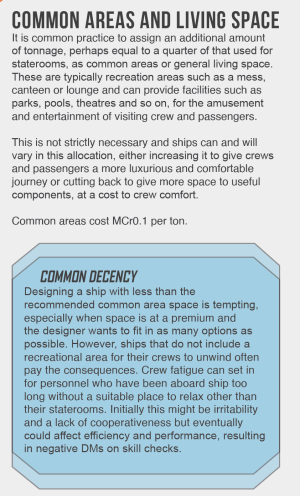
Screenshot 2026-03-12 at 5.36.10 pm.png

And, you assume space stations are larger and more spacious, I think page 66 should read "Allocate an additional 50% tonnage for common areas."

I am reading this right?

- Kerry
 
Ships are relatively spartan, even when luxurious. People will put up with less space to move around.

Stations are where people stretch out after a week or two on a ship or are living, possibly with families, full time. More space is expected.
The station uses twice the common areas of a ship.
 
On top of that, starships usually don't have business districts and public facilities, like proper schools and hospitals (although they may have in-stateroom resources to get by with).
 
First I'd toss out the explanation for station accommodations. It is factually incorrect about advanced worlds moving into SPACE due to limitations on a space. A planet is MASSIVE compared to any station. An average TL-12 planet would never really run out of room - materials science and construction methods would be more than adequate to build UP (arcologies) would be cheaper on any planet that was habitable since you'd not be paying for 24/7 environmental controls, DOWN (undersea habitats, underground, arcologies going down vs up) or even floating (grav tech would allow for floating cities). Building on a planet will always be cheaper due to environmental issues.

Second, unless people are forced to live in very cramped accommodations with no other choices (Kowloon City in Hong Kong is an example), a standard living compartment of 4dtons is not very realistic. This is where people live, and anyone living on a space station wouldn't be living in a slum. Babylon 5 kinda-sorta referenced poor people living in slum-like conditions (Grey 17 was a bit of a stretch...) but it wouldn't be like that in reality. Every breath you take is air that has to be recycled, every bit of water you drink has to be recycled. Most of the food you eat will be imported, or at least has to be created artificially. That means there would be no such thing as free space on a station. SOMEONE has to pay that bill. And don't forget that Traveller has some insanely expensive life support requirements. A station is no different than a space ship, thus that 4Dton 'apartment' and all those common areas have to pay the same cost as starships do for life support. So while people will live on stations for many reasons, the listed premise is false.

I don't bother trying to use rules to build out a station based on book costs. The book should be used as a starting source of ideas for things you'd encounter in a station. The average person who lives on a station will undoubtedly have a smaller foot print than someone who lives on the surface due to the far higher costs of living in space. However once a society masters gravity, lifting materials into orbit is easy. Personel accomodations would be expected to be closer to say what you saw on Babylon 5 for the size of quarters. On the show you only saw the two rooms - a bedroom and a living/kitchen area (and the unseen bathroom). A reasonable expectaion for an apartment would be something along the size of a 1 bedroom apt in Manhattan (500-600 sq ft) for personal space. Civilians are far less likely to put up with the more cramped quarters that military personnel would, meaning civilian spaces will be larger for the same population levels by default.

Public spaces are going to be a little bit different. You have to consider the size of the permanent station crew and the transient who pass through the station. So one that is a major transport hub is going to have a lot more public space vs one that exists as say a scientific outpost. For stations that have transient populations, THOSE temporary quarters can be starship cabin-sized since they people are just passing through and they just need to sleep/rest in their quarters.

Unless you are wanting to play accountants in space, build your station with the facilities and quarters that fit the expected need of the station. If it's a poor society then maybe make things a little more cramped and utilitarian. A flourishing trade hub near a rich industrialized world will have more to offer in the way of space and facilities to it's visitors and it's crew, so pump it up with things that seem appropriate. I find it helpful before making one to come up with the reason the station exists and add in the features and creatures next. So long as it more or less makes sense it's a success as far as I'm concerned.
 
Just to throw some real numbers out there, I live in a 470 sq ft 1 bedroom and using an online calculator I found that equates to roughly 2 dTons. It's not particularly well layed out but is a good enough basic living space. I share it with my 13 year old twin boys 4 days a week and it's adequate, we all have enough space to live and sleep without feeling overcrowded and with good ergonomic and proper bunks I think 4 people wouldn't be an issue, though a 2nd half bath would probably be needed.
So in Traveller terms, that tracks with a standard stateroom and double occupancy. But, it does need additional space to get out and stretch from time to time, everyone gets antsy if they can't get out occasionally. And then having a place to work or go to school is needed as well.
Now, my apartment does have a kitchenette, so it does have some common area equivalent, about 1dton worth, but I wouldn't count that againt a standard stateroom for housing. Unless it was a single occupant. Which is where I think that ackward bit in the space station rules comes from. I would say, ignore it and change it to for each dTons of accommodations space, you should add .5 dTons in common area for standard comfort levels.
 
Yeah, I think the key point is that you DO need to add space for where you work, where the kids go to school, to transport you to and from those, plus somewhere for you to shop, maybe restaurants and entertainment, administration... it all adds up.
 
There is the gated community aspect.


tumblr_ox1azaNxjh1w4t58uo1_540.gif
 
I have decided to go with +50% common area on top of the allocation for accommodations listed from page 66 shown above.

In addition, I am including some extra common space in all of the other areas of the space station, specifically the commercial zone, to which I added another +25% common area (for open areas, parks, etc).

In all of the working zones I added smaller common areas for break areas.

As the clip from page 25 says, 25% is the recommended minimum. As others have mentioned, living in a space station shouldn't feel as cramped as living on a starship, though since it has to be build, maintained and provided with life support, I don't think it will be as spacious as living on a planet.

- Kerry
 
Just to throw some real numbers out there, I live in a 470 sq ft 1 bedroom and using an online calculator I found that equates to roughly 2 dTons. It's not particularly well layed out but is a good enough basic living space. I share it with my 13 year old twin boys 4 days a week and it's adequate, we all have enough space to live and sleep without feeling overcrowded and with good ergonomic and proper bunks I think 4 people wouldn't be an issue, though a 2nd half bath would probably be needed.
So in Traveller terms, that tracks with a standard stateroom and double occupancy. But, it does need additional space to get out and stretch from time to time, everyone gets antsy if they can't get out occasionally. And then having a place to work or go to school is needed as well.
Now, my apartment does have a kitchenette, so it does have some common area equivalent, about 1dton worth, but I wouldn't count that againt a standard stateroom for housing. Unless it was a single occupant. Which is where I think that ackward bit in the space station rules comes from. I would say, ignore it and change it to for each dTons of accommodations space, you should add .5 dTons in common area for standard comfort levels.
Wouldn't your apt measurements be more like 21 to 22 feet per full wall side? At least when trying to reverse engineer your sq footage into Dtons I get your apt being about 10Dtons. 2 Dtons would be like 3m x 3m. Fine for a prison cell for 2, but not for 3 people unless you really like being close together.

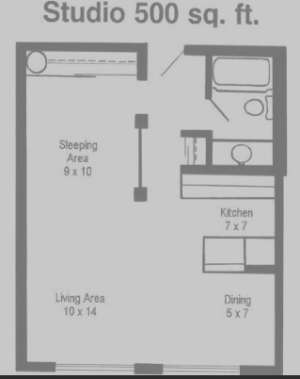
Here's what a 500 sq ft apt floor plan might look like.
1773411905182.png

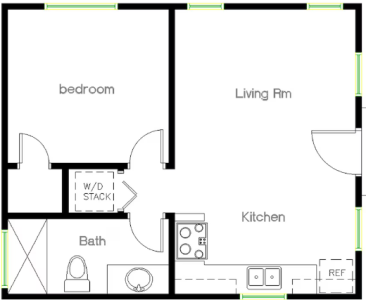
Here's another example
1773412041696.png

If you had a family, it might resemble more of like Star Trek, with bedrooms on each side with a common living/entry area. The Orville had some interesting sets like this as well.
 
Interesting ideas.

What about 4-dTons per adult? That way, a family apartment would be 8-dTons, that could include two parents and two children.

- Kerry
 
Interesting ideas.

What about 4-dTons per adult? That way, a family apartment would be 8-dTons, that could include two parents and two children.

- Kerry
It's reasonable. You'd expect a lot of stations to have very cookie-cutter approach to their accommodations, with perhaps internal walls that could be easily repositioned, but most fixtures don't. Remodelling your station apartment and adding a 2nd bath or whatever is not as practical (but not impossible) as it is in a terrestrial house. But also expect larger apartments where someone with the credits or pull has combined two units into one because, well, they can afford to. Wealth will always find a way to get used. Because it's a station they won't be able to say expand through structural bulkheads or safety zones, but anything else would be possible.
 
Back
Top