Travellers Needed! High Guard Updates

Slight correction: he puts a personal energy shield (in many ways an even more mad device) in play in Sylean Dream. It's Hanrahan who puts an energy shield on a ship in an adventure, and at least then it's Ancients so any cray-cray shit flies with that.

The one-off from Chris is ion-cannons: again, it is in the Glorious Empire book and is the only place those appear in all of the books I have (which is a shamefullly large number). He does love the novel, non-charted-space stuff.

Edit: this is not some pious objection on my part: I have used both.
Got it.
I wrote an adventure with a TL-17 personal field generator as an implanted augmentation on a time-shifted NPC.
Closest things we used to a ship-sized energy shield was a hullscale electrostatic armour (derived from the Vehicle Handbook) and a screen that uses gravitics to hold a special brand of sand in place around the spacecraft
 
Got it.
I wrote an adventure with a TL-17 personal field generator as an implanted augmentation on a time-shifted NPC.
Closest things we used to a ship-sized energy shield was a hullscale electrostatic armour (derived from the Vehicle Handbook) and a screen that uses gravitics to hold a special brand of sand in place around the spacecraft
I admit that I have the odd ship shield around. It makes fights last longer; it stops fights ending with a single beam laser shot from a cloaked ship; and (most importantly) it gives another combat role for the slightly-too-large Monday night table.
 
I hate jagged tables and it was a good fix for one, though there are still several that bother me. And it made 100 tons ships much more viable, which I loved.
I will miss the change.
Ok, looking back, there are only 3 tables in the construction rules that really bother me.
Bridges, p19
100 is the only line that doesn't start with a 1. Why?

Crew Reduction, p22
Why does it start with an ending 1, but all other lines are 0?

Docking Clamps
Type III, starts with a 0, where all the others start with 1.

There isn't really a magic line between 99 and 100 that turns a small craft into large craft. The only real difference is that you can't mount a jump drive under 100 tons.

I would just really like rational charts that don't have those jarring jumps and give some small advantage to 100 ton ships, because they can use the boost.

Anyway, I'll play it the way I want in MTU, but for when building for other folks, RAW is the law.
 
Someone I talk Traveller with elsewhere with made this suggestion. I kind of agree.

“I still think external cargo mounts should take 1 dton/100 dtons mounted like a cargo net.”

I wonder if external cargo mounts, jump nets, docking systems, and similar systems should consume hardpoints as an offset for their use of external surfaces.
 
There's lots of things that hull strengthenings should be used for, like docking clamps, hatches, and launch tubes.

But, you'd have to reexamine and redistribute hardpoints.
 
The Vehicle Handbook Update 2026 says this about docking clamps:

DOCKING CLAMP
A docking clamp allows a vehicle to carry another vehicle on the exterior of its hull while the vehicles are in motion. It provides a solid link and includes a vestibule coupler that can align with a coupler or hatch on an attached vehicle. A docking clamp is rated by the Spaces it can support.

The vestibule coupler says this:

COUPLER
A coupler is a compatible connector between one vehicle and another. A vestibule coupler can connect to a compatible vestibule coupler and maintain whatever environmental protections are available in both vehicles. It can expand about one metre to allow two vehicles to connect. It can maintain a connection between two moving vehicles on a track or smooth flat surface but to maintain a solid connection that supports any sort of environmental protection over movement off-road, or on water or air, docking clamps and hatches are necessary.

Page 23 says this:

A coupler or docking clamp allows power to be transferred between a towing and towed vehicle.

The language about all of this, including aligned hatches, should be included in High Guard so that the docking clamps there can align with hatches on the ship/pod/other item carried by the clamp. It will allow access and maintain atmospheric integrity and power transfer as well. I’d imagine that one the larger, ship sized docking clamps, the tube is longer. 5 meters? 10?

Not mentioned in the Vehicle Handbook because it is ship related, I would suggest it could also be purchased in combination with co-located airlocks (designed specifically to match ship and carried vessel) if desired, for personnel or cargo transfer, though mated hatches would likely work as well if they form a seal, and fuel piping (not useful for jump) or a neutered drop tank coupling (minus explosive bolts) that could be used for jump (also designed so the ship and carried vessel or pod line up correctly). Those would need to be paid for and accounted for as separate tonnage.

High Guard Update 2022 says this:

All airlocks include flexible plastic docking tubes that allow passengers to cross from one ship to another by floating through the air-filled tube.

That would mean a docking clamp co-located with airlocks could have an even longer tube, perhaps. I didn't see a length, so I'm unsure.

It makes sense to carry the themes and functions of the smaller docking clamps into High Guard, and that's what I'm suggesting you do.
 
Last edited:
The Vehicle Handbook Update 2026 says this about docking clamps:

DOCKING CLAMP
A docking clamp allows a vehicle to carry another vehicle on the exterior of its hull while the vehicles are in motion. It provides a solid link and includes a vestibule coupler that can align with a coupler or hatch on an attached vehicle. A docking clamp is rated by the Spaces it can support.

The vestibule coupler says this:

COUPLER
A coupler is a compatible connector between one vehicle and another. A vestibule coupler can connect to a compatible vestibule coupler and maintain whatever environmental protections are available in both vehicles. It can expand about one metre to allow two vehicles to connect. It can maintain a connection between two moving vehicles on a track or smooth flat surface but to maintain a solid connection that supports any sort of environmental protection over movement off-road, or on water or air, docking clamps and hatches are necessary.

Page 23 says this:

A coupler or docking clamp allows power to be transferred between a towing and towed vehicle.

The language about all of this, including aligned hatches, should be included in High Guard so that the docking clamps there can align with hatches on the ship/pod/other item carried by the clamp. It will allow access and maintain atmospheric integrity and power transfer as well. I’d imagine that one the larger, ship sized docking clamps, the tube is longer. 5 meters? 10?

Not mentioned in the Vehicle Handbook because it is ship related, I would suggest it could also be purchased in combination with co-located airlocks (designed specifically to match ship and carried vessel) if desired, for personnel or cargo transfer, though mated hatches would likely work as well if they form a seal, and fuel piping (not useful for jump) or a neutered drop tank coupling (minus explosive bolts) that could be used for jump (also designed so the ship and carried vessel or pod line up correctly). Those would need to be paid for and accounted for as separate tonnage.

High Guard Update 2022 says this:

All airlocks include flexible plastic docking tubes that allow passengers to cross from one ship to another by floating through the air-filled tube.

That would mean a docking clamp co-located with airlocks could have an even longer tube, perhaps. I didn't see a length, so I'm unsure.

It makes sense to carry the themes and functions of the smaller docking clamps into High Guard, and that's what I'm suggesting you do.
To add to this:

DOCKING HATCH
One docking hatch can act as a connector to another, or as an exit point from a vehicle, but it has no airlock or vestibule for expansion, requiring a tight lock.

So, with docking clamps using built in docking hatches, the two vessels could be mated directly and have no need for a vestibule coupler or airlock. Honestly, this should probably be the default for ships designed to access one another at the docking clamp. The cost of the docking hatch would be part of the price paid for the docking clamp. That would allow, for example, officers and crew on a Battle Rider to visit the Battle Tender during jump to plan for arrival in a target system.

That said, the other ship would need to buy a docking hatch, so it would need to be purchased like an airlock would be. In fact, the docking vestibule, docking hatch, and the like could be listed alongside an airlock.
 
More VH tech that should be applicable in High Guard. On page 23, it says this:

If the towing vehicle has extra capacity in lifters, inertial dampers or grav plates, or any other item with a non-physical effect (such as a holographic hull or anything else the Referee deems acceptable), it can be applied to towed vehicles but only up to the number of Spaces of the towing vehicle itself. For example, if a 10 Space vehicle was towing a vehicle of 10 or fewer spaces, it could extend a lifter field to the secondary vehicle if it had the extra capacity, perhaps by installing lifters twice on the towing vehicle.

Thrust and jump are already covered for ships in High Guard, but the ability to extend a holographic hull or similar effect should be elaborated on.

Active camouflage isn't covered in High Guard (though it should be as it is less expensive than the best stealth) and it might be covered as well. Or not.
 
As a beta reader for the VH, I saw a couple of things that didn't make the cut but still should be incorporated into High Guard. Here are a couple of things.

Communications Facilities
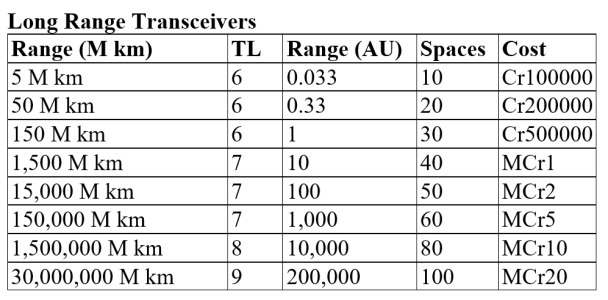
A communications facility is just a transceiver in a structure. It could be mobile or afloat, but it is a matter of adding options to a special-built structure or vehicle. Transceiver strength is its normal range for high bandwidth communications, but except for meson communicators, the signal can travel further than its listed range.

A dedicated transmission facility, often referred to as a ‘ground station’, though it need not be fixed on the ground, is a large antenna or laser system that can transmit or receive messages across interplanetary or technically interstellar distances and can maintain two-way communications with any receiver capable of orbital range (500 km) with a satellite uplink.

These long range transceivers do not decrease in Spaces or Cost as Tech Levels improve but are still subject to prototype and early prototype effects if built at earlier Tech Levels. Ranges are listed in millions of kilometres (M Km) and astronomical units (AU) with 150 Mkm equal to one (AU). A parsec is approximately 200,000 AU.
1772131430984.png

Long range communications are definitely needed for starports. There should be longer ranged sensors on such large structures as well.

This could potentially go into the Central Supply Catalogue, but I see few Travellers that would buy one.

Vehicle Construction Times
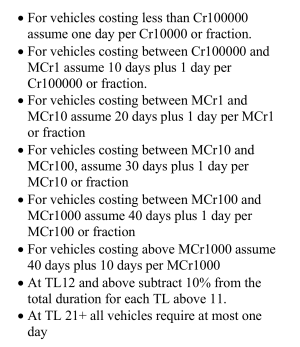
A Referee or vehicle creator can spend considerable effort developing the time requirements for constructing a vehicle, but that is often a distraction. Instead, a simple rule of thumb can determine the time to construct a vehicle, without constraints to materials, manufacturing equipment, or labour. Without these constraints, a basic rule for construction in a mass production setting is based on the Cost of the vehicle and factors of ten:
1772149822646.png

Construction Bay
For very expensive vehicles and smaller production runs, a construction bay is a cheaper alternative. The construction bay consumes twice as many Spaces as the completed vehicle. A construction bay in a structure costs Cr50000 per Space of the vehicle it will construct, or Cr25000 per Space the bay occupies. Build durations are 100% longer in a construction bay than in a production line. A shipyard building a starship with a jump drive costs 50% more per Space.

In my opinion, a shipyard is a construction bay by that inclusion in the above, so the ship construction times are doubled, and we could now calculate how long a ship build takes. The same could be done for a ship built in chunks by different yards, but the assembly time needs to be stipulated.

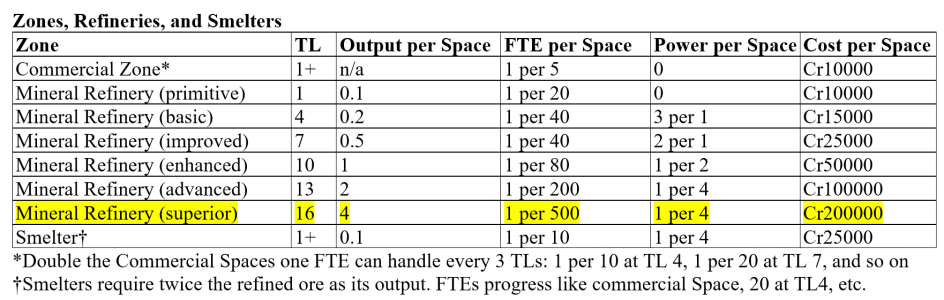
Mineral Refinery
1772132114989.png

While this section was cut from the VH, I believe the TL16 Mineral Refinery (superior) is deserving of being added to the High Guard Update.

 
Last edited:
Back
Top