Travellers Needed! High Guard Updates

Lifters. They are mentioned in the Starship Operator’s Manual but should be explained and quantified in High Guard. They can do things, so they aren’t fluff. Right now the discussion in another thread is if they could act as alternate landing gear and it sounds like they could. That makes them needful for a specific explanation.
 
Last edited:
Planetary gravity fields vary.

Going by Traveller mechanics, excess thrust allows motivation.

Under the local gravity pull, perhaps a variant of high burn thrusters.
 
And another thought: Advantages and Disadvantages for sensors.
Mostly thinking about prototypes and early prototypes, to make some sort of sensors possible on low tech spacecraft. Wouldn't give the higher tech ones DMs (well maybe DM+1 for two advantages), but things like longer detection ranges and better energy consumption (more like decrease by 1pp to no lower than 1pp, but not percentages) would be reasonable.
You can also simply apply retrotech rules to them, and let them get cheaper and smaller.
 
And another thought: Advantages and Disadvantages for sensors.
Mostly thinking about prototypes and early prototypes, to make some sort of sensors possible on low tech spacecraft. Wouldn't give the higher tech ones DMs (well maybe DM+1 for two advantages), but things like longer detection ranges and better energy consumption (more like decrease by 1pp to no lower than 1pp, but not percentages) would be reasonable.
And, you can put vehicle sensors on starships/spacecraft to fill in those gaps.
 
As an ask, @Geir , I'd like to see clarification about point-defense turrets on firmpoints. Something to the effect of "Point Defense Turrets may be mounted on firmpoints without being subject to the 0:1 limit that applies to Single turrets, but they may not mount a Heavy Point-Defence Laser (TL11)."
 
Lifters. They are mentioned in the Starship Operator’s Manual but should be explained and quantified in High Guard. They can do things, so they aren’t fluff. Right now the discussion in another thread is if they could act as alternate landing gear and it sounds like they could. That makes them needful for a specific explanation.
Z-drives are simple. The lifters are simply 0G grav drives that only work in 1D, are "built in" to gravity hulls, and have a top speed of Idle (Speed Band 1). You lose lifters when you choose a non-gravity hull or lose power to support "Basic Ship Systems" as described on pg 17 of the Core Rulebook.

I use them all the time. I am debating whether the new Cluster Truck rules should improve the lifter performance, or provide lifters when they aren't present.

An internal compensation system can be built into the hull of a vessel or a station that does not have a manoeuvre drive. Each 0.1G of internal gravity system adds Cr10000 per ton to the cost of the hull. 0.2G provides enough internal gravity to avoid most long-term health issues associated with living in microgravity. 0.4G is the minimum required for comfort. (Cluster Truck)
 
Please extend the computer table entries beyond TL 15. I think Behind the Claw added some TL 16 stuff including the ship computers but extending the ship computer table to TL 20 should be simple enough. Also some High Guard technology doesn't have a TL listed and some technology seems never able to be improved by technology advances or have cheaper predecessors. An example is the aerofins, there isn't a version that provides a +1DM (which could be cheaper or appear at an earlier TL than the standard aerofins if it had a TL or a more expensive and TL higher superior version.
 
Please extend the computer table entries beyond TL 15. I think Behind the Claw added some TL 16 stuff including the ship computers but extending the ship computer table to TL 20 should be simple enough. Also some High Guard technology doesn't have a TL listed and some technology seems never able to be improved by technology advances or have cheaper predecessors. An example is the aerofins, there isn't a version that provides a +1DM (which could be cheaper or appear at an earlier TL than the standard aerofins if it had a TL or a more expensive and TL higher superior version.
Have you @Shardan13 considered using the Retrotech rules? 1/2 cost per TL works out really well in filling those gaps, even when you add in /bis and /fib.
Or, adding in the 2300AD rules for NETWORKED CORES:
Multiple cores can be installed to manage the operations of large stations. The networked infrastructure takes no space but does cost 1% of the
total cost of the installed cores.

I built a “softpoint” system that was all .25 dton based as well. Works fairly well without overpowering.
To be fair, the 2300AD rules for "ball mounts" also work well: "
Ball Mount: The ball-mount is similar to a firing port but designed to accommodate fixed weapons, typically medium and large calibre machineguns. The weapon’s barrel protrudes from the ball that rotates freely within its socket, allowing a wide arc of fire. There is typically
a remote sighting mechanism on the weapon to allow accurate fire, although in some cases a simple armoured window is provided (DM-2 to attack rolls). Ball mounts cost Lv1000. A weapon of up to 500kg may be attached to them.
 
ProfGrizzlyJon I don't have the 2300AD rules and while I like the idea of the retrotech rules for cheaper ship computers at higher TLs Behind the Claw shows that Mongoose has the idea that higher TL computers are possible with their corresponding higher bandwidths.

I like the idea of networked cores and loved to see it in a High Guard update.
 
ProfGrizzlyJon I don't have the 2300AD rules and while I like the idea of the retrotech rules for cheaper ship computers at higher TLs Behind the Claw shows that Mongoose has the idea that higher TL computers are possible with their corresponding higher bandwidths.

I like the idea of networked cores and loved to see it in a High Guard update.
That is my point. The Ship's Computer table stops making sense
A TL 15 Computer/35 is MCr30.
A TL 15 Retrotech Core/40/fib/bis is MCr 1.4
A TL 15 Retrotech Core/80 is MCr 23.7
 
But stuff that actually has the effect that I want.

Which means a degree of customization, and trying to discover existing rules that accommodate this.
 
Z-drives are simple. The lifters are simply 0G grav drives that only work in 1D, are "built in" to gravity hulls, and have a top speed of Idle (Speed Band 1). You lose lifters when you choose a non-gravity hull or lose power to support "Basic Ship Systems" as described on pg 17 of the Core Rulebook.

I use them all the time. I am debating whether the new Cluster Truck rules should improve the lifter performance, or provide lifters when they aren't present.

An internal compensation system can be built into the hull of a vessel or a station that does not have a manoeuvre drive. Each 0.1G of internal gravity system adds Cr10000 per ton to the cost of the hull. 0.2G provides enough internal gravity to avoid most long-term health issues associated with living in microgravity. 0.4G is the minimum required for comfort. (Cluster Truck)
As a follow-up;
IMTU, Lifters play an important role in reentry to an atmosphere or even landing on any planet. Pilot is the appropriate skill, although Flyer (Grav) works in a pinch (treated as -1 due to interface difference, e.g, spacecraft controls are different from aircraft controls- although, if you have a Star Trek or Galaxy Quest style "pop-out" control sticks, that might remove this penalty).
If an spacecraft attempts reentry with M-drives inoperative (and lacking aerofins, aeroshells or wings), the lifters may be used to provide a minimum level of control (+1 Agility)
 
But stuff that actually has the effect that I want.

Which means a degree of customization, and trying to discover existing rules that accommodate this.
I am not sure I follow.
There are a wide-variety of groundscale weapons that have 1DD damage and displace less than .25 dtons. These fit into the High Guard rules already, and allow you unlimited placement per "SMALLER WEAPONS" on page 40. Even some of the larger groundscale weapons (>1dton) can fit as fixed mounts.
 
Off the shelf doesn't always fulfill specific requirements.

Twelve kilogrammes that spew two double dees of radioactive damage can certainly fit into a quarter tonne, but that does demonstrate a degree of inefficiency.

But, effective range is four hundred fifty metres, and you still have two hundred thirty eight kilogrammes of spare capacity.

You can't tinker with the man portables, and what I'd want if I install these weapons, with their limited range, is point defence; at space battle engagements, there are a lot more effective weapon systems installed in hardpoints, and for ground support, half a klix is not enough buffer zone from aerospace defences.
 
Off the shelf doesn't always fulfill specific requirements.

Twelve kilogrammes that spew two double dees of radioactive damage can certainly fit into a quarter tonne, but that does demonstrate a degree of inefficiency.

But, effective range is four hundred fifty metres, and you still have two hundred thirty eight kilogrammes of spare capacity.

You can't tinker with the man portables, and what I'd want if I install these weapons, with their limited range, is point defence; at space battle engagements, there are a lot more effective weapon systems installed in hardpoints, and for ground support, half a klix is not enough buffer zone from aerospace defences.
I disagree. I don't think you are looking at it the right way.

You can link man-portables in a single mount or turret (See "Linked Weapons" on pg 45 of the Vehicle Handbook): basically, you are using the "small turret", "large turret" and "pop-up mount" rules from page 38 of the Vehicle Handbook.

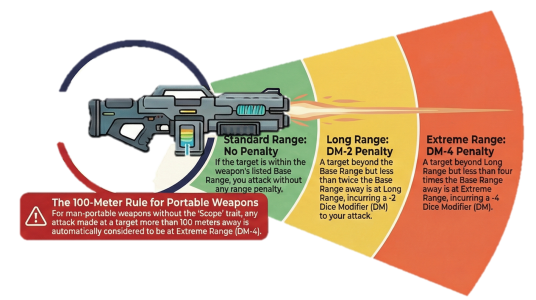
Regarding range, you neglected to calculate for Extreme Range (less than four times the Range away and double in minimal or zero-gravity). Yes, there is a DM -4 when making attack rolls, but you can easily compensate with the DM+2 for shooting at Spacecraft (pg 167 of CRB) and DM+1 for every full 10 tons of their targets' Shipping score (to a maximum of DM+6) per page 140 of the CRB. This gives even a PGHP-12 a range of 1000m or "Adjacent" in spacescale.

1769986391624.png
IMTU, we optionally add Sensors and Fire Control components (from the Vehicle Handbook) to represent a deliberate and more refined installation.
 
I considered opening the cargo hatch, and letting a Shilka rumble out.

Or, variant on that theme.

I took a step back, and asked myself exactly why I wanted the smaller weapon systems, and how they fit in in any number of doctrines I had developed.

1. Ground support - going to be suicide with a near peer, and doesn't really matter against someone who's not.

2. Interception - five hundred metres effective would confine that to adjacent in a dogfight, though not a bad option if you can gain initiative, or have little choice.

3. Energy drain - rules say the player ignores it.

4. Greatest threat, at a distance, for poorly armoured spacecraft are going to be missiles and torpedoes.

5. Best usage of smaller weapons likely fifty tonne and below smallcraft, but those would be affixed to fixed points, unless the single turret is sacrificed.

6. At that type of range, and linkage was a primary consideration, I'm looking other weapon systems, that can explicitly be used for point defence.

7. As I read the rules, each quarrier tonne can only install a single weapon system.

8. Customizing other weapon systems, will create multiple mounted weapons, as a single system.

9. Or, a laser gatling.

 
I considered opening the cargo hatch, and letting a Shilka rumble out.

Or, variant on that theme.

I took a step back, and asked myself exactly why I wanted the smaller weapon systems, and how they fit in in any number of doctrines I had developed.

1. Ground support - going to be suicide with a near peer, and doesn't really matter against someone who's not.

2. Interception - five hundred metres effective would confine that to adjacent in a dogfight, though not a bad option if you can gain initiative, or have little choice.

3. Energy drain - rules say the player ignores it.

4. Greatest threat, at a distance, for poorly armoured spacecraft are going to be missiles and torpedoes.

5. Best usage of smaller weapons likely fifty tonne and below smallcraft, but those would be affixed to fixed points, unless the single turret is sacrificed.

6. At that type of range, and linkage was a primary consideration, I'm looking other weapon systems, that can explicitly be used for point defence.

7. As I read the rules, each quarrier tonne can only install a single weapon system.

8. Customizing other weapon systems, will create multiple mounted weapons, as a single system.

9. Or, a laser gatling.
I think the worst abuse I had was installing a rotary autocannon with nuclear specialized munitions on a 10-dton stealth fighter (.5 dtons, 500 rounds, doing 6DD at Auto 5, with a .5km blast radius and an Extreme Range in Space of 8km or "Close"), and the most efficient was installing a Plasma Support Weapon, Anti-Bunker as the "warhead" of a torpedo-bot.
 
Back
Top