Geir
Emperor Mongoose
Or, perhaps more usefully:Please bear in mind that medication has been taken (nice, passive tense, blaming nobody), but my assumption would be:
View attachment 7675
assuming that F is what we want to start with.
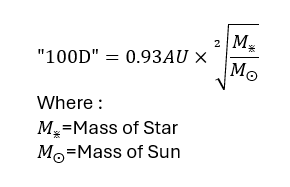

Or, perhaps more usefully:Please bear in mind that medication has been taken (nice, passive tense, blaming nobody), but my assumption would be:
View attachment 7675
assuming that F is what we want to start with.
I use the cube root (rather than the square root) because the relationship between diameter and volume (and thus mass) is a cubic one. To double the diameter (and the 100D limit), the volume of the stellar object would increase by a factor of 8, assuming the density is held constant. (Obviously, the density of dead stellar objects does not hold constant, but according to what's been published, we're treating the jump shadow of such objects as if they were stars of the appropriate mass. But it's an undefined area at the moment; it can be played either way without breaking the game.)Please bear in mind that medication has been taken (nice, passive tense, blaming nobody), but my assumption would be:
View attachment 7675
assuming that F is what we want to start with.


Which fanzine developed Trojan reach back story?Sorry, I wasn't sufficiently sarcastic in my post. I have a long-standing dislike of Trojan Reach backstory, which was developed in a fanzine back when lots of other things were not developed (which was fine) and not revised when it was picked up and made official (which was less so, imho).
That should have been a more eyeroll inducing, not a serious suggestion for how the Zhos got tech out of order.
Eat your heart out...Which fanzine developed Trojan reach back story?
Enjoy the Blotches… they are very of their time.Eat your heart out...
Third Imperium Fanzine
web.archive.org
Only until you drop the drop tank, then no more 5 jumpsAny Jump-2 or greater capable ship that carries a droptank equal in size to the ship's tonnage can make 5 jumps of 1 parsec each before it uses its internal fuel. This makes crossing most rifts trivial, but time consuming. This also works with jump 1 ships, but you must build the engine to handle a ship 2x the actual size.

In past editions I know they have mentioned the Navy recovering dropped tanks for reuse so I see no reason you couldn't detatch the tank, go do what needs doing, and then come back and reattach the tank.Only until you drop the drop tank, then no more 5 jumps
Go jump 4, but internal fuel only jump 2. My comment regards going and returning in the void where there is no source of fuelIn past editions I know they have mentioned the Navy recovering dropped tanks for reuse so I see no reason you couldn't detatch the tank, go do what needs doing, and then come back and reattach the tank.
It would be slow, but you could even detatch the tank, go and refuel at a gas giant, reattach the tank and transfer fuel to it, detatch and go refuel again and repeat until the tank is full.
Building a depot is easy enough in that case, jump in with a tank, drop the tank, jump out on internal fuel. Repeat until you have enough tankage on site to continue to the next link. Takes forever and is very expensive, but if the rift is more than 5 parsecs across to the next filling point it's about all you can do.Go jump 4, but internal fuel only jump 2. My comment regards going and returning in the void where there is no source of fuel
Most rift crossings have waypoints every 5 parsecs for refueling. An unexplored rift won't, but you should be using a jump 5 ship for that, which with a drop tank will have 5 jump 2 and it's internal jump 5 fuel.Back to the original comment..
Any jump 2 ship with a drop tank of tonnage equal to ships tonnage can make 5 jump-1 then detach tank. To cross a rift.
5 jump1 + internal jump 2= 7.
I can't jump five jumps and go back with only j2.
I can jump 7 to a system, but my drop tank is jump2 away. And I can't go back and get in.
So my point was the max distance would not be crossable by a J2 ship unless there was a drop tank at the Destination, then a J2 ship could cross 14 parsecs in 12 weeks.