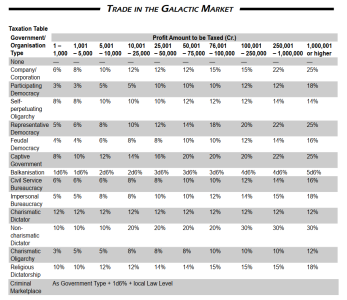
Taxes, the Imperium, and You!

Terry Mixon

Emperor Mongoose
In another thread, support for the Imperial Navy came up. How is is paid for was the thrust of the question.

With the Imperium ruling between the worlds, that strongly implies that they have to get their funding the same way. Imperial shipbuilding and maintenance, the Imperial Army and Marines, the Imperial bureaucracy, nobles skimming their share, and more besides needs to be paid for.

If the taxes must be on trade, how much would that be since the Imperium wants to promote trade? Maybe they want to promote trade because that is the income source.

IMTU, I set the taxes for purchasing trade goods as 2% to the Imperium and 1% to the world, but on reflection that is probably woefully inadequate.

What are your thoughts on funding the Imperium? How much? Where from? Etc.
 
Last edited:
I always modelled it as the Imperium wants lots of trade so it taxes the worlds being protected and the megacorps and not the commerce between them.
 

Attachments

  • afp5ew.jpg
    afp5ew.jpg
    69.7 KB · Views: 9
My basic problem with taxes is that you quickly create a burden, rather than a game, if the game demands you to keep track of all taxes and make the 3I balance it's books.

So, my initial thoughts were to have the individual worlds pay taxes to the 3I. That is kinda what the Traveller Wiki says.

All other PC taxable transactions would be 'transparent' for game purposes. I have to think that because mention of 'taxes to the 3I' is absent from the CRB and CSC.
 
The Imperium taxes worlds based on the specifics outlined at the time of its induction into Imperial membership. It is the responsibility of the world government to see that the taxes are collected and paid in whatever means it chooses - that is a matter for local affairs, and the Imperial Noble overseeing the world sees to it (via oversight of local and/or Regional Branches of Imperial Ministries) that they are in order and channeled into the Treasury via the Finance Ministry.

Taxation of interworld trade occurs as well, of course, but that is interworld commerce (also overseen by Imperial Nobility via Imperial Ministries).

The Imperium "ruling the space between the worlds" is a euphemism - the Imperium is not (and never has been) described as a Confederation. The phrase simply means that it doesn't rule the worlds directly and can't be bothered to deal with governing at such a minor level - it leaves that detail to local concerns. But those concerns most certainly are in subjection to Imperial interests and authority; otherwise, the Imperium does not rule at all save by mutual consent - and that is not a superintending government, let alone and Empire.

The Imperium does not interfere in local interests, government or culture as long as they do not conflict with Imperial interests. When they do, the policies pursued by the Imperium to correct the issue may vary depending upon the local situation after "discussion" with local Imperial Nobility and other relevant officials - the Imperium has at times been more subtle and patient (i.e. devious) in response, or "Kerrian" as Cleon Zhunastu and Zuan Kerr originally envisioned, and at other times more "Artemsian" like the Lentuli Dynasty and it's iron fist.
 
In another thread, support for the Imperial Navy came up. How is is paid for was the thrust of the question.

With the Imperium ruling between the worlds, that strongly implies that they have to get their funding the same way. Imperial shipbuilding and maintenance, the Imperial Army and Marines, the Imperial bureaucracy, nobles skimming their share, and more besides needs to be paid for.

If the taxes must be on trade, how much would that be since the Imperium wants to promote trade? Maybe they want to promote trade because that is the income source.

IMTU, I set the taxes for purchasing trade goods as 2% to the Imperium and 1% to the world, but on reflection that is probably woefully inadequate.

What are your thoughts on funding the Imperium?hoe much? Where from? Etc.
I think the Imperium itself has a large stake in many for profit businesses that generate income, in addition to taxes. They likely get a %, 1 or 2 maybe, on every starship built, at least on yards not owned by a planetary military, and every loan that has to be tracked beyond the local system.
Also, X-Boat fees probably are a major revenue source, there are trillions of credits a day moving through the network and you can be sure the government charges a tiny fee for each transaction per transit it has to make.
Beyond that, selling surplus equipment, tribute from captive governments and there must be some form of tax on system GDP.
Oh, and fees for lots of different services and form submissions.
 
My basic problem with taxes is that you quickly create a burden, rather than a game, if the game demands you to keep track of all taxes and make the 3I balance it's books.

So, my initial thoughts were to have the individual worlds pay taxes to the 3I. That is kinda what the Traveller Wiki says.

All other PC taxable transactions would be 'transparent' for game purposes. I have to think that because mention of 'taxes to the 3I' is absent from the CRB and CSC.

Absolutely. We should always look for ways to cut down on cognitive load on both referees and players.
 
hoe much?

No, can't say that I do.

What are your thoughts on funding the Imperium?

One of ten, one of ten, a 10% flat tax at each level. The Imperial planetary fiefholder takes 10% of the GWP, the subsector duke takes 10% from what each of his subordinate fiefholders collect, the sector duke takes 10% of what his subsector dukes collect, and the Iridium Throne takes 10% of what his sector dukes collect. There are also 10% tariffs assessed on goods imported through Imperial starports, so free traders and foreign traders get taxed, and of course it's illegal to import goods through a non-Imperial port. Planetary governments generally tax their populations at a rate of at least 15%. The tax revenue must flow. Much of Imperial Law can be boiled down to "fiefholders better have my money".

This arrangement inspires government at all levels to promote economic development and personal wealth. Since it's a flat tax on economic activity, if planetary governments want more funding then they need to promote economic development on their worlds. The same for Imperial fiefholders. The Imperium doesn't tax personal income or capital gains, so once planetary, subsector, and sector fiefholders are done paying 10% to the next level up and paying for their expenses, they keep the rest. They can take this money and invest it into various investments or businesses. Imperial fiefholders, Imperial high nobility, and their households are exempt from planetary taxes. Businesses owned by Imperial fiefholders are not exempt, and goods imported by Imperial fiefholders still have tariffs applied.

The expenses of Imperial fiefholders can include planetary navies (planetary governments can also field their own), huscarls and other security forces, various retainers and advisors, upkeep of various installations and properties, unofficial spy networks, administrative departments, and various "diplomatic expenses".

EDIT: The Iridium Throne, through the Imperial Navy, pays for the construction and upkeep of the sector and subsector fleets. They are too important to be left to care of subsector and sector dukes, who would be tempted to cut funding to enrich themselves. The same holds true for the Imperial Army and the other armed forces and ministries of the Imperium.
 
Last edited:
The aristocracy and the Imperial family draw their privy purses from rental income and annuities.

The Imperium itself, corporate taxation and tribute.
 
If nobles gain their income from the economic activity of their subsector worlds then why don't they take steps to improve the worlds in their subsector? The Spinward Marches have been settled for a thousand years, yet even in critical subsectors worlds are allowed to be less than economically vibrant. Their populations have not been raised to a billion, TL has not been improved, basic technologies common to the Imperium for over a thousand years are not locally manufactured...

I have posted my thoughts on this before, but to recap, the high population worlds are the economic power houses, and the high population high TL worlds are the major manufacturing centres and the really critical economies... sort of.

Megacorporation shareholders are nobles, megacorporations pay dividends to those nobles, so they want a market for their goods, hence they don't want every world to be a self sufficient manufactory for everything the world needs, they want worlds to require off world trade so they have a market. In the Ziru Sirka world economies were deliberately specialised so trade was a necessity, trade controlled and overseen by the Beuraux. In Cleon's Imperium the Empire controls trade and world development in order to rig the markets, to ensure wealth flows to the nobles and the Imperium.

Every member world has to pay taxes towards the Imperium, but the Imperium also takes a cut of all intersteller trade via tariffs, and finally gets an extra cut from the dividends due to the nobility as shareholders.

Why do sector dukes not require their subsector dukes to improve every world in their subsector? The thing is the sector duke is a "first among equals" it is not a official position, or at least it wasn't in the previous canon. The sector duke does not take a cut from each subsector duke, but there are sector wide Imperial Ministries that the sector duke is in defacto oversight of in their position as most powerful subsector duke. Sector dukes can also play one subsector duke off against others so they can not challenge the sector duke's authority. The sector duke can offer support for trusted subsector dukes, or undermine the position of a subsector duke to replace them with a more trusted family...
 
If nobles gain their income from the economic activity of their subsector worlds then why don't they take steps to improve the worlds in their subsector?

Because this is IMTU, and IMTU they do.

This arrangement inspires government at all levels to promote economic development and personal wealth. Since it's a flat tax on economic activity, if planetary governments want more funding then they need to promote economic development on their worlds. The same for Imperial fiefholders.
 
The Third Imperium book says very little about Imperial taxation:
  • Nobles collect taxes.
  • Evading Imperial taxes is a crime.
  • Nobles can rent and tax the lands under their purview (but they only get relatively small estates, rather than entire planets).
  • The peerage can tax the Imperial citizens under their purview. Purview means "...The extent or range of activity, function, power, or competence; scope. synonym: range." Does this mean the citizens who live or do business on their personal estates? On the planets they oversee? Again, too vague to be helpful.
 
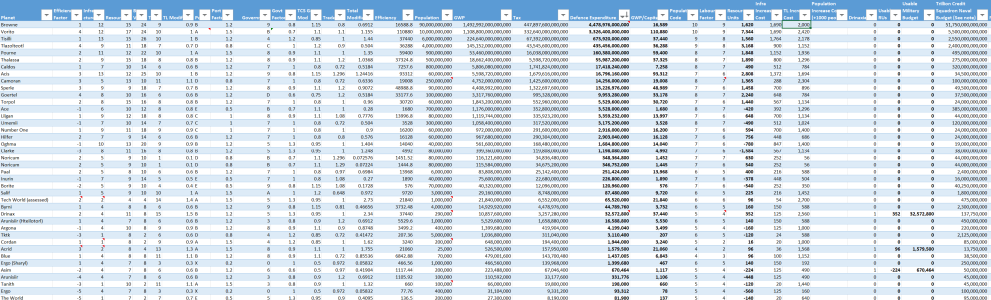
I've spent quite a while modelling enough of this in various ways to run PoD, first using the Pocket Empires rules, then the WBH rules, then adding the TCS element for comparison, with a brief attempt to find a way to use T5 (lawl, lesson learned).

I've come to a bit of a balance using resource units for civilian with a carved-out 1% of GWP (half of the alleged NATO figure, although most of us outside the USA cheat) for total defence capex and opex. I combine the RU approach with a bastardised version of the faction system from SWN to limit how many initiatives a polity can advance at once. I don't want to end up running Civilisation VII in Excel...

My real goal here is to add more rounded domain play in the sector I want to use after my current two PoD campaigns end. I am well aware from past experience that that will be a long time, so I have time to finish polishing the maths :D

Edit: the TCS element on the right is just something I'm working on for comparison, and doesn't include the TL scaling that the campaign version adds. The majority of the data on there is taken straight from the World Builder's Handbook and traveller map. There are red note icons where I've adjusted values for current campaign progress.

1766527070800.png
 
Last edited:
I'd turn this on its head a bit. The Imperium appears to be the main driver of TL advance, with the Navy at the forefront of all that. How much revenue is the IMPERIUM getting from providing technology to the private sector? Also, I'd expect that by TL15, and at the scale the Navy operates, they could well be self funding just from what they have in place to turn rocks into fleets. Those robot factories can be kept running well past their required peacetime need to, with the excess product onsold as military surplus.
 
There is an inherent flaw in the taxation concept - that is every world would need to convert it's local currency and economy to Imperial Credits. A poor world (say TL5) economy would be quite small in IMP Cr terms compared to a moderately populated higher TL world (say 12 - the Imperial average).

In this case you would very much have worlds that paid a pittance in taxes compared to more industrial and technical worlds. Even converting pure GDP won't solve the issue, as PPP (purchasing parity power) is a more accurate model of what the 'average' citizen can buy a serving of ramen for locally. And as we see in real-life (TM), imposing import and export tariffs are messy and rarely equate to the totals that are claimed.

This idea is terribly complicated and the game already butchers the economic model. Because of all the challenges I just ignore it completely. The Imperium gets its money in a magical way, it spends it in a magical way, and the running of the government is magical. It simplifies a lot of things and leaves more time to try and rationalize things that have at least a potential of being explained away in a reasonable manner.
 
Back
Top