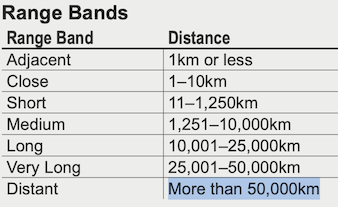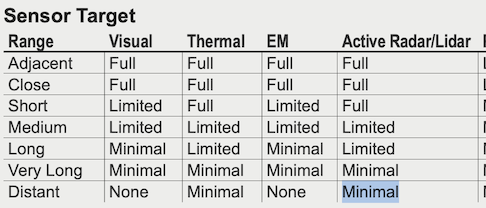
Space Combat - Did I miss something?

"Sensors can see further" is not a direct contradiction of my point that there is no evidence that "Minimal" information can be obtained from sensors beyond Distant.
So, you have abandoned your assertion that is sensor detail is "None" at Very Distant?
You are now maintaining that there is some intermediate state of sensor detail between "None" and "Minimal" that isn't defined, discussed, or even vaguely alluded to in the rules?


If it said "... but sensors can obtain "minimal" information at Very Distant but it requires a formidable check" then that would be a direct contradiction (but if it said that we wouldn't need to be discussing it).
Why would that rule limit other rules unnecessarily? What if some other book introduced SuperDuper Advanced sensors with "Limited" detail?

The textbox describes the difference from range band to range band, at Very Distant the difference is the task difficulty.
No other difference is specified, so why would there be any other difference?


But what that information might be is not specified it is just more than jump flash and apparently a vague tonnage.
At Far we can see ships, but can't identify them:
Far (over 5,000,000km): At these ranges, sensors can spot the signature of ships making jumps (inbound or out) and can determine only whether a contact is a ship or other similar-sized astronomical body. In either case, sensors are only able to determine the size of the contact to the nearest 10,000 tons.
We can detect jump flash.
We can detect ships and rocks, but only discriminate between ships and rocks, not between different ships.
In either case, only to ±5 000 Dton.

Where is the problem? What is undefined?


With sensors difficulty does not alter the type of information you get at a particular range.
Agreed, so?


"All Electronics (sensors) checks become Formidable (14+)." That sentence will apply to the check to determine if one of those random blips you see on your scope is a real object or a ghost image. It does not need to imply any increase in sensor range for it to have a purpose for being in the rules.
If there is no sensor information at Very Distant, why would we roll to discover it?
That there is a specific roll at Very Distant does imply that there is information hence sensor range at Very Distant.


You are solely focussing on the information in the side bar (and reading into it more than is actually RAW).
The textbox is the only source that I know of that discusses "Very Distant" or "Far" at all, so that is rather important to any discussion about "Very Distant" range, yes.


If you apply "All Electronics (sensors) checks become Formidable (14+). to the Initial Detection rules on P76-77 then you will see that you can have to make check to differentiate blips. If you fail that check you cannot differentiate, regardless of the range of your sensors.
Yes, obviously, just as Distant range.

Failure indicates that the location of the ship (or even that it is a ship) cannot be accurately determined. Exceptional failure means the object is not detected at all or just assumed to be some inert object such as a planetoid, defunct satellite or space junk."
Yes, obviously, just as Distant range.

There is nothing special about Very Distant range here, the rolls are just harder than at Distant. We get the exact same information, or lack of information, at Distant and Very Distant range.

What are you trying to demonstrate?
 
So the editing error first (HG 22, p55):

"By using multiple hull-mounted arrays in an integrated computer-controlled arrangement, it is possible to increase the effective antenna size and range of a sensor suite. EM and active radar/lidar can then detect objects at Distant range [sic] and passive radar/lidar at Long range."

But active radar/lidar was already able to provide minimal info at distant range.


Presumably, this is meant to shift this to Very Distant range (otherwise it provides no benefit to that sensor type), ...
I wouldn't read too much into that.

In MgT2'16 Distributed Arrays were specifically to get Minimal sensor info at Distant range for Radar (even if we already had it for Visual and Thermal), just as the text still says.
Core'16, p150:
Skärmavbild 2025-12-28 kl. 18.34.47.png

That was then given for free in Core'20, making Arrays basically redundant.
Core'20, p150:
Skärmavbild 2025-12-28 kl. 18.36.23.png

The rules text for Arrays were never changed.

I have no idea why.
 
I had noted that the effect on active RADAR/LIDAR was nil but that could also be explicitly confirming there was no additional benefit to active RADAR/LIDAR. The problem with supposed editing errors is that if it is an error you often do not know which way it was supposed to go and unless the error has been confirmed as such then it might just be clumsy writing. In this case it could just be saying that now both EM and active RADAR/LIDAR can detect objects at Distant range.

The extension net is however explicitly limited to sensors that already provide Full or Limited information. It does not increase the range of minimal information. I see no contradiction in extending something that had Limited information at Distant into Full at Distant and Limited at Very Distant. There is however no such sensor.

I would agree that BS fleets at very distant range can see one another, but I don't think you need to extend the range of sensors for that to be the case, primarily because they introduce a lot of new objects into space which can be detected at Very Distant under the Initial Detection rules.
a) If they jumped in they would have been detected at Far range by the jump flash and that also allows an estimate of size. If we are talking several 10,000+ DTon ships jumping in synchronised there is very little alternative interpretation than it is a battle fleet. If you are not expecting your own battle fleet then it stands to reason this is an enemy fleet and hostile intent is a fair first guess.
b) If you just happened to move within Very Distant range of a fleet that was already in position you just need to make Formidable sensor checks to identify if those objects that just got added to your plot are ships or astronomical bodies. If you were already in sector you will likely already have catalogued everything else so your check is focussed on the new stuff. I agree with you that in a fleet action there are probably at least a few sensor ops* that could regularly make such checks and any object would be subject to extensive scrutiny until it was unequivocally identified as a non-ship or friendly.
c) If you were the fleet jumping in then things might be a little more difficult since you probably don't have comprehensive information about every astronomical object within Very Distant range yet. I would presume that SOPs would be to focus on the closest stuff first as it will take many rounds before that a Very Distant maybe-threat is actually in range to do anything. This might not take that long through in actuality because of Virtual Crew.

Virtual Crew can easily spam the checks. It only costs only 1 extra band-width for each extra 5 Sensor Ops. Even small fleet supports can likely run 100 virtual sensor ops (15 bandwidth basic plus 19 for the extra instances). Even Virtual Crew Level 2 is pretty cheap compared to the cost of the ship itself. As far as I am aware you only pay for the software once regardless of how much bandwidth you apply to use it.

Virtual Crew(2) operating as Electronics(Sensor)-2 is likely not the highest skill in the fleet (and probably won't be able to benefit from every DM a sophont can leverage) and therefore probably won't always succeed at a Formidable check (unlike expert systems I see nothing that prevents Virtual Crew at any level attempting formidable checks), but you have several hundred virtual sensor ops and you know if you failed to identify an object you can just add it back into the stack of things to be checked (or flag it up to one of the flesh bags to resolve). A fleet working together (and fleet sensor operations will be well drilled) could be checking tens of thousands of objects each round and if only 10% of those checks succeed they will still be able to map that entire zone in a few rounds. Any ships (especially a battle ship) will therefore be easily detected (and unless they are sending friendly transponders pings) they will also be identified as hostile and become subject to greater scrutiny.

Actual formal identification, and exact positioning for targetting would still need for you to be in sensor range of an active sensor. Since you can't attack at Very Distant range then you have plenty of time to identify the target and if the other fleet has hostile intent then standing off at Very Distant isn't going to achieve anything. Interestingly on the Sensor Operator section of the crew duties (HG p97 onward) it only mentions the type of information provided by specific sensors with respect to exploration activity.
"Under more peaceful circumstances, a sensop might be employed with the task of examining sensor data to gain more information about near-space objects. " HG p98
Hostilities seem to be covered by the Initial Detection mechanic (for which specific sensor qualities seem to be irrelevant) and once you have the ships position it is locked in unless it is a stealthy ship changing range bands.

Apologies, maybe I read it the wrong way. I also didn't intend any snark in my reply, so I guess we can both "put up our swords" :)
Would the virtual crew operating as sensops need dedicated sensor stations? I ask not for the seating, but for the additional capability to host additional sensor operations. The base system can’t be unlimited in the things it can more closely examine after all.
 
Would the virtual crew operating as sensops need dedicated sensor stations? I ask not for the seating, but for the additional capability to host additional sensor operations. The base system can’t be unlimited in the things it can more closely examine after all.
I don't think the sensors are doing any more work. It is the analysis of their output that takes up the time running spreadsheets and the like. Flesh bags need a station to display that stuff and to work from, but the ships computer doesn't need a display device or IO device to conduct internal analysis.

You also need extra stations if you are trying to perform different sensor op tasks in the same round. Ships with entirely virtual crews don't even require a bridge (and therefore any sensor stations).

Ships over 7500 Dton don't require additional sensor stations for their extra sophont sensor operators anyway.
 
Last edited:
So, you have abandoned your assertion that is sensor detail is "None" at Very Distant?
You are now maintaining that there is some intermediate state of sensor detail between "None" and "Minimal" that isn't defined, discussed, or even vaguely alluded to in the rules?
I was interpreting that since there is no undefined and undiscussed intermediate level of sensor detail that if it isn't "Minimal" at Very Distant it can only be "None".
Why would that rule limit other rules unnecessarily? What if some other book introduced SuperDuper Advanced sensors with "Limited" detail?
The textbox describes the difference from range band to range band, at Very Distant the difference is the task difficulty.
No other difference is specified, so why would there be any other difference?
I don't think there is any difference to the type of information. At Distant you still get minimal for Thermal and active LIDAR/RADAR. It is your suggestion that the Sensor Target table is changed and that a new line needs to be added for Very Distant and that it needs to have the value minimal.
At Far we can see ships, but can't identify them:

We can detect jump flash.
We can detect ships and rocks, but only discriminate between ships and rocks, not between different ships.
In either case, only to ±5 000 Dton.
So an astute commander could infer that a 500,000 DTon ship would be limited to certain vessels dependent on the setting and could identify it as a likely battleship.
Where is the problem? What is undefined?
The difference between what can be determined at Very Distant and Far when a ship has not jumped in. Can you for instance determine the vague tonnage of a ship that did not jump in or is it the size of the jump flash that provides that information?
Agreed, so?
Good we are in agreement.
If there is no sensor information at Very Distant, why would we roll to discover it?
That there is a specific roll at Very Distant does imply that there is information hence sensor range at Very Distant.
You are conflating information about the ship which is "Minimal" (which has a specific in-game meaning per the Sensor Detail table) and the information required to unequivocally identify something as a ship and its precise location for targeting for which a Formidable skill check is required.

There is no requirement for there to be minimal information (Hot or Cold or Basic Outline) for you to get a fix on a target at Very Distant range.

As corollary a ship with Basic Sensors running only passive RADAR/LIDAR gets to detect whether a blip is a ship or some other object at ranges beyond Distant. It only has to engage active RADAR/LIDAR to get a precise fix to enable targeting or a convergent course.
The textbox is the only source that I know of that discusses "Very Distant" or "Far" at all, so that is rather important to any discussion about "Very Distant" range, yes.
The section on Initial Detection specifically refers to "Beyond Distant". That includes "Very Distant" and "Far".
Yes, obviously, just as Distant range.
Good more agreement.
There is nothing special about Very Distant range here, the rolls are just harder than at Distant. We get the exact same information, or lack of information, at Distant and Very Distant range.
Yes and the sum of that information is a precise fix and confirmation that it is indeed a ship.
What are you trying to demonstrate?
That you do not get whether it is hot or cold or get a basic outline from the Initial Detection roll. The specific type of sensor that is in your sensor package (and what its range it can operate at) makes no difference to the roll it is purely the overall DM that package gives you that matters.
 
Last edited:
I was interpreting that since there is no undefined and undiscussed intermediate level of sensor detail that if it isn't "Minimal" at Very Distant it can only be "None".
OK, "None".
Then why are we discussing detection or sensor rolls at Very Distant? There can't be any.
This would be a direct contradiction: "However, it is possible for sensors to reach further in order to detect incoming threats."


I don't think there is any difference to the type of information.
So, you get the same information at Very Distant, despite sensor resolution being "None".
I'm sorry, but that makes no sense whatsoever to me.


At Distant you still get minimal for Thermal and active LIDAR/RADAR. It is your suggestion that the Sensor Target table is changed and that a new line needs to be added for Very Distant and that it needs to have the value minimal.
I suggest the Core table is taken literally: Active Radar has Minimal detail at 50 000 km and over. Core'22, p160:
Skärmavbild 2025-12-28 kl. 21.44.19.pngSkärmavbild 2025-12-28 kl. 21.45.15.png


So an astute commander could infer that a 500,000 DTon ship would be limited to certain vessels dependent on the setting and could identify it as a likely battleship.
Sure, if there is only ever one ship class at 500 000 ± 5 000 Dton in a universe, that is one of them.


The difference between what can be determined at Very Distant and Far when a ship has not jumped in. Can you for instance determine the vague tonnage of a ship that did not jump in or is it the size of the jump flash that provides that information?
It's right there in the rule in clear text:
In either case, sensors are only able to determine the size of the contact to the nearest 10,000 tons.
That only applies to Far range, and whether the ship jumped in or not.


You are conflating information about the ship which is "Minimal" (which has a specific in-game meaning per the Sensor Detail table) and the information required to unequivocally identify something as a ship and its precise location for targeting for which a Formidable skill check is required.
Yes, of course.
If we can't detect the ship, we can't discriminate it from rocks...
If sensor resolution is "None", we can't see the ship, so nothing else to worry about.

The basic procedure is:
Core'22, p160:
Under normal circumstances, an Electronics (sensors) check is all that is required to detect and identify a target that has moved into range of sensors.
No range, no detection.
No successful check, no detection.


HG'22, pp76-77 expands on that with:
When a starship comes out of jump or during in-system transit, their sensors detect hundreds if not thousands of objects, depending on population and traffic in the system. Beyond Distant range (more than 50,000 kilometres), most of these objects simply appear as blips on a display, difficult to differentiate from each other.
"Beyond Distant range (more than 50,000 kilometres)" is an obvious mistake as either "Beyond Distant" or "more than 50,000 km" is wrong.
50 000 km is Distant range.
For the rest of the text to make any sense they must mean more than 50 000 km = Distant range and beyond.
HG'22, p77:
For all intents and purposes, the knowledge that these ships and other objects are present is all that is needed; however, should one ship need to approach another for boarding or to engage in combat, more precise information is required. To obtain this level of information, the ship’s sensop must make an Average (8+) Electronics (sensors) check (1D minutes, EDU), ...
Average check at Distant, Formidable check at Very Distant, according to HG'22, p26.

Note that there is no explicit mention of Very Distant or Far range bands in this chapter, and it works just as well without the optional rule on p26 of HG'22.


There is no requirement for there to be minimal information (Hot or Cold or Basic Outline) for you to get a fix on a target at Very Distant range.
Yes, there is; there is a requirement to detect the ship (and the other space debris) in the paragraph before.


Are you seriously maintaining that we can't detect a ship at Very Distant as sensor resolution is "None", and at the same time we can get a targeting solution at Very Distant, or even Far, as per HG'22, p77?
 
OK, "None".
Then why are we discussing detection or sensor rolls at Very Distant? There can't be any.
This would be a direct contradiction: "However, it is possible for sensors to reach further in order to detect incoming threats."
So, you get the same information at Very Distant, despite sensor resolution being "None".
I'm sorry, but that makes no sense whatsoever to me.
You have misunderstood that is all.
I suggest the Core table is taken literally: Active Radar has Minimal detail at 50 000 km and over. Core'22, p160:
View attachment 7018View attachment 7019
The normal rule is that HG2022 supersedes CRB2022 just like all the other specialist supplements do. You are free to ignore that as a house rule but it is not the normal way of operating.
Sure, if there is only ever one ship class at 500 000 ± 5 000 Dton in a universe, that is one of them.
Then we are in agreement that competent naval officers will make more of limited information than some rando. Gods bless the IN.
It's right there in the rule in clear text:
That only applies to Far range, and whether the ship jumped in or not.
So your suggesting is that unless the ship jumped you cannot tell it's tonnage at Very Distant (or presumably beyond the range of a densitometer) or detect it at Far at all? I can go along with that.

I am going to skip the rest of your post to save a bit of time and cut to the nub of it.
Are you seriously maintaining that we can't detect a ship at Very Distant as sensor resolution is "None", and at the same time we can get a targeting solution at Very Distant, or even Far, as per HG'22, p77?
Bloody hell this is hard work.
Last try.

Sensor Detail table = "None" means you do not get hot or cold information from Thermal and you do not get Basic Outline from active RADAR/LIDAR at Very Distant range. That is not saying you do not detect it. Its is saying you get no details about it.

IRL.
I can look up into the sky at night and see hundreds of tiny points of light. I can detect them. I have been told they are stars and have no reason to believe otherwise but I personally have no sensor information other than the visual information my eyes provide. If a new point of light appears up there I might detect it but I have no way of knowing if it is a star, an aircraft a satellite or in some cases a drop of water on my glasses reflecting light from elsewhere. If I watch it for a while I might see it move and be able to infer some more facts from that. Situational modifiers (light pollution, clouds, moving objects getting in the way, eye spots etc. might prevent me from detecting it even though it is at the same range as other that I do detect).

In Game.
To detect that it is a real object only needs you to make the Initial Detection Electronics (Sensor) check. That is either an Average check at Distant or a Formidable check at Very Distant. If you succeed you can get a fix on the object and determine if it is a ship or a rock.

If you have detected a ship and want more details then you can then use the sensors to provide them. If you are at distant you can then see the outline and see that it is hot or cold. If you are at very distant you get nothing.

If you want to target that ship you have just detected you need to use active sensors and they need to be in range so again you cannot engage at Very Distant. At Distant you can use Active RADAR/LIDAR but you will also light yourself up like a Christmas tree. Thermal is a passive sensor so you cannot target using that but since every sensor package has active RADAR/LIDAR every ship can target a ship at distant range that it has detected).

If you do not detect the ship at whatever range you get no details about it regardless of what sensors you are using and you cannot target it. These are completely unrelated aspects of sensor operations.
 
Back
Top