Show Us Your (Vehicle Handbook Update 2026) Vehicles!

I think that there's a fallacy in your argument, along the lines of the classic damage assessment on shot-down planes.

There are lots of worlds that were attacked by nukes in the Reach. It appears time and again in the materials.
There are four that I can think of that have not yet been cleaned up: Clarke, Noricum, Ergo and Drinax. There may be others, of course: God knows the Sindalians loved a nuke.

Why are the rest of the attacked worlds not also still suffering from taints from lingering actinides? Because they were cleaned up, presumably: especially in the case of low-hydrographic ones like Hilfer.

Those four worlds were either hit too recently and extensively (Ergo) to have recovered enough to clean up the damage; were hit too hard with associated bioweapons (Drinax and Noricum); or were just too fatalistic and too poor (Clarke - temporary-death-embracing religion and economic efficiency -3 which is almost the worst in the sector!)

Others that we know were subjected to orbital bombardment (eg Tech-World or Hilfer) have been cleaned up. And if Drinax gets its act together then they'll no doubt start doing the same as soon as they have a few million to spare.

We know the tech exists. We know it has no WMD uses. We know it is cheap. We know it is widespread throughout civilian society. We know that it can clean up radiation. We know that various bombarded planets are now clean.

One society or another might, for some reason, try to make it military-only for some cultural reason, but it is surely too much to suggest that *every* planet does so.

Do you have a very specific reason why that would be so for every single culture? Why even law level 0 societies that don't ban poison gas and personal FGMPs draw the line at the peaceful use of dampers? Because as soon as a single world says they are fine then you have a market, and where there is a market there will be a producer: companies don't leave money on the table.
 
Last edited:
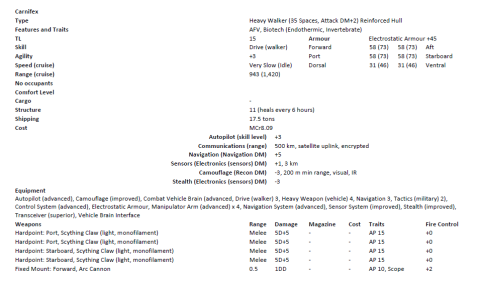
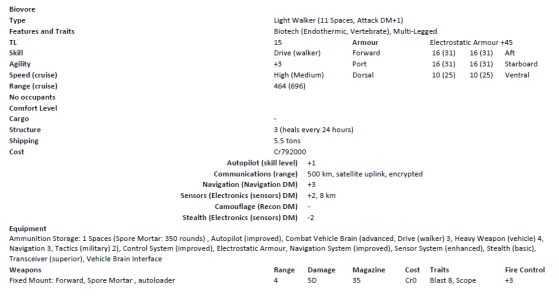
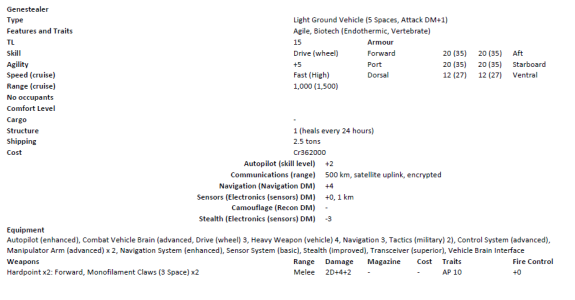
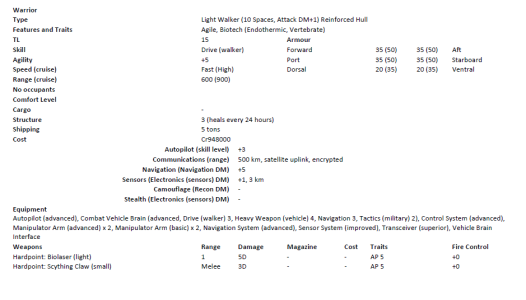
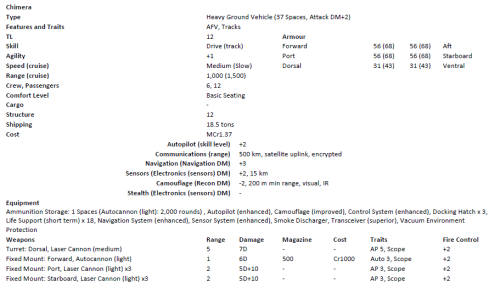
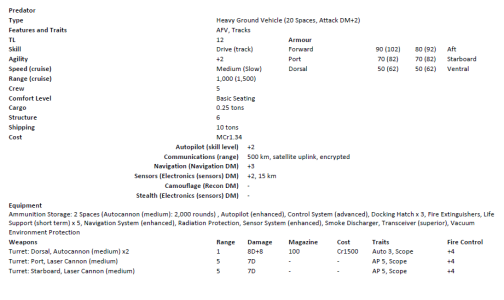
I ran a non-campaign scenario using vehicles made from the new ruleset to familiarize my players with the changes.
These were the biotech vehicles "that escaped from a lab and were destroying everything in their path."
The infantry in power armor and vehicles (modelled after a Chimera and Predator/Devastators) failed to stop the rampage.
1773014987594.png

1773015016698.png

1773015041045.png
 
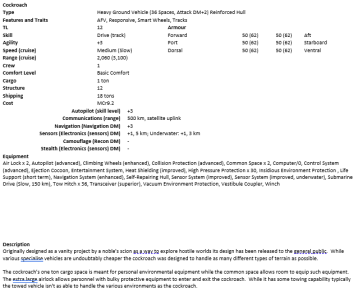
Okay I have (over) designed another vehicle that has been rattling around my head for a while. The idea behind it is an one person vehicle that can survive anything the environment throws at it.

1773028872344.png
 
Last edited:
Starship containers always seemed ridiculously expensive if designed using High Guard - given that they were a utilitarian power box. A vehicle handbook designed container (to me) is much more reasonable.

It’s basically just an 8 space structure with vacuum protection, grid power and a transceiver to identify itself - and comes in at a much more reasonable Cr16,600. I’ve made it TL12 but it can be built from TL6 onwards though the transceiver price would change.

Of course, the only issue is cargo mass - 4 metric tons. A real world container while slightly smaller weighs about 2,200kg and is rated to carry up to 28,000kg - though it’s usually significantly less in real terms.

1773172621236.png
 
Starship containers always seemed ridiculously expensive if designed using High Guard - given that they were a utilitarian power box. A vehicle handbook designed container (to me) is much more reasonable.

It’s basically just an 8 space structure with vacuum protection, grid power and a transceiver to identify itself - and comes in at a much more reasonable Cr16,600. I’ve made it TL12 but it can be built from TL6 onwards though the transceiver price would change.

Of course, the only issue is cargo mass - 4 metric tons. A real world container while slightly smaller weighs about 2,200kg and is rated to carry up to 28,000kg - though it’s usually significantly less in real terms.

View attachment 7650
I like the idea. Good thought.

The tonnage is displacement tons, not weight. Would it need to be reinforced? And that's a lot of armor for a shipping container.

With only 2 dtons of capacity, that's a pretty small cargo container and seems pricy. The draft version of the Vehicle Handbook had cargo containers like in the Starship Operator's Manual with prices. It ended up being cut, but Geir said it might be in the Vehicle Catalogue. A 10-dton airtight and powered container was Cr22,000, so scaled to the 2-dton, it would be Cr4,400. I wonder if a vehicle container can get that cheap?

It doesn't feel right to share the chart when it will be coming out, so I'll leave it at that.
 
Last edited:
I like the idea. Good thought.

The tonnage is displacement tons, not weight. Would it need to be reinforced? And that's a lot of armor for a shipping container.

With only 2 dtons of capacity, that's a pretty small cargo container and seems pricy. The draft version of the Vehicle Handbook had cargo containers like in the Starship Operator's Manual with prices. It ended up being cut, but Geir said it might be in the Vehicle Catalogue. A 10-dton airtight and powered container was Cr22,000, so scaled to the 2-dton, it would be Cr4,400. I wonder if a vehicle container can get that cheap?
In this case it’s both - dTons and weight. An 8 space structure actually holds 16 spaces of cargo - 4 dTons and as per Page 27 Step 12 250kg of cargo per space or 4,000 kg. It’s shipping size is 4dTons.

I’d say the 4,000kg is a nominal load where you can easily access what you’re looking for. Double this for a reasonable rummage around to find stuff and multiple it by 8 for the maximum reasonable load.

A real world TEU Container displaces 2.83 dTons (11.33 spaces) and can hold a maximum 24,000kg if going by rail (it can technical hold more but you can’t transport it most places). Roughly, 8 1/2 tonnes per dTon or 2,100kg per space.

The price is mostly derived from the vacuum protection - without that it comes out at a ridiculously cheap Cr400. Reinforcing it only takes it up to Cr600 so seemed a no brainer.
 
In this case it’s both - dTons and weight. An 8 space structure actually holds 16 spaces of cargo - 4 dTons and as per Page 27 Step 12 250kg of cargo per space or 4,000 kg. It’s shipping size is 4dTons.

I’d say the 4,000kg is a nominal load where you can easily access what you’re looking for. Double this for a reasonable rummage around to find stuff and multiple it by 8 for the maximum reasonable load.

A real world TEU Container displaces 2.83 dTons (11.33 spaces) and can hold a maximum 24,000kg if going by rail (it can technical hold more but you can’t transport it most places). Roughly, 8 1/2 tonnes per dTon or 2,100kg per space.

The price is mostly derived from the vacuum protection - without that it comes out at a ridiculously cheap Cr400. Reinforcing it only takes it up to Cr600 so seemed a no brainer.
Ah. My mistake on the container. I should have realized it is a structure.
 
I added external fabricators (all 5 grades) at a full space to the sheet and present you the Enhanced Mobile Shipyard Fabricator! It's 10 dtons in size and built at TL15 standards, so it can build TL12 ships (or other items) solo or in groups. It can be completely robot operated, but it has a cabin for a two-person crew.

View attachment 7554

A robotically controlled fabricator made to work in space, though it can also be used on a planet. Its Enhanced Fabricator is built at TL15, so it is capable of making TL12 items. It has 3 dtons of space for raw materials, which will be roughly used in two two-hour sessions. It mounts the external fabricator outside on its front and uses its grav drive and high agility to work with precision.

With 1 dton (four vehicle spaces) dedicated to the fabricator, it can fabricate 0.6667 of a dton of ship (or other programmed item) in two work hours, four hours for advanced robotic brains. That means it could make a 10 dton fighter in 30 total work hours. It could make a 200 dton merchant ship in 600 total work hours.

It can operate in tandem with other units to make the work proceed faster and is rated for around the clock operation, only needed one 8-hour shift down for maintenance every week when the robotic brain is running the show.

It has accommodations for a sophont crew of two (pilot & fab tech) to do the work if desired.

Attached is the modified design sheet. Also attached is the spreadsheet I used to calculate how many chamber liters make up a vehicle space for external fabricators. And a calculator to figure out how long it takes to fabricate things. The percentage of raw materials required (cost wise) is able to be set in that sheet.

Thanks go to @mavikfelna and Monjot for helping my math-challenged brain figure out external fabricator output formulas.

View attachment 7536
 
Back
Top