Show Us Your (Vehicle Handbook Update 2026) Vehicles!

Terry Mixon

Emperor Mongoose
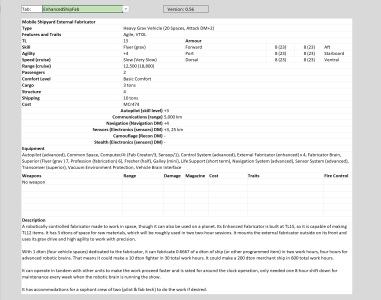
I added external fabricators (all 5 grades) at a full space to the sheet and present you the Enhanced Mobile Shipyard Fabricator! It's 10 dtons in size and built at TL15 standards, so it can build TL12 ships (or other items) solo or in groups. It can be completely robot operated, but it has a cabin for a two-person crew.
1772400665158.png

A robotically controlled fabricator made to work in space, though it can also be used on a planet. Its Enhanced Fabricator is built at TL15, so it is capable of making TL12 items. It has 3 dtons of space for raw materials, which will be roughly used in two two-hour sessions. It mounts the external fabricator outside on its front and uses its grav drive and high agility to work with precision.

With 1 dton (four vehicle spaces) dedicated to the fabricator, it can fabricate 0.6667 of a dton of ship (or other programmed item) in two work hours, four hours for advanced robotic brains. That means it could make a 10 dton fighter in 30 total work hours. It could make a 200 dton merchant ship in 600 total work hours.

It can operate in tandem with other units to make the work proceed faster and is rated for around the clock operation, only needed one 8-hour shift down for maintenance every week when the robotic brain is running the show.

It has accommodations for a sophont crew of two (pilot & fab tech) to do the work if desired.

Attached is the modified design sheet. Also attached is the spreadsheet I used to calculate how many chamber liters make up a vehicle space for external fabricators. And a calculator to figure out how long it takes to fabricate things. The percentage of raw materials required (cost wise) is able to be set in that sheet.

Thanks go to @mavikfelna and Monjot for helping my math-challenged brain figure out external fabricator output formulas.

View attachment 7536
 

Attachments

Last edited:
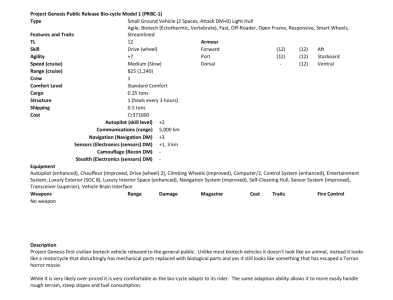
Okay last year I said that Project Genesis was going to release it first civilian vehicle so I better pony up. Like all biotech vehicles it's effective TL is 2 less than what is listed.

It's too late in the night to figure how to paste it in so I put it as an attachment.
 

Attachments

Last edited:
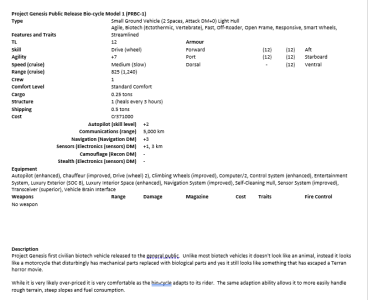
Okay last year I said that Project Genesis was going to release it first civilian vehicle so I better pony up. Like all biotech vehicles it's effective TL is 2 less than what is listed.

It's too late in the night to figure how to paste it in so I put it as an attachment.
You can do a screen capture of the summary and paste it into the message. Preferably just the part with the summary.

1772380402837.png
 
Last edited:
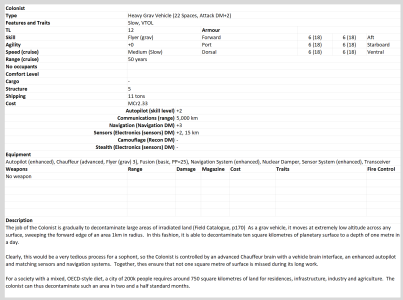
This one was inspired by the question of how practical it would be to decontaminate an irradiated world like Drinax in the Trojan Reach (obviously, tailored viruses are a different matter: thanks, genocidal Aslan!).

For those interested in where the figure of ten square kilometres per day comes from, it's largely from Striker. In that, we are told that a nuclear damper can decontaminate the area of a single nuclear crater in (the fire phase of) a single turn. Each turn lasts 30 seconds.

I assumed that in such a game the nukes would be tactical (as mentioned on Striker p.27, although p.9 does allow up to 100kt if available, which would end most Striker engagements at once!), and a 1kt ground blast will give you a crater with a radius of about 18 metres, depending on the soil type, of about nine metres depth, while 100kt will give you one about 73m in radius and 37m deep. I took a middle path of 50m radius.

This gives us a rate per day of about 22 square kilometres but I took a conservative approach and more than halved that, since the long-lived contaminants (mainly actinides after a few decades) will largely have settled through the soil, so we need to treat a bit deeper. To treat in this way, the vehicle has to move extremely slowly: less than 0.5km/hour!

The radius of the damper comes from the VHB (p77) and the Field Catalogue (p170), each of which agree on this figure.

The result of this nerdery is the Colonist automated damper vehicle:

1772915866100.png

A better investment than MCr2.33 in return for 10km2 of usable land per day (and a substantially lower healthcare budget) is hard to imagine!
 
Last edited:
This one was inspired by the question of how practical it would be to decontaminate an irradiated world like Drinax in the Trojan Reach (obviously, tailored viruses are a different matter: thanks, genocidal Aslan!).

For those interested in where the figure of ten square kilometres per day comes from, it's largely from Striker. In that, we are told that a nuclear damper can decontaminate the area of a single nuclear crater in (the fire phase of) a single turn. Each turn lasts 30 seconds.
Any close approach to a nuclear armed ship with nuclear dampers would neutralize their weapons AND that includes their own use of nuclear dampers. Also knocks out any fission power plants until refuelled.
 
Any close approach to a nuclear armed ship with nuclear dampers would neutralize their weapons AND that includes their own use of nuclear dampers. Also knocks out any fission power plants until refuelled.
Since it is moving at less than 0.5km/h I suspect that most ships will manage to evade!
 
I meant with the dampers being used in ship to ship battles where they are at close or even adjacent ranges.
Ah, gotcha!

I did wonder whether there should be some sort of discount for a civilian damper that might lack the sensor suite, targeting systems and mountings to allow it to detect and react to incoming threats in milliseconds, but thought I should just leave it.
 
I would think there would not be "civilian" dampers.
The need to use them would be done by people in the military (Navy) for the most part.
The other key people using them would be scientists working for government, who typically have the budget over people. So a lack of reason to develop a civilian version, just deal with the paperwork of getting permission for the standard one.
 
I would think there would not be "civilian" dampers.
The need to use them would be done by people in the military (Navy) for the most part.
The other key people using them would be scientists working for government, who typically have the budget over people. So a lack of reason to develop a civilian version, just deal with the paperwork of getting permission for the standard one.
I'm intrigued. Why do you think that the use case in my vehicle is invalid? I could list a bunch of systems in the Trojan Reach alone where they would be highly valuable, and the use case is canon across multiple versions of the game.

Leaving that to one side, we know that dampers are widely used for civilian applications: for moving short-lived radioactive elements for medical or industrial uses, for instance. And in literally every Fusion+ vehicle or power plant.

As regards the budget: they're very, very cheap for the benefits to be gained. The maths is up there in my post: which bit do you think was wrong (remembering that I cut the efficiency to 45% of the book, so I was super-conservative)? The idea that NewWorld Terraforming Solutions corporation wouldn't have a bunch of dampers ready to go on one platform or another because they cost half as much as a tier-2 autodoc or twice as much as a civilian air/raft is odd!
 
Last edited:
I'm intrigued. Why do you think that the use case in my vehicle is invalid? I could list a bunch of systems in the Trojan Reach alone where they would be highly valuable, and the use case is canon across multiple versions of the game.
Not invalid at all.

I did wonder whether there should be some sort of discount for a civilian damper that might lack the sensor suite, targeting systems and mountings to allow it to detect and react to incoming threats in milliseconds, but thought I should just leave it.
I am in 'agreement' here.

I do not think there would be a civilian damper discount. I do not think that a civilian version would be any different than the current military versions. It is a licensing/regulation issue. Not a technology one.

In a civilization where:
A - Nukes are bad and not often used
B - We have places like the Reach where there are an abnormally high number of worlds where they were used
C - Those places have not been cleaned up in hundreds or thousands of years

So that leads me to believe that dampers stay in the military or controlled scientific realm. Perhaps they are restricted from being transported by merchant ships (see other threads for discussion on armaments for merchants)? Perhaps there is some sort of customization tuning needed per planet used on? Given that it could ruin a populations power systems tighter controls make sense.
 
Back
Top