
Should maned small combat crafts be deleted from chartered space?

Should maned small combat crafts be deleted from chartered space?

  • Yes

    Votes: 0 0.0%
  • No

    Votes: 12 100.0%

  • Total voters
    12
Why wouldn't you scale these up to the battle riders that carry capital ship killing weapons? Why risk a single life when you can have virtual crew, robots et al operate your warships...

The people can stay on the carriers, tenders and battle directors, ready to jump away if the battle goes against them...

the sad thing is if you apply MgT rules and supplements as written this is how it would be done, and only the Hivers value life enough to do it.
Because that doesn't sound like fun, and I am not running a simulation so I get to focus on what's fun for the players.

If they tried flying fighters they would very quickly cease having fun with those, too!
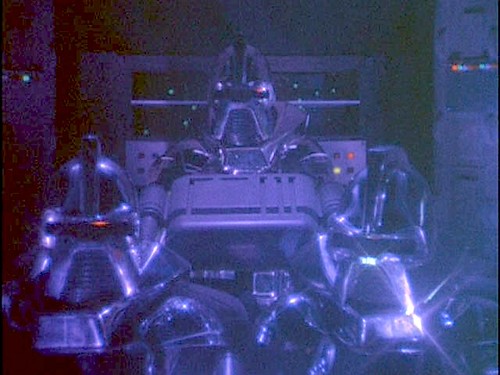
 
2416724479_f74feeae28.jpg


It's sort of inferred that every spacecraft has to pay for every copy of their computer programmes.

The Imperium heavily discourages piracy.
 
Obviously, it's not fun or desirable. My position is that they should write the rules so that it is also sensible to do it the fun and desirable way, rather than idiocy. But this applies to a lot of things in the military space combat rules. Spinal Mounts are supposed to be decisive, battleships necessary for big battles, and various other things that are just untrue in the rules as written.

Traveller's rules should probably make TL matter more and not just be "ooh, I get a +1 for being better". Space Above & Beyond may well make sense at TL 8-10 and not make sense at TL 14-15.

Manned fighters can useful in patrol roles even if they are pretty stupid in giant space battles. In the level where players matter, six fighters patrolling from a deep space platform (ship or station) with human pilots can be fun and make sense where thousands of pilots getting swept from the skies by automated PD in a large battle does not.
 
I would point out that while the focus has been on fighters, armed small craft could just mean a utility craft with a laser. Those can be called upon to fight (and may be quite dangerous to civilian shipping), but their design is pitched at whatever usual job they have (interface transport, asteroid mining, remote sensor craft etc). Often it would make more sense for those to have a living crew than to install expensive automation.
 
I would guess there are a few reasons living pilots are primarily still being used.
1) social: both the 3I and the solomani have a strong bias against Warbots.
2) Creativity: while a robot can probably pilot fighters easily you’re not going to get the insane creative problem solving in a chaotic environment like a battlefield.
3) cost: life is cheap while those robot brains not only cost more but are going to require more maintenance than the human pilots plus your probably going have to replace about a third of those pilots you don’t have with highly trained robot engineers which are going to add to your maintenance costs.
4) counter measures: we already see that every country in the world are developing anti-drone technologies I can’t see robots being treated differently. Plus what if the enemy figures out how to hack those same Robots than you have your own fighters attacking you. Live pilots can’t be hacked.

Like most things I don’t think there’s a single reason but instead a whole host of reasons.
 
It is unlikely that robots would be more expensive. While there is a lot of human life that can be wasted by the careless, training is actually quite expensive. The US government tends to say it takes between 5 and 10 million dollars to train the pilot from pre-screening through actually serving in an effective manner.

Likewise, maintenance requirements probably do not compare to the salary + benefits (housing, medical, food, etc) that those human pilots absorb.

While wartime training is, by necessity, truncated compared to the processes used in peace time and would therefore be less costly, I do not think that there is any basis to assert that drone brains in Traveller would clearly cost more than pilots in general.
 
I think it's supposedly six years for a pilot, with unit integration, and experience/skill being the cherry on top.

Ironically, the larger and more sophisticated the spacecraft, the less cost per tonne to amortize computers and programmes.
 
Drone brains, no. Those aren't particularly smart and basically follow orders. We're talking about robot brains which are sophisticated enough to make on the spot decisions. Keep in mind there may be an appreciable signal delay (as well as jamming) that prevents remote control of drones being useful.

I take the point about whole of service costs; nonetheless robot brains have maintenance and running costs too. And robots probably need training too; a lot of that 5 to 10 million is the cost of providing aircraft to train in... a robot pilot may still need that (or some significant fraction of that), unless you're comfortable launching them untested.

And... would it really cost that much to train a pilot in the Far Future? Things are a lot more automated.
 
I often see training costs cited by government as a brag, to inflate budgets and to mask waste. They bundle in a lot of cost that in reality would need to be met elsewhere anyway (accommodation, food, wages and facilities) or lost productivity (or loss of stupidly expensive aircraft) or sometimes the lost productivity from not bothering to deliver the training. We also spend a fortune redeveloping courses to take account of developing technology (in Traveller tech is stagnant so that won't be an issue).

I have worked on systems where the accounting went the other way and they dispensed with training altogether in order to manage waste elsewhere. In the last 30 years I have seen our IT systems and work processes changed out of all recognition five or six times (we tend to be held to account every 5-10 years and someone comes up with a whizzo scheme to make it all magically better). We went from dedicated training in decade 1, to a month of floor walkers in decade 2 to "here are some helpful open source websites, work it out yourself" in the last decade. The training budget argument is now "If we had to pay for the training it would have cost us this much - look how much we saved by not doing it"

Wartime training is probably more representative of true cost as you often can't afford to faff about. The cost to train a modern pilot is quoted as high, but a WW1 pilot often had minimal training and any training was likely conducted in a tent on a blackboard. Which is more representative of stagnated technology (flying centuries old ship designs) and a push-button universe.

In Traveller many of the overheads of real world activity have magically gone away. Power is free, if robots are ubiquitous then wages for many projects drop to the 0.1% maintenance costs and the amortized capital cost. Food could be reduced to the cost of raw materials if the government decided it wanted that in it's facilities since you can "print" pies from woodchip. The cost again becomes the maintenance cost of the robots. Training would mostly be completed in sims as is becoming increasingly the case.

Once the cost of the robots capable of doing the flying has come down enough to make it "cheap" then the cost of robots to do all the simple stuff has also come down to the point that you have a post scarcity society and actually people have nothing to do anyway and "jobs" are more to give meaning to people than an actual economic necessity. In that society robots are cheap, but people are largely worthless.
 
Back
Top