Project Phoenix Refits

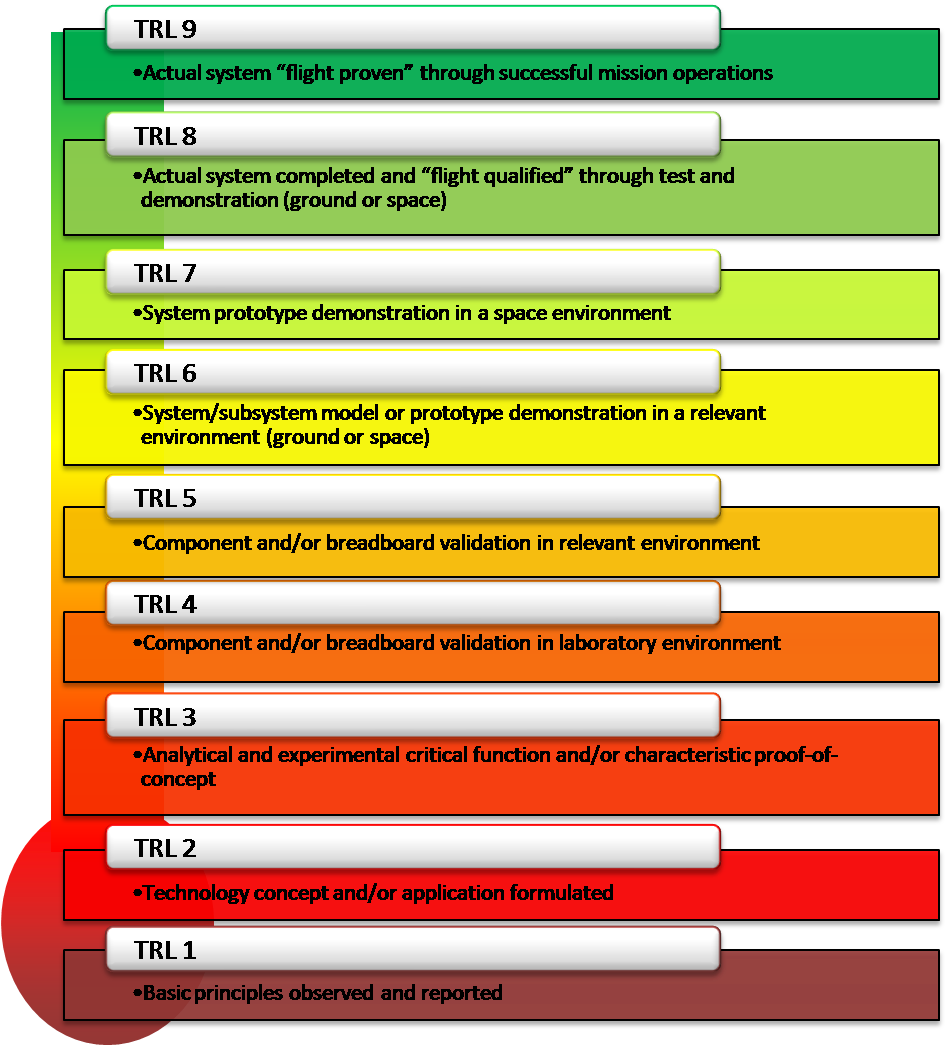
A couple of the real world science related channels I watch use NASA's Technology Readiness Levels (I can't link yet so search the web for "nasa trl") to take a rough guess at when a particular technology will become available or what challenges still need to be solved.
 
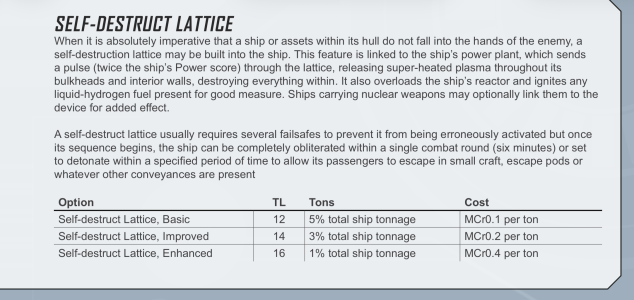
They do have the prototypes in Singularity protected (if that’s the right word) with self-destruct lattices. About to fall into enemy hands? "Code Zero, Zero, Zero, Destruct, Zero."

I’ve added it to the designs.

1770656996379.png
 
Last edited:
Interesting. The way I read the High Guard book is that a Hop 1 can travel 1 to 10 parsecs, but it does not actually list how long that take other than to say the drive in similar in principle to the jump drive. Is it the same time calculation as a Jump Drive in that respect...about 1 week?
 
Interesting. The way I read the High Guard book is that a Hop 1 can travel 1 to 10 parsecs, but it does not actually list how long that take other than to say the drive in similar in principle to the jump drive. Is it the same time calculation as a Jump Drive in that respect...about 1 week?
It is. Singularity Act 2 says this:

"Hop-1 gives a starship the ability to travel across 10 parsecs during a single week in jumpspace, enabling Travellers to cross huge expanses of space in significantly less time than the most advanced jump drive."
 
Last edited:
Interesting. The way I read the High Guard book is that a Hop 1 can travel 1 to 10 parsecs, but it does not actually list how long that take other than to say the drive in similar in principle to the jump drive. Is it the same time calculation as a Jump Drive in that respect...about 1 week?

I don't recall for MgT2, but in T5 you had to enter and exit beyond 1000 diameters as opposed to 100 diameters.
 
It isn’t made to use a longer distance in MgT2, so 100D.

But in T5, it wasn't the "jump" distance attempted, but the drive "type" that determined the entry tolerance. Each successive drive type increased the minimum entry/exit distance by a factor of 10 with use of that type of drive.
 
But in T5, it wasn't the "jump" distance attempted, but the drive "type" that determined the entry tolerance. Each successive drive type increased the minimum entry/exit distance by a factor of 10 with use of that type of drive.
I hear you, yet Mongoose 2e isn’t T5. Unless they change the rules, what T5 does isn’t relevant.
 
So here's a question I haven't seen addressed yet. It's pretty much a given that a Hop-1 (10-parsec) activation would use fuel equal in volume to 10% of the overall ship volume. So... how much fuel does a Hop-1 drive use if it's only traveling (for example) 7 parsecs? Is it still the full 10%? Or would it be prorated down to 7%? I can see arguments either way, and I don't recall seeing anything official in the rules (may have missed it, though). Is there an official ruling, or is this something that's fair game for table rules?
 
So here's a question I haven't seen addressed yet. It's pretty much a given that a Hop-1 (10-parsec) activation would use fuel equal in volume to 10% of the overall ship volume. So... how much fuel does a Hop-1 drive use if it's only traveling (for example) 7 parsecs? Is it still the full 10%? Or would it be prorated down to 7%? I can see arguments either way, and I don't recall seeing anything official in the rules (may have missed it, though). Is there an official ruling, or is this something that's fair game for table rules?
It doesn’t say that the fuel use is fractional. A jump drive in the same system uses a J1 of fuel, so I would say a partial H1 uses an H1 of fuel.
 
Last edited:
*Nod* Like I said, I can see arguments either way, and it's not a huge issue. I'd be inclined to think the same way, just on the basis of easier bookkeeping (and probably using your same argument).
 
*Nod* Like I said, I can see arguments either way, and it's not a huge issue. I'd be inclined to think the same way, just on the basis of easier bookkeeping (and probably using your same argument).
Stop the presses. I just found this in Singularity Act 2:

"The ship they can travel on is the Paradigm Shift, built on the chassis of a Broadsword-class Exploration Cruiser (refer to page 18 of Adventure Class Ships), which features a functional hop drive complete with hop governor, enabling it to hop accurately in increments of 1–10 parsecs per hop, consuming a commensurate amount of fuel. For example, if they only hop four parsecs, the hop drive uses only 40 percent of the fuel for a hop-1."

It seems it does use fractions of an H1 fuel allotment.
 
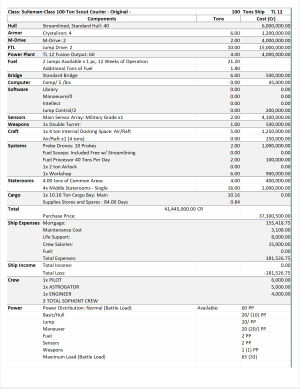
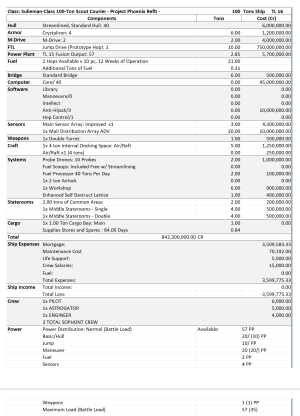
Folks have talked about an H1 courier/express boat. I considered refitting the standard express boat, but it was uninspiring. It needed more flexibility. So, I looked instead to refitting the ubiquitous Sulieman-Class 100-Ton Scout/Courier instead, trying to keep as much capability as possible. The cargo space suffered, since I wanted to keep two hops of fuel and I added the advanced mail distribution array. I had to drop the number of cabins, too, but it does fit. Barely.

I modified the original to use the 6-ton bridge as that is the new standard and converted the extra four tons into a common area. Seems like a reasonable alteration to adapt it to the new rule.

The original:

1770750430049.png

The Phoenix refit:

1770750775419.png
 

Attachments

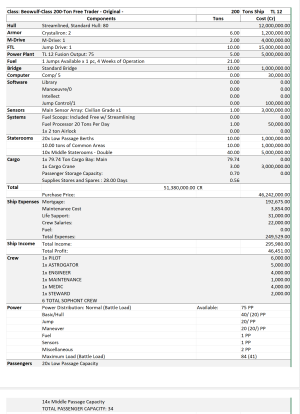
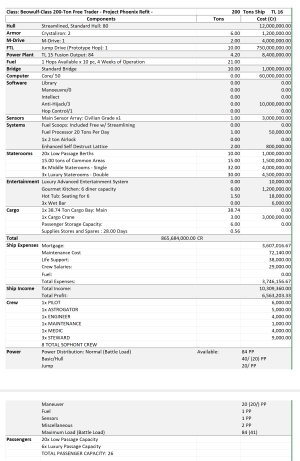
Just to see how a merchant refit would stand up, I took the ubiquitous Beowulf-Class 200-Ton Free Trader and gave it a facelift. With the bump to longer range, I decided the quality of passengers needed to go up to be able to pay the mortgage. The charts only go to freight/passengers at 6 parsecs, so I used that. With the Hop Drive on the horizon, Mongoose needs to expand the chart to 10 parsecs.

Here is the original:

1770752163774.png

And here is the Phoenix refit. Not it can handily pay its mortgage and generate a tidy profit.

1770752216520.png
 

Attachments

Stop the presses. I just found this in Singularity Act 2:

"The ship they can travel on is the Paradigm Shift, built on the chassis of a Broadsword-class Exploration Cruiser (refer to page 18 of Adventure Class Ships), which features a functional hop drive complete with hop governor, enabling it to hop accurately in increments of 1–10 parsecs per hop, consuming a commensurate amount of fuel. For example, if they only hop four parsecs, the hop drive uses only 40 percent of the fuel for a hop-1."

It seems it does use fractions of an H1 fuel allotment.
*Laugh* Figures. I actually concede your argument, based on similar reasoning, and Mongoose overrides the both of us... *Shakes head*
 
Back
Top