
Mgt2 200 ton Frontier Trader

wbnc

Cosmic Mongoose
I''m fleshing out my Merchant/Adventure class starship catalog and thought I'd see what sort of feedback I cold get. This is a TL-12 ship, designed for working in rough neighborhoods. it's a little better armed than a Freetrader with heavier armor, and a few tricks up its sleeve. Also I have been working on my art to add a bit more detail to the designs. unfortunately There is a good bit of detail you can see from this angle..The animated turn around ay follow shortly.
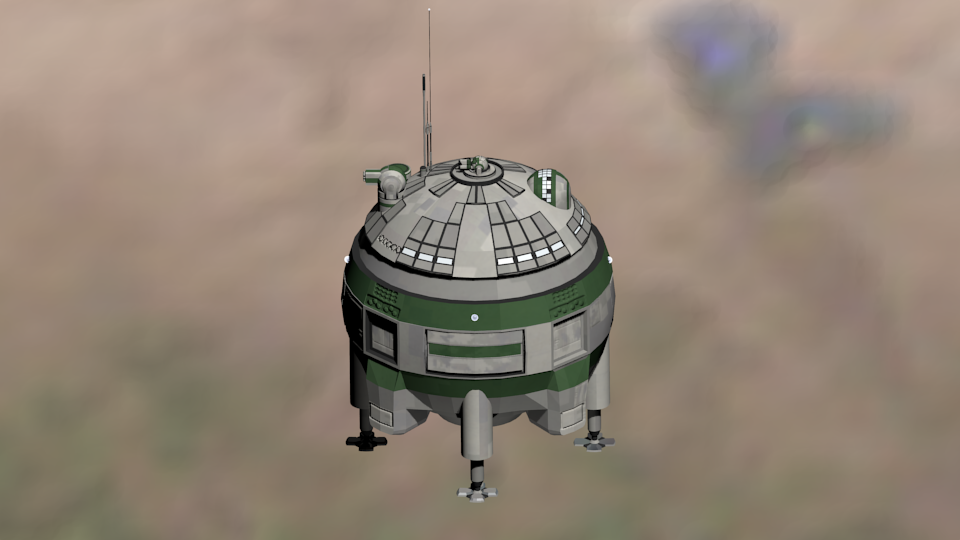
frontier_trader_by_wbyrd-da5n8xj.png

200 ton Frontier trader:

A variant of the Far trader the Frontier trader is a rugged well armed and armored merchant vessel intended for use in poorly patrolled, areas. It has slightly less cargo and passenger capacity than a standard Free Trader, or far trader but it's lower costs, heavier armor and more potent weapons load make it well suited for use in areas where the crew may need to repel attacks from criminals and pirates.

The simple spherical hull of the ship is not fitted with internal gravity systems. To compensate the decks are stacked one above the other, and use the natural acceleration forces of the ships drives to simulate gravity during flight. During Jump travel the crew works and lives in Zero Gee, so often the owner will add basic fitness machines to the common area to allow crews to maintain body tone, and avoid the negative effects of prolonged zero gee exposure.

The ship is not luxurious but it is roomy enough for the crew to enjoy leisure activities in the common area. A crew of four can handle the ship leaving four staterooms open for passengers in addition to the ten low berths included in the design. passengers may be inconvenienced by the zero Gee travel but if the ship is the only available transport headed for frontier regions they are willing to "enjoy" the unusual experience of prolonged weightlessness.

The ship is designed with multiple power sources, and battery packs to ensure that it can operate for extended periods, without taxing the small reactor that powers the ship. In emergencies, the ship's forward hull is plated with solar cells that give it indefinite endurance, and can power the low berths for as long as needed for a rescue ship to arrive.

Since the reactor is capable of producing a surplus of energy, or devoting a significant amount of power to charging the batteries if the ship is not using its main drives. This allows a near constant charge to be maintained in the batteries allowing the ship to make a fast jump out of a system if it has fuel on board.

Even if the batteries are depleted when the ship encounters an attack, a captain of a frontier trader will use the ships reactor to power weapons, sensors, and drives. While the ships solar arrays provide power for basic systems power. while tricky to accomplish this gives the ship the ability to fight maneuver and rapidly charge it's jump batteries when engaged in combat in the inner reaches of a star system.

Hull
Armor 6 Crystal Iron
Performance
Thrust 1
Jump 2
Endurance 4 weeks(***) reactor Fuel,
Power 75
Battery Power 60 Max capacity
Jump Fuel 40
Reaction Drive Fuel N/A
Fuel Scoop/processor 40 tons per day.
Computer bandwidth/5bis
Crew 4
Power requirements
Basic Systems 40
M-drive: N/A
J-drive 40
Weapons: 13
Sensors 2
Low Berth 1
Combat Power load 67
Combat power reserve 8
Battery reserve 60
Combat Jump Power load 107
combat Jump Power reserve 29
Sensors civilian grade Lidar/Radar -2 Dm on related checks
Marines 0
Weapons triple pulse laser
Missile barbette 1-ton ready ammo, 2 tons in reserve.
Accommodations 6 staterooms, 10 low berths, 10Dt common area
Munitions Storage 2 tons
Cargo 61 tons
Additional options
Cargo Crane
Solar cells
HighEfficiency batteries.

Cost Mcr 49.21

It has fewer staterooms than a free trader but better armor, weapons, and almost the same cargo capacity for a bit less up front. and it has the same range as a far trader. and with some fancy work on the engineering panel she can fight, maneuver, and prep for a jump at the same time...although maneuver may be a generous term since she's a bit sluggish.
 
A quick animated turn around of the ship to show off some hidden detail...it' ain't fancy but it works...

200_ton_free_trader_by_wbyrd-da5n24c.gif
 
I like the design, it's simple, utilitarian, and rather handsome. Not lacking detail, but not too much either.

I might question the lack of internal gravity, it doesn't save all that much money and might make it difficult to recruit and retain crew, especially for long tours (such as beyond the frontier).
 
I really like spherical ships and tail landers, probably because I grew up with Germany's Perry Rhodan science fiction, where almost all Terran starships were spherical tail landers. :D
 
rust2 said:
I really like spherical ships and tail landers, probably because I grew up with Germany's Perry Rhodan science fiction, where almost all Terran starships were spherical tail landers. :D
I have to admit a love for the B-tech drop ship style, they were my primary inspiration for this one.... I wanted a more basic "practical" look for this one...and a tail lander is a pretty solid option for a lower tech ship.

AnotherDilbert said:
I like the design, it's simple, utilitarian, and rather handsome. Not lacking detail, but not too much either.

I might question the lack of internal gravity, it doesn't save all that much money and might make it difficult to recruit and retain crew, especially for long tours (such as beyond the frontier).

Thanks for the compliment. I have tried the sphere shape several times with disappointing results...I honestly wish I could claim i knew what I wanted when I started LOL...I kind of channeled Bob Ross...that looks a little bland..I'll just add a happy little antenna cluster.

I had considered adding a few lines to the fluff text commenting on the fact that the lack of internal gravity has affected its popularity. In all reality, it was the only way to get it into the price range of a Standard free trader with all of its extra weapons, armor, and redundant power systems. So I can see the designers going for the cheaper Non gravity hull as a trade off . Then blaming marketing if people weren't enthusiastic about the design choice.

"hey look we met the design specs, hit the price point,and got it out on schedule...If marketing can't sell it, find a new marketing team"
Overheard at a quarterly review meeting.
 
Nice animation.

I would question the lack of g-plating though. Having an internal gravity system makes it much easier for the crew and your cargo. Based on the design, if the ship has to wait while in orbit then the crew will be in zero-g. Spacers will get used to being in/out of gravity due to the job requirements, but our bodies tend to prefer gravity, thus the default idea would be for people in general to prefer having gravity whenever possible.

Also, any cargo you carry will have to take zero-g without issue. While there's not a huge problem with using cargo nets or some other form of restraints to hold your crates/containers in place, the cargo INSIDE must also be packed with the assumption that there will be zero-g applied to it. It may seem like a 'duh!' sort of variable, if you actually strip things down to their basics, manufacturers provide packing materials to meet the minimum necessary standard to transport the goods safely. Adding in the concept that the goods can also drift/float and therefore must remain in the exact position they are crated up in, that would increase costs to them.

These are real-world issues that don't necessarily have to be applied, but if you are trying to craft models that pass the sniff test, they are things that need to be taken into consideration. I just don't see any race capable of building jump-capable starships to NOT implement grav plating. It makes no sense.

Something else to consider is how the cargo is loaded/unloaded. The tail-sitter means it's not as convenient to load as something along the lines of a free trader,with it's cargo deck closer to the ground. Since this is intended for the frontier you have to assume that where it's going may not have much port infrastructure to load/unload, which means you have to bring everything with you. Ships that are lower to the ground and can use simple ramps are better suited for rough neighborhoods.

Other than, things look very interesting.
 
phavoc said:
Nice animation.

I would question the lack of g-plating though. Having an internal gravity system makes it much easier for the crew and your cargo. Based on the design, if the ship has to wait while in orbit then the crew will be in zero-g. Spacers will get used to being in/out of gravity due to the job requirements, but our bodies tend to prefer gravity, thus the default idea would be for people in general to prefer having gravity whenever possible.

Also, any cargo you carry will have to take zero-g without issue. While there's not a huge problem with using cargo nets or some other form of restraints to hold your crates/containers in place, the cargo INSIDE must also be packed with the assumption that there will be zero-g applied to it. It may seem like a 'duh!' sort of variable, if you actually strip things down to their basics, manufacturers provide packing materials to meet the minimum necessary standard to transport the goods safely. Adding in the concept that the goods can also drift/float and therefore must remain in the exact position they are crated up in, that would increase costs to them.

These are real-world issues that don't necessarily have to be applied, but if you are trying to craft models that pass the sniff test, they are things that need to be taken into consideration. I just don't see any race capable of building jump-capable starships to NOT implement grav plating. It makes no sense.

Something else to consider is how the cargo is loaded/unloaded. The tail-sitter means it's not as convenient to load as something along the lines of a free trader,with it's cargo deck closer to the ground. Since this is intended for the frontier you have to assume that where it's going may not have much port infrastructure to load/unload, which means you have to bring everything with you. Ships that are lower to the ground and can use simple ramps are better suited for rough neighborhoods.

Other than, things look very interesting.

After some feedback the nongravity hull has been dumped....the extra capabilities of armorweapons and redundant power should be enough to offset the extra cost.

as far loading and unloading, it has its own crane system that can handle the cargo. I just have that tucked away behind the closed cargo hatch on the side. the process is a bit slower but it isn't a major delay.
 
Have you looked at the potential loss of cargo space due to the configuration? Maybe the cargo hold used internal fuel tanks to provide a more standard cargo hold, but angles or sphere's will lose absolute space when hauling containers (small or large).
 
phavoc said:
Have you looked at the potential loss of cargo space due to the configuration? Maybe the cargo hold used internal fuel tanks to provide a more standard cargo hold, but angles or sphere's will lose absolute space when hauling containers (small or large).

it is a problem I haven't found an easy fix for. I am currently looking at internal layouts for the cargo deck but all of the waste some space. roughly squaring off the hold by using the curved sections as tankage seems to eliminate the voids that aren't useful for cargo at lease partly.
 
wbnc said:
phavoc said:
Have you looked at the potential loss of cargo space due to the configuration? Maybe the cargo hold used internal fuel tanks to provide a more standard cargo hold, but angles or sphere's will lose absolute space when hauling containers (small or large).

it is a problem I haven't found an easy fix for. I am currently looking at internal layouts for the cargo deck but all of the waste some space. roughly squaring off the hold by using the curved sections as tankage seems to eliminate the voids that aren't useful for cargo at lease partly.

Yeah, that'd be the way to go. Though since you say you only have two decks, you may also have to think about floor/ceiling curvature as well. Though since you can play fast and loose with deckplans it's not a huge issue. But it's nice to see a design that incorporates it so you don't have to play too fast or too loose. :)
 
A Sphere of 200 dTons has a 6 inch radius! Ignoring the top and bottom inch for a moment, that’s up to 5 decks!

I would divide the usable space like so:
There is a deck through the middle of the sphere, to maximize the usable space; there’s very little curvature here, so the walls are very straight... you lose less than 13 centimeters from the 9 meter radius!
Below this center deck are two decks of engineering in a narrow cylinder. Power Plant, Jump Drive, and (if you’re not me) Maneuver Drives are here.
Above the center deck... well... I’m not too sure... the top of your ship is... interesting.

Code:
Actual Math:
200 dTons
800 In^3
Radius = 5.76 (Calculated & Rounded by Google)

Rounding up for convenience:
Radius = 6"
Volume = 904.78 In^3 (Calculated & Rounded by Google)
Percentage of Rated dTonage: 1.130975 (Using Google’s Volume)
 
wbnc said:
phavoc said:
Have you looked at the potential loss of cargo space due to the configuration? Maybe the cargo hold used internal fuel tanks to provide a more standard cargo hold, but angles or sphere's will lose absolute space when hauling containers (small or large).

it is a problem I haven't found an easy fix for. I am currently looking at internal layouts for the cargo deck but all of the waste some space. roughly squaring off the hold by using the curved sections as tankage seems to eliminate the voids that aren't useful for cargo at lease partly.

wbnc, the way I do it is to find the volume of a deck slice through the sphere, subtract the full deck height cylinder that consists of the uncompromised height space, and then, with the value of the volume remaining, divide that into “pie slices” of whole dTons, and assign fuel or equipment to each “slice”. Alternately, before you take out the cylinder, shrink it just a little to the nearest full half-dTon, so you don’t have to think about the edges there, either, and then pie-slice the compromised height ring that remains.
 
Tenacious-Techhunter said:
wbnc said:
phavoc said:
Have you looked at the potential loss of cargo space due to the configuration? Maybe the cargo hold used internal fuel tanks to provide a more standard cargo hold, but angles or sphere's will lose absolute space when hauling containers (small or large).

it is a problem I haven't found an easy fix for. I am currently looking at internal layouts for the cargo deck but all of the waste some space. roughly squaring off the hold by using the curved sections as tankage seems to eliminate the voids that aren't useful for cargo at lease partly.

wbnc, the way I do it is to find the volume of a deck slice through the sphere, subtract the full deck height cylinder that consists of the uncompromised height space, and then, with the value of the volume remaining, divide that into “pie slices” of whole dTons, and assign fuel or equipment to each “slice”. Alternately, before you take out the cylinder, shrink it just a little to the nearest full half-dTon, so you don’t have to think about the edges there, either, and then pie-slice the compromised height ring that remains.


thanks for the info...it may come in handy.

one advantage I have is that in blender I can build internal layouts that are to proper scale and test arrangements with cargo containers and other fittings...such as stateroom and bridge mockups. I have been working on internal details and this is one of the models I am using to work out the details.
 
Rectangles seemed to be the most easiest solution to logistics, so holds should be optimized for that.

You could divide the sphere into four parts: the centre as the hold, the top for bridge and staterooms, the bottom for engineering, and the odd hull curves as fuel bunkerage.
 
Condottiere said:
Rectangles seemed to be the most easiest solution to logistics, so holds should be optimized for that.

You could divide the sphere into four parts: the centre as the hold, the top for bridge and staterooms, the bottom for engineering, and the odd hull curves as fuel bunkerage.

I was planning to put two decks up top for quarters and flight deck. and then a cargo bay in the central band. qith drives and power plant inteh lower portion of the sphere. I Definitely had planned to put some tankage around the crew areas since Hydrogen and water make great sumps for charged particles.
 
Inspired by 2001's Clavius Lunar Shuttle??
On cargo, perhaps turn to aircraft hulls which are also circular, but employ angled or form fitting cargo containers or Unit Load Devices: https://en.m.wikipedia.org/wiki/Unit_load_device#/media/File%3AAirbus_A300_cross_section.jpg
 
wbnc said:
I was planning to put two decks up top for quarters and flight deck. and then a cargo bay in the central band. qith drives and power plant inteh lower portion of the sphere. I Definitely had planned to put some tankage around the crew areas since Hydrogen and water make great sumps for charged particles.
The spherical starships of the early Perry Rhodan series had the bridge on the top, the quarters below the bridge, the engineering section below the quarters, and the store rooms and the cargo hatch at the bottom of the ship, with a retractable elevator leading from the ship's bottom to the planetary surface. The actual drives were housed in a horizontal ring around the middle of the sphere.

Just another example of how it could be done. :)
 
phavoc said:
Nice animation.
The tail-sitter means it's not as convenient to load as something along the lines of a free trader,with it's cargo deck closer to the ground.
Other than, things look very interesting.

A cargo crane is mentioned in the description, which in my mind would be an industrial side-loading cargo lift ... but I agree with you Phavoc. My all time favourite is the Type R Subsidized merchant with fore and aft cargo ramps!
 
Back
Top