How to make Traveller more popular with TTRPG players

This is all based on personal anecdotes though. I don’t see many new players, myself, in the interactions I’ve had with them, that are actually that fussed. Moreover, the game system already does support multiple settings so all of this seems like a moot point to me.
When I deal with players who don't have any experience with Traveller, they naturally don't care about that because they don't have any pre-existing thoughts about the game.

When you deal with players who do have a background with Traveller, which you often do when discussing sci fi games online, then you have to deal with this. When folks ask what game to play for a given type of sci fi, there are frequently people discounting Traveller because of this associating with Charted Space and its specific tropes.

We know you can play a wide range of sci fi with Traveller. But that's not how most sci fi games work. They are "Setting: The RPG". They are about a specific IP, the idea that you aren't playing the game in a specific IP is actually kind of unusual in sci fi. And Charted Space has a long history of being heavily marketed as if it was Traveller.

Gurps Traveller, T20, Hero Traveller, this new Traveller 5e are all "Charted Space in some other game system". So, of course people think that the distinguishing feature of Traveller is Charted Space.

I, personally, think that it is beneficial for Traveller rules to cover a lot more material than just what works for the Charted Space setting. That's what I advocate for. I don't want the published rules to be limited to things that work in Charted Space and I don't want Charted Space warped into incoherence by becoming a grab bag of anything there are rules for.

BUT

None of that has anything to do with marketing to new people. Sci fi games are already dramatically less popular than fantasy games. And the great majority of them are IP centric. The only way you are going to get more people to play the game is running the game for them. At conventions, in person, online, wherever.

There's no secret product change that will bring in new players. Charted Space will bring in some players and scare off other players. Nothing you can do about that. But, ultimately, players want games they can find other players for. So they have to be shown that there are other players. And that means the existing players need to run games for new players. Because there's a limit to what a few employees of a small company can actually do.
 
Last edited:
It isn't about supporting settings. It's about Mongoose creating multiple settings that are popular. Like the owners of D&D did.

But the most popular ones were created outside of TSR and WotC, then adopted later. Ed Greenwood created the Forgotten Realms in the late 60's and it was only adopted by TSR about 20 years later. Ravenloft was also created by non-TSR creators and then adopted. Dragonlance was created previous to the creators being employed by TSR, just barely, but still. Dark Sun was developed in house, but most of the design team was new to TSR. I guess what I'm saying is that if Mongoose decides to develop new settings, it might consider looking to the Traveller fanbase for new settings, and then developing any settings they find to have potential.
 
That's why I think looking at Paizo instead of TSR/WoTC is more useful.

Pathfinder and Starfinder are "Setting: The RPG" products. Broad enough to allow a very large number of stories to be told in, but not so generic as to overwhelm. Circumstances meant that they were able to have a clean break from everything that had come before in the D&D lore.

By all means use some area of Charted Space if you like, though I think a similar clean break that moves on from the legacy stuff would work best. Drill down to the real core - characters using skills; tactical firefights; spaceships firing lasers and missiles at each other. Character creation won't need to change; it's one of Traveller's best features.

Keep in mind all I'm proposing here is reframing a setting more in tune with what the average player is expecting from a science fiction game. A lot of the actual details don't need to change much. I'd drop the EC Tubb terminology - skimmers or aircars instead of Air/Rafts. Coldsleep instead of Low Berths.

Jumps can be to hyperspace and take longer the more you're in it.

Aliens. LOTS of aliens. Don't make anyone have to buy a supplement to play a robot. Charted space gets in the way of itself at times here.
 
But the most popular ones were created outside of TSR and WotC, then adopted later. Ed Greenwood created the Forgotten Realms
Doesn't matter if made in house or purchased from an outside author. They have to be in the stable of the game company and managed by an in house product manager type person. Gamers don't care about the economics behind the scenes.
 
Doesn't matter if made in house or purchased from an outside author. They have to be in the stable of the game company and managed by an in house product manager type person. Gamers don't care about the economics behind the scenes.

Gamers don't care, but what matters is that Mongoose's staff writers can't be expected to do it all.
 
I'd drop the EC Tubb terminology - skimmers or aircars instead of Air/Rafts.

Agreed. In the Dumarest stories an air/raft was very much like a raft. Open to the elements, relatively slow moving, and not particularly maneuverable. It was a slow flying cargo transporter. A Traveller air/raft is a flying car.
 
I'd include pretty much any thing, term or concept that you might have scratched your head over when first reading whatever version of Traveller was your first one.

Mind you, I didn't even understand guns at 14. My firearms education started with '77 Traveller.

I did think the laser power packs were dumb, though.
 
Last edited:
Agreed. In the Dumarest stories an air/raft was very much like a raft. Open to the elements, relatively slow moving, and not particularly maneuverable. It was a slow flying cargo transporter. A Traveller air/raft is a flying car.
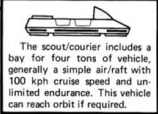
Now they are. They were pretty much open air flying rafts back in the day. Cruise speed around 60mph and no roof. That's faster than a Dumarest Air/raft but sloooooow by any kind of grav vehicle or aircraft standards.

1765860017495.png
 
Agreed. In the Dumarest stories an air/raft was very much like a raft. Open to the elements, relatively slow moving, and not particularly maneuverable. It was a slow flying cargo transporter. A Traveller air/raft is a flying car.
I must admit, when I first encountered Traveller in the early 1980s, I erroneously assumed that the Speeder in the LLB was the primary means of transport, and the air/raft was to be a minor player in the personal transport area, mainly for moving cargo in an open top platform. How wrong I was!
 
I, personally, think that it is beneficial for Traveller rules to cover a lot more material than just what works for the Charted Space setting. That's what I advocate for. I don't want the published rules to be limited to things that work in Charted Space and I don't want Charted Space warped into incoherence by becoming a grab bag of anything there are rules for.
This is what I am not understanding here. The Traveller rules are not limited to the Charted Space setting. They haven’t been since 2008 since Mongoose initially had the Traveller licence. The Traveller rules are used for 2300AD and, soon to be added, Pioneer and Dark Conspiracy. There have been others in the past, including 3rd party content and, I’d imagine there are more in the pipeline.

Charted Space itself is, frankly, a kitchen sink sci-fi setting - a broad church vehicle for telling a diverse range of science fiction stories. It suits the rules because it has essentially evolved from the rules.

And, as you point out yourself, none of this makes any difference whatsoever to marketing the game to new players or anybody else. So why is it a point of contention on this thread which is, ostensibly at least, about making Traveller more popular with TTRPG players?
 
And, as you point out yourself, none of this makes any difference whatsoever to marketing the game to new players or anybody else. So why is it a point of contention on this thread which is, ostensibly at least, about making Traveller more popular with TTRPG players?
No idea. Some folks are arguing that Traveller should be Charted Space: The RPG. Other people are arguing that Charted Space needs to be dumped in the trash. I think both of those things are a bad idea and neither of them will make the game more appealing than it already is.

But I disagree with a lot of the premise of this thread. Traveller is, in fact, one of the most popular sci fi games out there already. Sci fi is just not a very big slice of the ttrpg pie. Star Wars has more brand recognition. I don't know how big the actual player base is. Mothership has more buzz, but it is obviously very specifically a horror game. And there is Starfinder, which is basically fantasy in space. It apparently sells the best, though I don't think anyone has good metrics for that.

Traveller is selling metric f-tons more product than just about any other sci fi game out there. Mongoose is producing a LOT of material for the game and its selling well enough that they can keep doing that and fund new variants.

Mongoose and the Traveller player base is not very good at Con presence, especially in the US. So all these "Most popular games at big Con" always looks bad for Traveller. Sometimes it seems like Traveller players go to Traveller specific conventions rather than the general cons.

Mongoose isn't particularly good at online presence either. Not the worst out there, but nothing special. By far the best online thing about Traveller is Travellermap and that's not even an official product of the company. And the 2nd best thing is probably Seth Skorkowsky.

But neither of those things have anything to do with the product itself. Changing the product is not going to change either of those things. Changing those two things is what's going to change that perception. Like I said back on page one of this thread, the only way to make Traveller more popular as a product is to make it a fantasy genre product.

The rest is just making people aware of just how successful Traveller actually is. And maybe sending Irklan to deal with everyone who keeps repeating the tired 'death in chargen' meme.
 
It isn't about supporting settings. It's about Mongoose creating multiple settings that are popular. Like the owners of D&D did.
The propagation of multiple settings - and, thereby, fractured audience markets - was a major factor in the death of TSR. MongooseMatt has explicitly said that they're very aware of that, too.

It's a shame: TSR created some amazing settings during that period. But it helped kill them.
 
If it interests anyone, here is the data from last year from match.rpg.net: it's not perfect since it only counts those who have rpg.net accounts, for one thing. But right now it is probably the best data we have available, and the largest sample size from a neutral platform that's available (even VTTs likely have a larger bias due to availability of rulesets). It'll be skewed, but the overall distribution is the best we have available.

1765877505391.png
Thanks primarily to the Alien TTRPG, the share of Sci-Fi isn't as low as I had feared. It's still very much dwarfed by fantasy and particularly by The Big One.

Traveller is the sixth sci-fi RPG in the list, which is a good sign: there is growth potential there. Three of the sci-fi systems above it are tied explicitly to popular culture licenses, however.
 
Last edited:
Like I say, the only license really viable on that list is Star Wars. I could have seen a Traveller version of Alien, perhaps, but it has been well taken by Fria Ligen now. Cyberpunk and Shadowrun are their own beasts, and the former has a lot of media profile from it’s computer game and TV show these days. Starfinder is really just Pathfinder in space so their sizeable market for the fantasy RPG probably mostly accounts for the same group buying their sci-fi game.

Star Wars hasn’t really been doing anything as a licensed RPG product, however, for some time now however. With it’s 50th Anniversary occurring the same year as Traveller’s I genuinely think that an approach from Mongoose could pick up some really impactful on their overall profile and sales, if they could get the license.

I do note that Star Trek Adventures and a number other sci-fi games still seems behind Traveller’s nominal placement of #20. I’m surprised there seems to be no mention of Warhammer 40K games. I think Mongoose should be targeting the Top 10 though.
 
And, honestly, only Star Wars is really the same genre as Traveller. As in Traveller and Star Wars can do the same range of things.

Aliens and Cyberpunk do very specific things extremely well. Traveller could do those games (with some effort since it doesn't have the focus of those two) but those games don't really the rest of space opera at all.

I don't know if I put Urban Fantasy like Starfinder & Shadowrun in the sci fi category at all. I feel like doing elves and magic in futuristic settings is the point of those games, not doing sci fi? But that's a matter of opinion.

I guess I just don't think that someone who wanted to play Aliens, Cyberpunk, Shadowrun, or Starfinder is looking for anything other than that very specific game. Like you wouldn't ask for that game if you didn't want that exact thing.
 
I'll quibble.

There is a society to fit into, because each planet's society is an amalgamation of Vilani and Solomani/Sylean culture, with the exception of the homeworlds of the minor human races. Planetary cultures will have their variations to be sure, sometimes great variation, but they still have their roots in either Vilani or Solomani culture. The vast majority of people speak Anglic and/or Vilani, and it even says in Classic Traveller that the people of the Imperium regard themselves as "Imperial", which suggests that they feel a common identity. The Imperium, over time, would impose its own norms in some areas of culture in order to maintain order and ensure the flow of trade, and it would do this through the nobles overseeing each of its subject worlds (I know it's supposed to be "member" worlds, but let's not kid ourselves). I mean things like imposing regulations that Anglic is the only language used in Imperial starports, and that the Imperial Credit is the only currency accepted in Imperial starports. I'm not suggesting that this is all stated in the rules somewhere, I'm stating that logically empires do things like this, and so the planetary cultural variations are going to be just that, variations, not different cultures unintelligible to each other. The Falkland Islanders didn't turn into headhunting savages or raise up idols to sea gods after 200 years of separation from Britain, they stayed British. Icelanders stayed culturally stable for 1000 years despite their remote location. My point is that Vilani and Solomani populations on the worlds of the Imperium would remain mostly culturally and linguistically stable, even over the centuries, and they would have some fundamental commonalities with each other, and therefore it is possible for characters from the Imperium to be connected to this culture.

But let's take it down to a smaller scale. You've stated that characters can't be connected to society because there is no society to connect to, because all planets are their own different societies. I say that characters can be connected to society because they can be connected to part of it, like the part of it that hires them after they muster out, and they can care about that part of society. If they become retainers for the noble house ruling the Lunion subsector, they're going to become accustomed to the culture of the world of Lunion. In the course of their missions they'll become familiar with other worlds of the Lunion subsector. They become connected to the society of Lunion and the other worlds of the subsector to a greater or lesser extent.
I will happily quibble your quibble.

Where in all the Mongoose Traveller Third Imperium corpus does it mention that every human world is a mixture of Vilani, Solomani, minor human race cultures left to stew for over two thousand years and produce cultures as widely different as those detailed in the Aramis subsector in the Traveller Adventure?

Your Falklands and Iceland analogies do not work in my opinion, as neither of those societies has been isolated, there has been continual trade and travel between those islands and their homelands. A better anology would be the Viking settlers of north america we know existed... where are they? Some are now suggesting that Viking DNA can be found in certain "native ameriacn" tribes. Were they wiped out or were they assimilated?

The linguistic stability of the Imperium is pure fantasy, the long night lasted long enough for every language on every planet to diverge - 6 7 times. The Third Imperium requiring planets to educate their populations in the Imperial language is the more likely explanation, it is the Stargate SG1 problem. 8for the first few episodes they showed the language barrier, then mysteriously is disappeared and everyone understood english...)

I will ask this about the Third Imperium setting. Where is the detail about the noble households and the oversight of subsector dukes?

I am all in favour of writing a Third Imperium primer that goes into this sort of PC facing setting detail, but as things stand I doubt if a person new to the game would find this stuff easily, which is why I say the TI is not fit for purpose.

A supplement detailing a subsector and a noble household, the megacorporations, the free trader organisations, the mercenary goups, the industrial espionage agents for hire, how the Imperium and these organisations keep the Imperial peace within all those different self governing worlds in the subsector...
 
Last edited:
I wonder how many contributing to these threads have introduced new people to there games in the last couple of years?

I have.

I started with character generation and gave a brief description of the setting, and then it was off to Death Station. My crib sheet for the Third Imperium was not passed around until either the fourth of fifth setting, I forget which but I can ask one of them, they may remember.

I loaned out several of my print on demand copies of The Traveller Book - that book has a lot of setting details but they do not appear until right at the end of the book, they are not interwoven as they are in MgT core rule book.
 
I have two groups: one of four players old enough to have played Traveller back in the 1980s, a another four completely new that I brought across from 5e.

All enjoyed different aspects of the game. Some were really into trading and watching the credits roll in. Some like being spies and agents. A couple just like shooting stuff and seeing big explosions.

The setting never came into it because I did all the work so when they arrived at a planet I give them a rundown of what they knew given their characters or what they need to know if they bother to look up the information.

I have never been asked deep lore questions by any of my players.
 
1. Air/raft is an ingenious pun.

2. You have to write settings that players want to inhabit and experience.

3. If you don't, it will take time, effort, and money to convince them to try.
 
I wonder how many contributing to these threads have introduced new people to there games in the last couple of years?

I have.

I started with character generation and gave a brief description of the setting, and then it was off to Death Station. My crib sheet for the Third Imperium was not passed around until either the fourth of fifth setting, I forget which but I can ask one of them, they may remember.

I loaned out several of my print on demand copies of The Traveller Book - that book has a lot of setting details but they do not appear until right at the end of the book, they are not interwoven as they are in MgT core rule book.
Since I don't run inside the 3I, I didn't ever give a lore dump about it. A little detail about their homeworlds, some of which was made up with them, and "How do jump drives work" covered just about everything. They don't care about the deep lore unless it affects the adventure they are on.
 
Back
Top