How much actual volume required per crewman in a military spaceship?

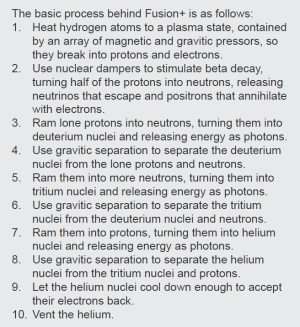
Fusion+ (which I think is basically the TL12 technology) was detailed in Starship Operators Manual, from 2024. Essentially, it's gravitics assisted AND nuclear damper assisted. Earlier fusion systems probably did make use of gravitics, since that tech comes in around the same time as viable fusion plants. Maybejust the part 1 of Fusion+, using gravitic squeezing as a supplement to electromagnetic containment?

1770764937374.png
 
The reason I break things up that way is that there are definitive fusion plant versions at TL8, TL12, and TL15 and gravitics does not appear as a technology until TL9.
 
The reason I break things up that way is that there are definitive fusion plant versions at TL8, TL12, and TL15 and gravitics does not appear as a technology until TL9.
Gravitic drives do not appear until TL9, however, lifters and basic gravitic tech is TL 8, hence the TL 8 air/raft.
 
Yep. Gravitic assisted fusion does not equal M-Drive.

For what it's worth, WBH lists "basic Fusion+" at TL10. The full process described in SOM would be a mature version, probably the TL12 standard, with the TL15 version a more advanced design that may not involve any different processes but utilising more advanced versions of the TL12 ones.

So, I'd posit the following:

TL8: Basic gravitics, allowing practical early fusion powerplants through better plasma confinement (step 1). Steps 9 and 10 seem likely not to require any more advanced technology, especially step 10.
TL10: Early Fusion+, using more advanced gravitics to aid the process by separating isotopes (Steps 4 6 and 8)
TL12: Mature Fusion+, adding nuclear dampers (step 2). Nuke dampers as a screen come in at TL12, so this seems a likely match.
TL15: Advanced Fusion+

Steps 3, 5, and 7 might be introduced at any of the TLs. My hunch is they might be part of early Fusion+, but get more efficient at higher TLs.
 
Last edited:
I recognize that rules-as-written list TL8 lifters before TL9 gravitics. I treat that as presentation order rather than engineering history. In my model, large-scale, brute-force field effects appear before refinement and domain formalization.

TL8 lifters represent early gravitic field manipulation: static lift systems that partially offset local gravity wells. They are bulky, power-intensive, and limited in gradient control. They allow levitation and atmospheric transport, but they do not provide gravity-independent thrust or meaningful inertial control.

TL9 marks gravitics as a formal engineering discipline. At this point field generators become stable and vectorable at macro scales. Maneuver drives capable of 1G sustained thrust in any direction become possible, along with artificial gravity and inertial damping up to 1G. However, this remains coarse field control, sufficient for modest propulsion and habitat stabilization, but not yet precise enough for plasma-scale confinement.

TL9 fusion at my table therefore remains magnetic containment, derived from TL8 electromagnetic bottles and refined with incremental construction improvements (represented mechanically as gaining one Advantage under the shipbuilding rules). It does not yet employ gravitic plasma shaping.

True gravitic fusion confinement emerges at TL12. This is an architectural shift, not a refinement. Gravitational gradients are now stable and precise enough at microscopic scales to shape and stabilize the fusion reaction directly. That transition represents the maturation of gravitic precision engineering. You could spend a lot on a prototype at TL11 if you have credits to melt.

By TL13, gravitic thrusters are compact enough for vacc suits, reflecting another order-of-magnitude reduction in size and control tolerance.

And that's why I also model a new architectural shift for the TL15 fusion plants. At TL15, fusion plants incorporate internalized damping controls based on nuclear damper principles. This improves containment stability and safety margins without changing the underlying reaction type.

In short: Static lift precedes vectorable thrust. Vectorable thrust precedes gravitic precision. Etc.

 
I don't recall when, probably parsing through my previous posts archive would give an indication, but when looking at the Traveller technological tree, I came to the realization it's pretty dependent on the understanding and application of gravity.

Technological level eight with air/rafts and basic fusion, being the primary clue, and manoeuvre and jump drives at technological level nine.

That gave me the epiphany, that almost the entirety of Traveller technology is weighed down by that breakthrough.
 
history-history-repeating-apple-falling_apple-sir_isaac_newton-CS620197_low.jpg


So, we're waiting for the apple to drop on someone else.
 
I can also imagine that contra gravity that is in the same direction as the gravity gradient could be easier than across the gradient.

You can easily use gravity to move something down towards the centre of the earth (you just drop it). When anti-gravity lifters are introduced it might simply be a reverse polarity aspect and it becomes equally simple to "drop it" up.

Moving you from side to side using gravity is more complex, traditionally requiring a block and tackle, cams, pivots, tracks etc. and these require an external fixed point to operate from. Perhaps the TL delta was discovering a gravitic "fixed point".
 
I think that gravitational propulsion can be expressed in a number of ways.
well, gravity is a know scientific phenomenon. It is only curvature of space. So you either create a gravity well that pulls you or a gravity "hill" that repels. There is no other ways. One could lift by creating a well above an object to lift it and move towards the direction you wanted to move, (pulling you along) or create a "hill" below to push you up and move it towards the "rear" of the direction you want to go.
 
Extreme example being projecting a micro black hole, though I haven't come across something that naturally repels objects, like similarly poled magnets.

For manoeuvre drives, gravitational force is thrust outwards in a specific direction.

My theory for gravitational motors that would be installed in grav vehicles, is that it's a field effect, that allows the vehicle to float, and dipped, presumably forward, to provide propulsion in a falling motion.
 
For manoeuvre drives, gravitational force is thrust outwards in a specific direction.
Gravity is not a force. We now know that for certain. Needs to be expunged from the any rules. If you put a G well in front of and above the craft you can make it go up, hover, go forwards etc. But there's no force projected. You can see it in action in the last USAF tic tac video released when pieces of an exploded device get caught up in the same gravity well pulling the tic tac along. It works exactly as a friend of mine who was an SR-71 pilot described it from the briefings he was given about not flying too close to such craft
 
Back
Top