I recognize that rules-as-written list TL8 lifters before TL9 gravitics. I treat that as presentation order rather than engineering history. In my model, large-scale, brute-force field effects appear before refinement and domain formalization.
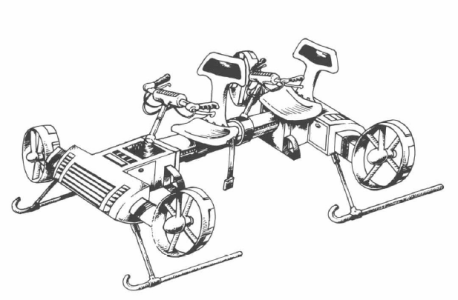
TL8 lifters represent early gravitic field manipulation: static lift systems that partially offset local gravity wells. They are bulky, power-intensive, and limited in gradient control. They allow levitation and atmospheric transport, but they do not provide gravity-independent thrust or meaningful inertial control.
TL9 marks gravitics as a formal engineering discipline. At this point field generators become stable and vectorable at macro scales. Maneuver drives capable of 1G sustained thrust in any direction become possible, along with artificial gravity and inertial damping up to 1G. However, this remains coarse field control, sufficient for modest propulsion and habitat stabilization, but not yet precise enough for plasma-scale confinement.
TL9 fusion at my table therefore remains magnetic containment, derived from TL8 electromagnetic bottles and refined with incremental construction improvements (represented mechanically as gaining one Advantage under the shipbuilding rules). It does not yet employ gravitic plasma shaping.
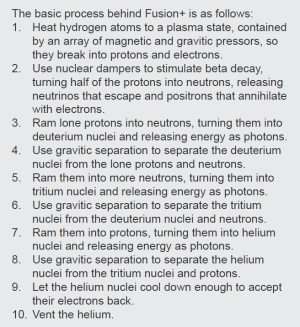
True gravitic fusion confinement emerges at TL12. This is an architectural shift, not a refinement. Gravitational gradients are now stable and precise enough at microscopic scales to shape and stabilize the fusion reaction directly. That transition represents the maturation of gravitic precision engineering. You could spend a lot on a prototype at TL11 if you have credits to melt.
By TL13, gravitic thrusters are compact enough for vacc suits, reflecting another order-of-magnitude reduction in size and control tolerance.
And that's why I also model a new architectural shift for the TL15 fusion plants. At TL15, fusion plants incorporate internalized damping controls based on nuclear damper principles. This improves containment stability and safety margins without changing the underlying reaction type.
In short: Static lift precedes vectorable thrust. Vectorable thrust precedes gravitic precision. Etc.