WBH Compatibility Rating

Dodo98

Banded Mongoose
Hey @Geir
I think I've found another point for your errata list. The example for the compatibility rating on p. 131 seems weird. The formula clearly says: 2D - Biocomplexity / 2 + DMs. So with the numbers provided for Zed Prime, it should be 7 - 5/2 + 2 = 6.5 (rounded down to 6). But the example uses: 7+3-2.5+2 = 9.5 (rounded down to 9). The extra +3 seems wrong here, unless I'm missing something.
 
@Geir You've already had that one in your errata list, sorry I missed that one.

But I have another quick question. The DM-2 for a "Solar tidally locked (1:1) world" in the Habitability section, only applies to planets locked to a star but not to moons locked to a planet or planets locked to a moon, correct?
 
In WBH, "world" can mean either "planet" or "moon".
A "tidally locked" world can be either a planet locked to a star or a moon locked to a parent planet or a planet to its moon.
The "Mainworld" determination is either predetermined (in the continuation method) or selected from candidate mainworlds (in the expanded method). Even if a world is not selected as the mainworld, it still can be a "significant world."
The Habitability Rating section exists in the World Physical Characteristics chapter. This chapter examines what makes a world unique and needs only be taken as far as the Referee desires.
The Highest Habitability Rating is one of the criteria for selecting a Mainworld from the Candidate Mainworlds, therefore both planets and moons need their Habitability Rating calculated, unless the Referee fiats the moon as insignificant.
The referee does not need to check every significant world in the system for characteristic lifeforms but should consider doing so for worlds in the Habitable Zone. => Since a world can be either planet or moon, then this applies to moons in the Habitable Zone, as well as planets.

But I have another quick question. The DM-2 for a "Solar tidally locked (1:1) world" in the Habitability section, only applies to planets locked to a star but not to moons locked to a planet or planets locked to a moon, correct?
The Habitability Ratings DM table on page 132 is unlabelled and should say if it is applicable for all worlds (both planets and moons) or if it is specifically just for planets.
The entry for "Solar tidally locked (1:1) worlds" does specifically emphasise the stellar body case, although "solar" strictly means pertaining to the sun (Sol), rather than pertaining to any star.

 
The entry for "Solar tidally locked (1:1) worlds" does specifically emphasise the stellar body case, although "solar" strictly means pertaining to the sun (Sol), rather than pertaining to any star.
Exactly. Because the DM is for there being a distinct bright, dark, and twilight side on the world. If the moon is in orbit around a planet, it should have a day/night cycle equal to its period of revolution around its planet.

I suppose there is some chance that a world would be locked to a planet that's locked to a star and the world is at the sun-planet's L1 point, but that's not a stable orbit. Or shouldn't be. And even then, the moon's darkside would at least get some planetshine.
 
Over and above all of this, everything will seek equilibrium, and solar system timescales start in terms of millions of years.

A satellite becoming tidally locked to its primary is normal, unless there are other bodies that affect it, in which case they usually find a resonance or the system is unstable and objects migrate into other orbits. Earth/Moon is a simple example - Mercury/Sun/Everything else is a complex one.

Worth noting all the large moons in the solar system are tidally locked, and those that have sister large moons are in orbital resonances with them as well.

If you REALLY need to work out this stuff outside of how far away from the planet a moon orbits, you may be better to plug the numbers into an app or program.
 
Last edited:
Exactly. Because the DM is for there being a distinct bright, dark, and twilight side on the world. If the moon is in orbit around a planet, it should have a day/night cycle equal to its period of revolution around its planet.

I suppose there is some chance that a world would be locked to a planet that's locked to a star and the world is at the sun-planet's L1 point, but that's not a stable orbit. Or shouldn't be. And even then, the moon's darkside would at least get some planetshine.
You might see it happen if the satellite was tiny, maybe a captured asteroid, or ejecta that made orbit.

It would have to be small enough that its tidal effect on the planet was insignificant, but it's probably realistic, if so.
 
@Geir
I have another question that has been on my mind for a while, but I always forgot to ask. With some moons, the composition indicates that they are mostly ice, but these moons have been given a hydrographics value of 0 (even though I used the method on page 100 so that size 0 or 1 worlds can also receive a hydrographics value). I find it somewhat difficult to rationally explain how a world that consists mainly of ice can have no surface ice. Or perhaps there is a logical explanation for this that I am overlooking. I'm playing with the thought of giving worlds that mainly consist of ice always a minimum hydrographics value of 1, but I wanted to hear your thoughts first :)
 
@Geir
I have another question that has been on my mind for a while, but I always forgot to ask. With some moons, the composition indicates that they are mostly ice, but these moons have been given a hydrographics value of 0 (even though I used the method on page 100 so that size 0 or 1 worlds can also receive a hydrographics value). I find it somewhat difficult to rationally explain how a world that consists mainly of ice can have no surface ice. Or perhaps there is a logical explanation for this that I am overlooking. I'm playing with the thought of giving worlds that mainly consist of ice always a minimum hydrographics value of 1, but I wanted to hear your thoughts first :)
That's definitely an artifact of Traveller's mainworld generation system, so it's less than ideal, but a way to think about it is to distinguish a surface ice sheet, like a glacier, from the world's bulk composition, which might be a mix of ice and rock at the surface. So for the hydrographics, it represents mostly pure ice chunks that you can toss into an onboard fuel refinery, where for icy crust, you'd probably need a mineral refinery to get to the water and then hydrogen without the rocky, dusty bits.
 
There's also what ices are present. Carbon Dioxide is common, even as close in as Mars. At outer system temperatures, methane and ammonia are expected.

(Athough potentially those last two ARE good sources of hydrogen. But you may need specialist gear to extract it from them; water is more common in most places, and simple to crack, so it makes sense that by default Traveller ships are set up for that).

I agree with Geir - hydrographics is accessible surface water or water ice. Anything that needs more than boiling and electrolysing it is something else, that requires more time or different equipment.
 
(Athough potentially those last two ARE good sources of hydrogen. But you may need specialist gear to extract it from them; water is more common in most places, and simple to crack, so it makes sense that by default Traveller ships are set up for that).
Why would you need specialist gear? At most you would need to melt/vapourize them just like water ice as they are the same materials you scoop from gas giants for fuel.
 
Ships are set up to split water to hydrogen and oxygen. You would need different equipment to turn Methane into Hydrogen and Carbon. Or possibly Oxygen and Methane into Hydrogen and Carbon Dioxide, depending on the process. But burning Methane to get H2 and CO2 is a straightforward reaction... which you can't perform in an electrolysis chamber.

Gas Giant skimming is just ram filtering gaseous molecular hydrogen directly. We were discussing ices.
 
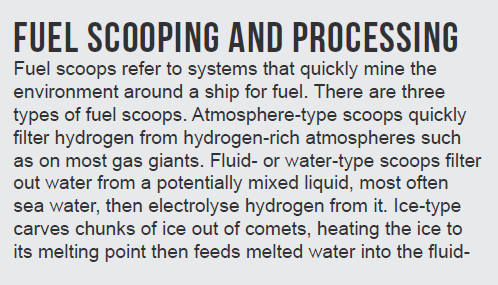
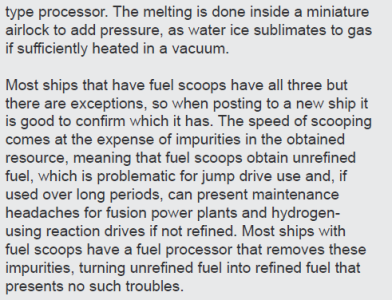
SOM is fairly specific on this:
1768864485902.png
1768864519861.png

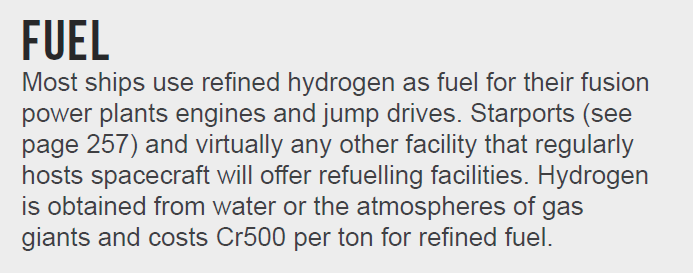
But even CRB says atmospheric Hydrogen or Water:
1768864711518.png

*POSSIBLY* you are thinking of metal hydride fuel storage? But if you have that installed, it comes with the equipment to store and release the hydrogen. You would still need to obtain molecular hydrogen to fill it up.
 
SOM is fairly specific on this:
Which I haven't been able to acquire locally. Still seems that what is gathered is unrefined fuel requiring the fuel processor to make into refined. It isn't just filtered.

I always had the impression that any hydrogen compound could be processed.
 
Well, as I posted, current CHB says otherwise. I'm assuming you have that.

I'm fairly across all the GDW editions, and have never heard that one, at least as far as standard fuel processors are concerned.

Obviously it would be chemically possible to engineer equipment that can process stuff other than water, but that appears to be an edge case that's rarely required, and a needless expense if not.
 
Hey @Geir
I think I've found another point for your errata list. The example for the compatibility rating on p. 131 seems weird. The formula clearly says: 2D - Biocomplexity / 2 + DMs. So with the numbers provided for Zed Prime, it should be 7 - 5/2 + 2 = 6.5 (rounded down to 6). But the example uses: 7+3-2.5+2 = 9.5 (rounded down to 9). The extra +3 seems wrong here, unless I'm missing something.
Might it be worth using the Feedback forum (which is for this sort of thing) and sticking it all into one thread where it is easy to see all of the answers at once? As it is Geir or anyone else who wants to see the discussion will have to know that there are numerous threads dotted aruond the place.
 
Back
Top