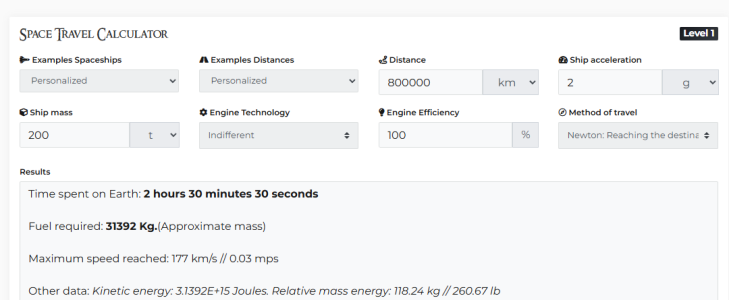
The tables in the Mongoose core book are really, really useful in giving a quick reference, particularly when a lot of people break down when presented with a mathematical formulae. Event the basic idea of burn, flip and burn can be tricky to minds poisoned by Star Wars.
However, presenting that in the CRB as the only option in getting from A to B focuses those who don't have a physics background or who haven't read lots of hard sci fi away from thinking about the choices they actually have. You can still do them, as long as your referee has the science knowledge to not forbid it, but many won't know this or at least won't want to try to figure it out.
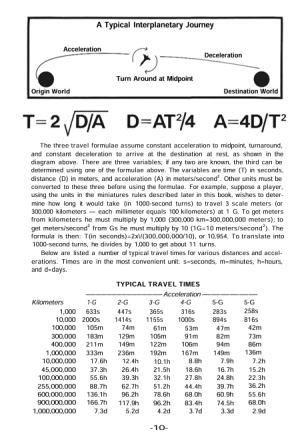
These travel options should be laid out in the CRB and travel times tables for them included ( at least as regards the two main options).
Option 1:
Basically, you are most likely to want to either arrive with little or no vector relative to the destination object, so accelerate to the midpoint, flip, decelerate to the destination IF you want to board something, land on something, orbit something. Probably also if you want to engage in combat with something, at least if you want an extended combat (this also assumes functionally unlimited M fuel, which is usually the case in Traveller)
The implications are that you will be moving at relatively slow velocity relative to the departure object when leaving, and relatively slow velocity to the destination object when arriving at the destination. The travelling ship can make decisions which affect this - by decelerating a bit less on the approach for example, to fly quickly by the destination.
In the middle of the journey, the travelling ship will be moving really fast relative to other objects in the star system (often 100s of KM per second), so unless a intercepting ship is on an intercept course (i.e. has the right starting vector and M drive capability to do this), any interaction between the travelling ship and other objects will be very brief.
Option 2:
Sometimes, you will want to accelerate to a point, and either want to be moving fast, or don't care if you are moving fast (i.e. you want to get to 100 diameters, or you are being chased by Space Pirates and getting away is the overriding priority. Or you are scouting and just need to take a peek at something, but quickly. Or you want to shoot something, but just need to get one shot off, rather than have a sustained combat).
In this case, the travelling ship will be travelling very fast relative to the destination point.
While you could try to land on a destination object, the outcome will be a large crater. You'll not walk away in one piece, or to quote AJ Rimmer, "if you do, it will be one large flat piece"
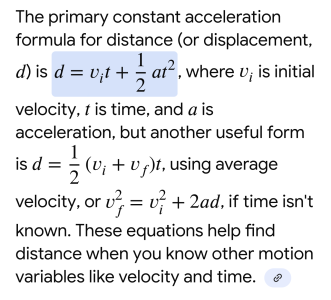
In these cases, you can arrive sooner than with Option 1, and retain a large vector. You need the no turnaround formula Rinku cites,
T = √(2D/A), D = AT²/2, A = 2D/T² to figure out time, distance or acceleration for these scenario.
The CRB really should have a table with these travel times in there because 1) people without the needed background need to know it is possible to do this, and so this makes it clear it is a RAW thing with official blessing 2) it is an easy reference for at least one very common scenario - that the PCs' ship is accelerating to 100Ds to jump. Diagrams like those from Rinku's post comparing the scenarios would make it clear to even those with no science background what is happening.
Other travel options:
Other options come up far less frequently, but the main one is optimizing for fuel rather than time. This is relevant mainly if 1) you don't have enough fuel (reaction drive only or some kind of shipwreck scenario) or 2) you don't want to use the M Drive for stealth reasons. The reason why these are marginal cases in Traveller is that 99.9% of the time, when you have M Drives like Traveller ships do, it just doesn't make sense to consider other that Options 1 and 2. However, these can come up as options for players trying to think their way around problems.
Hohmann transfers, gravity slingshots, atmospheric braking, or shorter burns followed by a longer coast to the destination, should all be mentioned, and their implications briefly discussed in the CRB. Probably there are others I didn't think of. Obviously, the math can get really complex to get it exactly right, but even just giving the Referees and players an idea of the implications opens the possibilities, and suggests they should maybe look it up - or just don't worry about it if it isn't relevant to the scenario.