The Core Expeditions Errata

A jump 1 ship that carries 50% of its displacement as fuel can make five one parsec jumps. If that jump 1 ship is TL12 is can take three fuel reduction advantages and now only needs to carry 35% of its displacement as fuel.

But I don't think that is what Vormaerin is alluding to. Within the current setting, using the rules as written in various supplements empty hexes, even those in rifts, are no linger empty empty. Given sufficient time, political and economical will then there are discoverable refueling points in just about every "empty" hex.

The setting should really apply its own rules. You can have light sabres arc weapons, personal energy screens, robots, protoyupe TL16 and 17 fabricators... but for some reason PC scale toys are acceptable but infrasctructure isn't considered. Is it because applying such technologies would require a complete re-write of the setting?

It's not as if the Imperium is just discovering the rifts last week, they have had a thousand years to map the "empty" hexes.
 
You trade time for space.

If you have fuel already onboard, the period spent between jumps would be mostly for checking your position and the equipment, which if it's a day, would make that about six weeks traversing five parsecs.

The way I calculate it, technological level twelve jump drive factor/three is the best compromise, between the two.
 
Any Jump-2 or greater capable ship that carries a droptank equal in size to the ship's tonnage can make 5 jumps of 1 parsec each before it uses its internal fuel. This makes crossing most rifts trivial, but time consuming. This also works with jump 1 ships, but you must build the engine to handle a ship 2x the actual size.
 
It's time consuming, sure. But compared to going all the way around through Corridor? A big chunk of strategic discussion in the setting acts like losing Corridor to the Vargr is like "OMG, we can't reinforce the Marches!". And the coreward side beneath the claw is a military backwater because no one can realistically come at them across the rifts. And there's various discussions of Zhodani-Imperial strategies that assume you have to go certain routes because the empty spaces can't be crossed.

And this is fundamentally no longer true in the rules.


EDIT: Mind you, I like the Empty Hex rules in general. But they have unintended consequences for the way Charted Space specifically works.
 
It's time consuming, sure. But compared to going all the way around through Corridor? A big chunk of strategic discussion in the setting acts like losing Corridor to the Vargr is like "OMG, we can't reinforce the Marches!". And the coreward side beneath the claw is a military backwater because no one can realistically come at them across the rifts. And there's various discussions of Zhodani-Imperial strategies that assume you have to go certain routebecausethe empty spaces can't be crossed.

And this is fundamentally no longer true in the rules.


EDIT: Mind you, I like the Empty Hex rules in general. But they have unintended consequences for the way Charted Space specifically works.

Unless what makes up the Great & Lesser Rifts is more than just empty void with sparsely scattered interstellar objects . . .

Are there other anomalies or general navigational hazards present that render the Rift crossing difficult except in certain known or well charted regions?

That isn't canonical of course, but perhaps there are reasons other than simple size/distance that make the Great Rift "Great" ...


The actual Great Rift, or Cygnus Rift, which lies close to that bearing and distance are overlapping nebular/molecular clouds at varying distances from Earth that are optically opaque and obscure visible/optical (but not infra-red) observation. Maybe certain regions are more generally opaque than others, and obscure hidden anomalies or other dangers.
 
Sure. They could come up with alternative reasons why the Rifts are problems. They have suggested some jump space anomalies in the various books. The point, again, is that the setting currently does not reflect the rules. Adding technologies and rules concepts that change the way the setting works should result in the setting being changed to reflect them. Or they should be flagged as not applicable to that particular setting. Or some equivalent result.
 
Recent observations of the voids between galatic clusters suggest that voids are strange places.

Whether smaller light year wide voids could have similar properties hasn't been examined to my knowledge.

Because of gravity voids tend to be really empty. There is far more mass outside of the voids than inside and given billions of years that draws almost everything with mass out of the void including dark matter.

Whether dark energy is also drawn out is an unknown, but there are some theories that the expansion of space isn't uniform and that the space inside the void could be expanding at a different rate to surrounding space that contains a lot for matter.

This could mean that the fabric of spacetime may have lumps or ridges and valleys where the different rates of expansion distort the Lorentzian manifold.

Now it comes down to how jump space works in traveller. It is known that objects with mass bend the fabric of space with what we call gravity. However the jump shadow seems to be based on the physical dimensions of an object with is why a star has a big jump shadow while a blackhole has no jump shadow.

There have been mentions in traveller of jump space annomalies like jump reefs. So if the fabric of space is distorted in a void that could act as a potentially massive jump shadow that would cause starships to misjump.

If you go with the above then it could take centuries of exploration to find safe routes across major voids. A ship could risk jumping its way across but given the risks of misjump few would take that option. Also with far fewer objects with mass or gravity refueling or setting up resupply stations would be a difficult task requiring massive resources.
 
What's optional, are jetstreams between star systems, that can either increase or decrease time spent in jumpspace.

Or, maybe require less fuel, and/or said fuel usage pushes you into the next hex.

It's unlikely this will ever canonically be mapped out, but regional general gravitational force, or lack thereof, may effect travel in other dimensions.
 
However the jump shadow seems to be based on the physical dimensions of an object with is why a star has a big jump shadow while a blackhole has no jump shadow.

Is this alluded to somewhere in a current Mongoose Publications?

I am not aware that this has been ever explicitly stated anywhere. Some of the current Mongoose material implied that the 100D rule of thumb does not necessarily apply to compact objects (like Degenerate Dwarfs or Neutron Stars, and presumably, Singularities) - and I think this makes sense - that the relationship is more complex than either mass (gravitational potential) or volumetric (size/density) considerations alone.
 
Is this alluded to somewhere in a current Mongoose Publications?

I am not aware that this has been ever explicitly stated anywhere. Some of the current Mongoose material implied that the 100D rule of thumb does not necessarily apply to compact objects (like Degenerate Dwarfs or Neutron Stars, and presumably, Singularities) - and I think this makes sense - that the relationship is more complex than either mass (gravitational potential) or volumetric (size/density) considerations alone.
Not in a Mongoose Publication that I am aware of but it goes way back into the age of Classic Traveller.

This is an example from the wiki.

627-301 Blackhole
 
Not in a Mongoose Publication that I am aware of but it goes way back into the age of Classic Traveller.

Classic Traveller never said anything about the issue of Neutron Stars or Black Holes and their Jump limits that I am aware of. The issue has not formally been raised prior to recent times.

This is an example from the wiki.

627-301 Blackhole

Never use the wiki itself as a source, only the references that it cites. I assume you are alluding to the infobox with the stars and their limits. The infobox has "0" 's for the Black Hole because the info is unknown (i. e. there is no data for the standard formula in the template to work from).

I believe MgT2 World Builders Handbook has jump and maneuver diameter modifications for extreme objects like collapsed matter.
 
Last edited:
Is this alluded to somewhere in a current Mongoose Publications?

I am not aware that this has been ever explicitly stated anywhere. Some of the current Mongoose material implied that the 100D rule of thumb does not necessarily apply to compact objects (like Degenerate Dwarfs or Neutron Stars, and presumably, Singularities) - and I think this makes sense - that the relationship is more complex than either mass (gravitational potential) or volumetric (size/density) considerations alone.
Cool, I get to quote myself: World Builders Handbook, page 18 has a blue box on it. It gives three options (of which I personally prefer the second):
1. Use actual 100D,
2. Use stellar mass instead, where 100D for one solar mass is 0.93 AU
3. Use #2, but use the photosphere of the star (this applies to red giants and most supergiants) as the start of the 100D calculation.

To me, the mass basis #2, makes the most sense.
 
Cool, I get to quote myself: World Builders Handbook, page 18 has a blue box on it. It gives three options (of which I personally prefer the second):
1. Use actual 100D,
2. Use stellar mass instead, where 100D for one solar mass is 0.93 AU
3. Use #2, but use the photosphere of the star (this applies to red giants and most supergiants) as the start of the 100D calculation.

To me, the mass basis #2, makes the most sense.

I think I would base it off of the g-value of Sol at 100D, and recalculate the distance for that value for a 3-4+ M Sol singularity, since most stellar-mass black holes are at least that massive.

Or is that what you were saying and I misunderstood?

In any case, I would not use the Event Horizon as the basis of the diameter (i.e. Option #1) as it is a purely mathematical surface, not a physical one - there is nominally "nothing there" at that radius. It is merely the distance from the singularity where the escape velocity = "c".

(Of course, I like the tidal force model of g/meter rather than simple g-value.)
 
Last edited:
Now it comes down to how jump space works in traveller. It is known that objects with mass bend the fabric of space with what we call gravity. However the jump shadow seems to be based on the physical dimensions of an object with is why a star has a big jump shadow while a blackhole has no jump shadow.

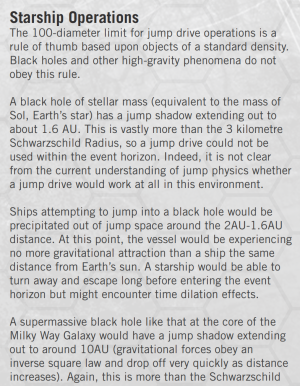
According to the Great Rift box set (The Great Rift - Book 4 - Deep-Space Exploration Handbook) this is not true:

1773434658524.png
 
Cool, I get to quote myself: World Builders Handbook, page 18 has a blue box on it. It gives three options (of which I personally prefer the second):
1. Use actual 100D,
2. Use stellar mass instead, where 100D for one solar mass is 0.93 AU
3. Use #2, but use the photosphere of the star (this applies to red giants and most supergiants) as the start of the 100D calculation.

To me, the mass basis #2, makes the most sense.
Personally, for a quick answer about the jump shadow of stellar-scale or more massive object, I use:

0.93 * (cube root of the object's mass in solar units) AU.

It's a quick approximation which gives a workable answer. Probably could be refined further, but the MOARN principle applies here. If the answer's good enough, why quibble?
 
I think I would base it off of the g-value of Sol at 100D, and recalculate the distance for that value for a 3-4+ M Sol singularity, since most stellar-mass black holes are at least that massive.
Yes. But I may be slightly muddled today.
Or is that what you were saying and I misunderstood?
Yeah, I left it a bit vague, but assumed that it would be linear based on mass.
But, if my slightly muddled math on a napkin (okay, sticky note) is good, then it would really be more a factor of the square root of the mass, so a 4 solar mass black hole would have a 'shadow twice the size of the sun's 100D limit.
In any case, I would not use the Event Horizon as the basis of the diameter (i.e. Option #1) as it is a purely mathematical surface, not a physical one - there is nominally "nothing there" at that radius. It is merely the distance from the singularity where the escape velocity = "c".

(Of course, I like the tidal force model of g/meter rather than simple g-value.)
I thought of it as the jump shadow being the 'depression' in space (if space where a rubber mat like those two-D examples with deformations based on the mass pushing 'down'. The bigger the mass, the deeper (and wider) the depression.
 
Personally, for a quick answer about the jump shadow of stellar-scale or more massive object, I use:

0.93 * (cube root of the object's mass in solar units) AU.

It's a quick approximation which gives a workable answer. Probably could be refined further, but the MOARN principle applies here. If the answer's good enough, why quibble?
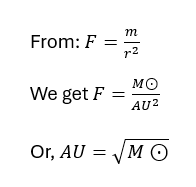
Please bear in mind that medication has been taken (nice, passive tense, blaming nobody), but my assumption would be:
1773456372373.png
assuming that F is what we want to start with.
 
Back
Top