Soo.... Airlock freebies

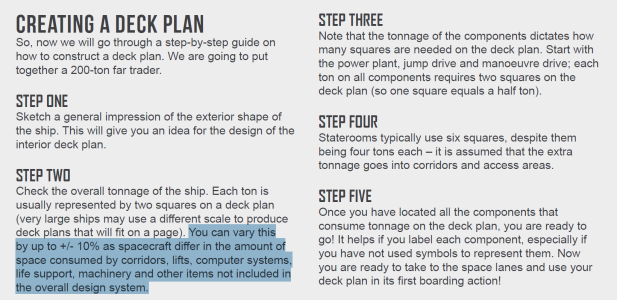
The latest interpretation I read was that the free airlocks fall into the +/- 10% for ship deck plans.
We'll have to see if that changes in the upcoming HG review.

My house rule is that I differentiate between pressure doors for bulkheads and full on airlocks which have additional equipment for safe ingress/egress. Pressure doors and cargo doors are emergency exits ("alarm will sound") or for use in atmo/hangar bay. True airlocks have to be paid for in spreadsheet tonnage.
 
Where's that ten percent variable coming from?

Is it fuel tanks?

Then, we can calculate more finely actual fuel requirements for transitions.

Is it engineering?

We tend to pay per tonne for the volume that engineering takes up.

Though, we could sardinize staterooms, with little consequence.
 
Where's that ten percent variable coming from?

Is it fuel tanks?

Then, we can calculate more finely actual fuel requirements for transitions.

Is it engineering?

We tend to pay per tonne for the volume that engineering takes up.

Though, we could sardinize staterooms, with little consequence.
It's part of creating deck plans and is nebulous in my opinion. High Guard says the one airlock per 100 dtons is free, but I personally don't believe it should be no tonnage.

1776888111723.png
 
That's why it's absurd, and can't bear scrutiny.

Initially, considering the two percent allocated to bridges, a lot could be assigned to that, such as ship's locker, and the additional airlocks, if not taken to extremes.

Outside of which, the plumbing costs a default two hundred kilostarbux per two tonnes.

If applied to a primitive planetoid, accounting for, but not actually installing a free airlock per hundred tonnes, becomes an infinite money machine.
 
That's why it's absurd, and can't bear scrutiny.

Initially, considering the two percent allocated to bridges, a lot could be assigned to that, such as ship's locker, and the additional airlocks, if not taken to extremes.

Outside of which, the plumbing costs a default two hundred kilostarbux per two tonnes.

If applied to a primitive planetoid, accounting for, but not actually installing a free airlock per hundred tonnes, becomes an infinite money machine.

Don't forget that up to 25% of the displacement for some spaces can be allocated to access.
 
They should redo all of the published ships to meet what their rules say. The rules don't exist if even the company that makes the rules can't use them right. Obviously though, that would be whenever they update the books that have those ships in them.
Frankly, they should just add a rule saying "Subject to GM discretion, a ship's final size and cost can he adjusted by +/- 10% of what the design rules say, as different manufacturers and engineers will design things more or less optimally". Then the ships can retain their designs and people can stop complaining that they're not perfectly rules legal (and they can simulate the fact that not every stateroom is going to take up exactly the same amount of tonnage from every manufacturer, etc).
 
You can easily justify varying deckplans, if only to fit in access and odds and ends, because the roof height isn't fixed.

Access, twenty five percent or otherwise, would be to specific spacecraft components, hence accessways within engineering, and corridors to staterooms; they don't cost anything, nor take up extra space.

Default bridges should have quite a lot of empty space, in order to be able to access controls and monitoring equipment.
 
If we're accounting every system that the base hull might contain, we're returning to MegaTraveller, and I don't consider that a good thing or expect Mongoose to cater to it.

But if that's someone's thing, by all means go for it in their game.
 
Use common sense. Does it make sense for a 500 dton craft to have 5 airlocks? Each one is a breach in the hull and a possible risk. They are used to enter and exit, and if there is no need, then why have it?

The rules are, at best, a guideline. The rest comes from the designer.
 
Each one is a breach in the hull and a possible risk. They are used to enter and exit, and if there is no need, then why have it?
You can have internal airlocks. An air lock isolating cargo from passenger areas or crew and passenger areas. In case of a hull breach you isolate the area but you can still get in and out unlike an air tight hatch which would release the air from the air tight section. Also a security breach on one door could give warning to respond before the criminal makes it through the other door.
 
All the more reason to leave it to deckplan design, having a sensible scheme of access and compartmentalisation.

...or an awkward scheme, if the ship is a conversion. Or if the designer was a bit rubbish.
 
The reason consistency is a requisite, is because it's science fiction.

Things can be made up, but need to follow the laws of physics, as stated in that universe.

A hatch isn't necessarily airlocked, but it helps.
 
You can have internal airlocks. An air lock isolating cargo from passenger areas or crew and passenger areas. In case of a hull breach you isolate the area but you can still get in and out unlike an air tight hatch which would release the air from the air tight section. Also a security breach on one door could give warning to respond before the criminal makes it through the other door.
Well, sure, technically it's true. If the ship had labs onboard you may have an airlock for those. You may have medical isolation airlocks, etc.

But for the most part that's just a standard door with enhanced security. Or, if you have reinforced bulkheads, it's a door between sections.

I think the definition of airlock in your case is being overly expansive. An airlock for egress from a ship is (usually) going to be designed for personnel to come in, to go through a decontamination process looking for pesky bugs, to blow off potentially hazardous particles, etc. You may have maintenance locks that are meant more for a person to be able to access a part of the ship that may not have the extra's the regular airlocks where you let outsiders in from your ship or where crews normally return.

Airlocks have a specific function, and security sections/doors would not need all this expensive functionality. Traveller internal doors function as "airlocks" inasmuch as they can hold an atmosphere on the other side. In this case all doors would act as airlock doors.
 
But for the most part that's just a standard door with enhanced security. Or, if you have reinforced bulkheads, it's a door between sections.
Not what I meant. It needs to have 2 doors both air tight and capable of being evacuated to vacuum to be an airlock. Though for some purposes you might do without the evacuation, that still isn't what I intended. One air tight door doesn't constitute an airlock in my view, it is just an airtight door.
 
Not what I meant. It needs to have 2 doors both air tight and capable of being evacuated to vacuum to be an airlock. Though for some purposes you might do without the evacuation, that still isn't what I intended. One air tight door doesn't constitute an airlock in my view, it is just an airtight door.
Agreed (on airtight door). I would expect any spaceship to have the ability to seal off corridors and evacuate the air using the environmental system.

Aside from having massive redundancy needs, which most ships would not normally do, there isn't much of a reasonable need to have many internal sections like this. Space is always going to be valuable on a ship, as well as costs, so unless that need is great you'd not install them.

Always your mileage may vary sort of thing.
 
Internal airlocks let you enter the section in vacuum to do repairs without putting another section in vacuum to do so. Also lets the guy who made it into the rescue bubble to rejoin the rest of the crew and not worry about the bubble running out of air. I mentioned the security element earlier.
 
Back
Top