
Solomani Confederation (Military)

Confederation Navy: Airships

L. The lifting body has ten usable spaces out of fifty, at sixty five kilostarbux, and a speed band of high.

M. The blimp has ten usable spaces out of a hundred. at thirty kilostarbux, and a speed band of medium.

N. Drop the speed from high to medium, you get an extra five spaces, one of which would be usable, cost reduces to fifty eight and a half kilostarbux.

O. That would be 5'318.18181818 per usable space.

P. The advantages of the lifting body are half the volume for a given usable space, at a seventy eight percent premium.


Confederation Navy: Airships

Q. That would be what would be aimed for.

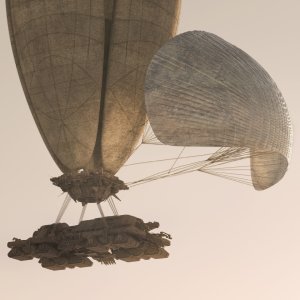
R. But, it seems obvious that's it more grav powered, with the balloon giving additional lift.

S. External crane would be used to carry large sized loads, upto the airship's designed cargo capacity.

T. Current heavy lift helicopters have a capacity of twenty tonnes.

U. I'm not sure you could trade air speed for additional cargo capacity, on the spot.
 
482880073_18132288493398470_6565501355585972414_n.jpg


Confederation Navy: Airships

V. The above seems an interesting variant, with the balloon giving lift, and the sail providing direction and propulsion

W. Though it seems doubtful that you can squeeze much speed from it.

X. Too bad that wouldn't work with a solar sail.

Y. Since any secondary drive acceleration would, by a far margin, exceed that of the solar winds, with the sail likely being more of a drag.

Z. Though, onboard lasers could be used to bombard the sail, to give it an additional boost.
 
Confederation Navy: Airships

1. For airships, you have to wonder exactly what happens to range, if you just park the airship at a specific orbit, indefinitely.

2. Potentially, that's infinite, until something breaks, or you run out of food.

3. Presumably, you can harvest water from humidity, or a passing cloud.

4. Likely, for all aircraft, range has to include maintaining orbit against wind currents.

5. Updrafts, downdrafts, crosswinds, headwinds, tailwinds.

6. Which would include helping or hindering movement, which results in modifying range.

7. Time spent being exposed to those wind conditions, times wind speed.

8. If anchored by ropes to the ground, range modification would not apply.

9. Unless the motors are also actively counteracting the wind.
 
Confederation Navy: Airships

A. Performance customization isn't really worth it, since advancing a speed band doubles cost.

B. Lowering the speed band only benefits with a ten percent discount, and a ten percent space increase.

C. You might want speed to mitigate headwinds in adverse weather conditions.

D. With a default six thousand klix range, you could sacrifice three quarters of that, gaining you an additional thirty percent extra spaces.

E. That would change the cost to five kilostarbux per usable space for a lifting body.

F. 2'307.6923076923 starbux per usable space for a blimp.
 
Confederation Navy: Airships

G. Without a full ten usable spaces, cutting speed bands or fuel capacity isn't worth it, since you don't get the benefit of extra spaces.

H. Fuel efficiency directly affects cost, not spaces.

I. You could lower costs by thirty percent. if you lower range by seventy five percent.

J. Lifting body adjusted cost per usable space, forty five and a half hundred starbux.

K. Blimp, twenty one hundred starbux per usable space.
 
Confederation Navy: Airships

L. By using sails more commonly seen on waterborne vehicles, a light chassis can be propelled at some surprising speed.

M. However, the vehicle is utterly reliant on prevailing conditions and its maximum speed can never exceed that of the current wind.

N. This increases the Cost per Space by Cr200.

O. Tech Table TL/Speed 1-6/Very Slow 7-9/Slow 10+/Medium

P. Borrowed from Unpowered Vehicle chassis, but I think it applies if you switch off the engines, and attach a set of sails.
 
Confederation Navy: Airships

Q. Although it is rarely done intentionally, a vehicle can be weakened by using poorer quality materials or just tolerating shoddy construction.

R. A vehicle can decrease its Hull by -25%, by decreasing its Cost per Space by -25%.

S. This may be done once.

T. Together with the seventy five percent range reduction, that would discount the cost of a vehicle by fifty five percent.

U. Which, for a four usable spacer lifting body is twenty times cheaper than the default air/raft, at the same speed.
 
Confederation Navy: Airships

V. Twenty spaces would make a lifting body, or blimp, as large as the maximum size of a light ground vehicle.

W. Four usable spaces, about the capacity of a compact car.

X. Thirteen hundred times twenty, times forty five percent, is eleven and three tenths kilostarbux.

Y. Fully inflated, that would require a shipping space of ten tonnes.

Z. Deflated, two tonnes shipping space, plus a helium or hydrogen pump.
 
Confederation Navy: Airships

1. Assuming that daily rental rates for transportation, specifically personal, is point three or or point four percent of the purchase price.

2. That would be for eleven and three tenths kilostarbux, about thirty four to forty five starbux, for the compact lift/air.

3. Though, if the rental company had bought a fleet of them, the wholesale price would have been much lower.

4. One issue that's sort of hard to address in Traveller, is planned obsolescence.

5. It should be very obvious to everyone within that universe, what the technological upgrade path is.

6. With that knowledge, deliberate micro level upgrades would seem, for a rational actor, to be something to be disregarded.

7. If there is no demand for something shiny and newy, careful maintenance of rental transportation should stretch their useful lives just before major refurbishment is required.

8. Avoidance of taking such a depreciation hit, would be the impetus of disposing the rental transportation on the second hand market.

9. I'm not sure when quirks start appearing for Vehicles, but presumably, that's a decade's worth.
 
Confederation Navy: Airships

A. For customization of airships, twenty spaces becomes the minimum size.

B. Four hull points are easily calculated to drop to three.

C. Anything smaller still would drop a hull point, though for game purposes, one would assume you still need a minimum of one.

D. That would make ten spaces the absolute minimum if you weaken the hull.

E. I would guess that would be the equivalent of an open frame for other chassis types.

F. Not actually an option for airships, since it doesn't make it go up a speed band.
 
Confederation Navy: Airships

G. At the other end of the stick, two hundred usable spaces should be enough for cattle class in a regional airliner.

H. Technological level seven would seem internal combustion engine.

I. Technological level eight would seem an electric engine.

J. Speed is the same as technological level seven, so besides increased range, odds are that the propellers, presumably, or ducted fans, are going to be more silent.

K. Regional should be one to two hours, so at maximum speed of three hundred klix, destinations should be about five hundred klix.
 
Confederation Navy: Evolution of Line of Battle Ships

1. I was considering that if the technological level fourteen Prometheus class fast dreadnought was the analogue to the Queen Elizabeths, then how would the perspective of the other classes appear?

2. That would make the Victory class battlecruisers dreadnought armoured cruisers.

3. The equivalent to the Invincible class.

4. I'd say that the first ship of the class would be the Nike.

5. Since the Victory itself, would be preserved in an anti gravity drydock on Terra.

6. The oldest existing warship from Terra's Age of Sail.

7. The Constitution having been eminently domained as an Imperial yacht, and transported to Capital.

8. Being still somewhat seaworthy.

9. Currently suspected to be resting either in some obscure marina, or at the bottom of one of Capital's oceans.
 
Confederation Navy: Evolution of Line of Battle Ships

A. Since technological level twelve starwarships had existed before, towards the end of the Interstellar Wars, the Victory class was just a reinvention of the dreadnought armoured cruiser.

B. Which would mean that early technological level twelve, line of battle ships would be considered semi dreadnoughts.

C. And before that, line of battle ships would be predreadnoughts.

D. Considering that the Russian Baltic Fleet managed to sail half across the world, a coastal battleship has at least factor/one jump drives.

E. That would allow redeployment anywhere within a hex.

F. Possibly factor/two, considering that British monitors were considered to support operations in South East Asia.
 
Confederation Navy: Evolution of Line of Battle Ships

G. Warships without jump drives, would be more guard ships.

H. It would be parked in orbit, or a nearby satellite, guarding a planet or a starport.

I. Without a functioning jump drive, redeployment would be somewhat risky, especially if a diversion occurred.

J. Guardships are less likely to have high acceleration performance.

K. They could also be third class battleships, or lower.
 
Confederation Navy: Evolution of Line of Battle Ships

L. Guard ships have two purposes.

M. To intercept any major assault on a planet or starport, and allow any other military assets the time to mobilize.

N. To make any assault rather expensive, if not stop it in it's tracks, before it can damage any planetary or starport facilities.

O. That doesn't mean that there aren't any other defences, fixed or otherwise.

P. But the guard ship would act in a way, that would draw any attackers' attentions on itself.
 
Confederation Navy: Evolution of Line of Battle Ships

Q. The Victory class conception would be that it's small enough to minimize strain on existing Confederation naval and shipbuilding infrastructure, but have enough performance to threaten a technological level twelve Imperium dreadnought.

R. It would have to be at least a hundred kilotonnes, in order to take advantage of increased structural integrity, and lower crew requirements.

S. Performance would need to utilize the latest jump drive technology at three parsec range.

T. And the highest feasible acceleration that could be squeezed out of standard manoeuvre drives.

U. Which eventually turned out to be factor/five.
 
Confederation Navy: Evolution of Line of Battle Ships

V. Tradition would indicate that the spinal mount would be a meson gun.

W. Since we'll assume that the Confederation has a limited industrial capacity to manufacture starwarships, they'd have to decide on one principal weapon system, and stick with it.

X. Which would be why the meson gun factor/three would be selected, for the line of battle ship, likely modern guard ships, and deep meson sites for strategic worlds.

Y. This would be powerful enough to place into hazard Imperium Navy dreadnoughts.

Z. And certainly overawe any Aslan battle group.
 
Last edited:
Confederation Navy: Evolution of Line of Battle Ships

1. In combat, a mass driver spinal mount is unlikely to hit any moving target, considering it's orbital bombardment, and short range.

2. The railgun variant has a range of medium, which immediately invites an opponent to either stay in long range, or send in the greyhounds of space, to dogfight at close range.

3. Or, both.

4. At twenty two and a half kilotonnes, you could have considered a particle accelerator factor/seven, at twenty two thousand and fifty tonnes.

5. Or, find a way to squeeze in a full factor/eight particle accelerator.

6. This might work for a space navy with a large enough starwarships, that can accommodate a weapon system that can only be used in vacuum, for it's full effect.

7. Capital starwarships have both the roles to fight other capital starwarships, and, like star destroyers, project power planetside.

8. Meson spinal mounts are a great compromise, in terms of range, tonnage, cost, and damage, between these two roles.

9. So if industrial capacity is limited, or, at least, at a premium, this would be the one to choose.
 
Confederation Navy: Evolution of Line of Battle Ships

A. With the technological level thirteen breakthrough, a new battlecruiser class was commissioned.

B. The way I interpret the given statistics, it was equipped with a larger meson spinal mount.

C. However, I think that since the factor/three should be competitive enough, it would be retained as the primary armament for the Zeus class.

D. Primary differences between it, and the Victory class, would be that the Zeus class had a better balance of secondary armament and protection.

E. That would allow the Confederation Navy to retain the technological level twelve factor/three meson gun production lines.

F. Since they wanted to skip to a technological level fourteen factor/five meson gun, and the Zeus was seen as an intermediary solution before what became the Prometheus class fast dreadnought.
 
Last edited:
Back
Top