Shipyard Capacity calculation

Spartan159

Cosmic Mongoose
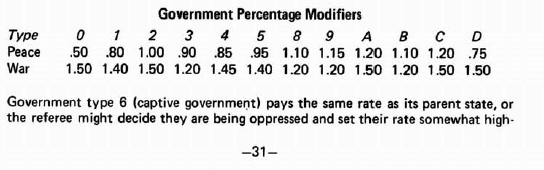
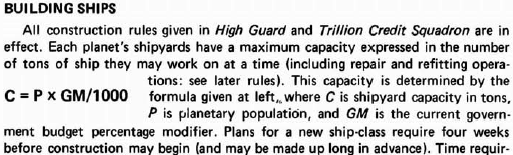
Somewhere there is a calculation that ends up with the shipyard capacity of a given planet, it's used on the Wiki. Does anyone remember where this is and what the calculation was?

 
In this case TCS and WBH handbooks are talking about different things. TCS is referring to the world's ability to construct its navy, while WBH is really sticking to the commercial shipyard capacity, I think.

Keep in mind the whole starport rating system (which you are free to modify in YTU) is based around Starships need a Type A, Non-Starships need a type B, repairs can be done at a Type C. WBH pp198-199 is talking about *build* capacity. As discussed on p199 a given type C may have no build capacity at all, but by definition still has repair facilities (otherwise it would be a Type D).
 
Last edited:
In this case TCS and WBH handbooks are talking about different things. TCS is referring to the world's ability to construct its navy, while WBH is really sticking to the commercial shipyard capacity, I think.

Keep in mind the whole starport rating system (which you are free to modify in YTU) is based around Starships need a Type A, Non-Starships need a type B, repairs can be done at a Type C. WBH pp198-199 is talking about *build* capacity. As discussed on p199 a given type C may have no build capacity at all, but by definition still has repair facilities (otherwise it would be a Type D).
The capacity from WBH is for build, overhaul and repair & refit.
 
No. It's very specifically build capacity. DOCKING capacity (p198) is a separate measure, and that covers repairs and maintenance.
 
Also, that capacity would be civilian capacity. Military shipyards would not be part of what the starport accounts for. Naval Bases would basically have their own construction yards.
 
Also, that capacity would be civilian capacity. Military shipyards would not be part of what the starport accounts for. Naval Bases would basically have their own construction yards.
One thing that came up in previous discussions about shipyard capacity was that the naval yards were not typically used for naval construction except in wartime situations. They normally allow civilian yards to do the naval construction under contract while the Naval yards do maintenance, repair, and some prototypes to test some features and equipment.
 
One thing that came up in previous discussions about shipyard capacity was that the naval yards were not typically used for naval construction except in wartime situations. They normally allow civilian yards to do the naval construction under contract while the Naval yards do maintenance, repair, and some prototypes to test some features and equipment.
I don't disagree, but is this written somewhere. I would think with entire systems dedicated to the Navy (The Depots), they would have construction capacity too. Currently the US navy has dedicated shipyards for its ships. They might be operated and staffed by civilians, but they are "owned" by the military. Groton Connecticut, New London, Mobile, etc. I freely admit I do not know how other countries build their naval ships.
 
I don't disagree, but is this written somewhere. I would think with entire systems dedicated to the Navy (The Depots), they would have construction capacity too. Currently the US navy has dedicated shipyards for its ships. They might be operated and staffed by civilians, but they are "owned" by the military. Groton Connecticut, New London, Mobile, etc. I freely admit I do not know how other countries build their naval ships.
Agreed. Depots are major fleet bases with significant construction and repair capabilities. However I'd think that while they may have that, they typically operate at lower capacity levels. They have no need to build 6 dreadnoughts at the same time, but with sufficient lead time they could ramp up since certain facilities (the equivalent of drydocks and cranes) are present and functional (or even mothballed). Many shipyards are not configured to regularly work on 100+ Dton ships - even a distributed shipyard - but a depot would have dedicated facilities to do this on a normal basis.

And don't forget that one of the tasks of a depot is to maintain the mothball fleet and rotate ships out of mothballs for upgrades and normal maintenance. So their repair capacities would should definitely outstrip that of a normal facility.
 
Naval depots would be specialized in every aspect of construction, refurbishment, and repair.

Shipyards which are privately owned, likely tend to lobby, and donate campaign contributions.
 
Naval depots would be specialized in every aspect of construction, refurbishment, and repair.

Shipyards which are privately owned, likely tend to lobby, and donate campaign contributions
Can't say I agree with that. A depot may have shipyards, and not all shipyards are going to be privately held. It's quite possible for some planetary governments to have state-owned shipyards to build both naval and private vessels. There is nothing that would (or should) prevent such things.

While you would see more private entities lobbying, today you see both private AND public entities lobbying and even providing some campaign contributions - though not always in the cash variety. State-controlled entities have access to funds to do a great many things like moving public funds into private hands. Look at what DeSantis did in FL with a Medicaid settlement to push money into a private group that lobbied the government. Happens a lot more than you think.
 
Most of Charted Space, most of the time is in a peacetime or at worst cold war situation (until the Rebellion era). Even the vaunted Fifth Frontier War only involved the fleets of two sectors, and definitely did not cripple those.

As I see it, the state fleets are usually at full strength, and that's a function of running costs not shipyard build capacity; naval yards are really only needed for maintenance and occasional repair. New construction and decommissioning of old ships are carefully planned out, builds mostly happening only at the big industrial hubs like Mora. And for various reasons, in the Imperium (but probably not all other states) it suits that much of the capital ship construction is done by "civilian" contractors... but as they're almost invariably megacorps, they're quasi government organisations anyway.

I'd be a little cautious of projecting 21st century (let alone 20th century or earlier) ship building too much into the Far Future. The scales are very different - a real world aircraft carrier is a major budget expense; the biggest warships of the Imperium, as expensive as they may be, are a far smaller part of the naval budget.
 
The Imperium at peace?

Are you sure about that?

"Traveller assumes a remote centralized government (referred to in this volume as the Imperium), possessed of great industrial and technological might, but unable, due to the sheer distances and travel times involved, to exert total control at all levels everywhere within its star-spanning realm. On the frontiers, extensive home rule provisions allow planetary populations to choose their own forms of government,
raise and maintain armed forces for local security, pass and enforce laws governing local conduct, and regulate (within limits) commerce. Defense of the frontier is mostly provided by local indigenous forces, stiffened by scattered lmperial naval bases manned by small but extremely sophisticated forces. Conflicting local interests often settle their differences by force of arms, with lmperial forces looking quietly the other way, unable to effectively intervene as a police force in any but the most wide-spread of conflicts without jeopardizing thier primary mission of the defense of the realm. Only when local conflicts threaten either the security or the economy of the area do lmperial forces take an active hand, and then it is with speed and overwhelming force.
The combat environment of the frontier, then is one of small, short, limited wars. Both sides must carefully balance the considerations of how much force isrequired to win a conflict with how much force is likely to trigger lmperial intervention. At the same time, both belligerents will generally be working with relatively small populations, with only a negligible number of combat experienced veterans. In this environment, the professional soldier will find constant employment. Small, poor states faced with invasion or encroachment will hire professional soldiers as cadres to drill and lead their citizen militias. Larger states will be able to afford to hire and equip complete mercenary contingents as strikers, or spearhead troops. Small commando units will be in demand as industrial espionage is waged between mega-corporations virtually nations unto themselves. In addition, the hired soldier will always be in demand as security or bodyguard troops, as force remains the only true protection against force.
The Golden Age of the Mercenary will have arrived."
The Imperium, a remote centralized government, unable to exert total control at all levels everywhere within its star-spanning realm. On the frontiers planetary populations raise and maintain armed forces for local security. Conflicting local interests often settle their differences by force of arms, with lmperial forces looking quietly the other way, unable to effectively intervene as a police force. The combat environment of the frontier is one of small, short, limited wars. in addition small commando units will be in demand as industrial espionage is waged between mega-corporations.

The Golden Age of the Mercenary has arrived.


As to polity vs polity wars it is a rare thing for an Imperial century to pass without a major war. For the first two hundred years there were constant wars of conquest, until the Julian War handed the Imperium a resounding loss. Then peace for a bit as regards to Imperial forces being anything but police, the Illelish revolt ended that. Then the Frontier Wars, the Civil War, another Frontier War, the Solomani Rim War, more Frontier Wars.
 
Back
Top