
Spartan159
Cosmic Mongoose
Somewhere there is a calculation that ends up with the shipyard capacity of a given planet, it's used on the Wiki. Does anyone remember where this is and what the calculation was?


While I agree for A & B ports, it's broken for C ports with any appreciable population, especially if it's an industrialized world. The x10 rate for C ports has given me planets with 100's of millions of tons of building capacity.Yah, just found that it sees a bit on the light side.
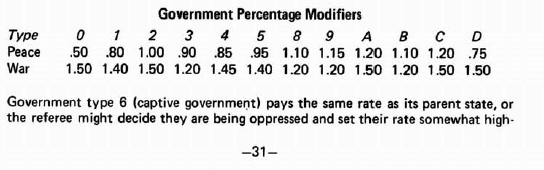
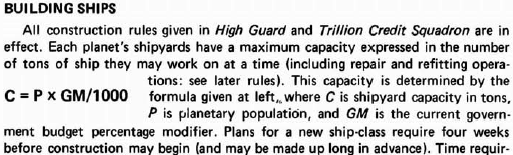
The capacity from WBH is for build, overhaul and repair & refit.In this case TCS and WBH handbooks are talking about different things. TCS is referring to the world's ability to construct its navy, while WBH is really sticking to the commercial shipyard capacity, I think.
Keep in mind the whole starport rating system (which you are free to modify in YTU) is based around Starships need a Type A, Non-Starships need a type B, repairs can be done at a Type C. WBH pp198-199 is talking about *build* capacity. As discussed on p199 a given type C may have no build capacity at all, but by definition still has repair facilities (otherwise it would be a Type D).


One thing that came up in previous discussions about shipyard capacity was that the naval yards were not typically used for naval construction except in wartime situations. They normally allow civilian yards to do the naval construction under contract while the Naval yards do maintenance, repair, and some prototypes to test some features and equipment.Also, that capacity would be civilian capacity. Military shipyards would not be part of what the starport accounts for. Naval Bases would basically have their own construction yards.
I don't disagree, but is this written somewhere. I would think with entire systems dedicated to the Navy (The Depots), they would have construction capacity too. Currently the US navy has dedicated shipyards for its ships. They might be operated and staffed by civilians, but they are "owned" by the military. Groton Connecticut, New London, Mobile, etc. I freely admit I do not know how other countries build their naval ships.One thing that came up in previous discussions about shipyard capacity was that the naval yards were not typically used for naval construction except in wartime situations. They normally allow civilian yards to do the naval construction under contract while the Naval yards do maintenance, repair, and some prototypes to test some features and equipment.
Agreed. Depots are major fleet bases with significant construction and repair capabilities. However I'd think that while they may have that, they typically operate at lower capacity levels. They have no need to build 6 dreadnoughts at the same time, but with sufficient lead time they could ramp up since certain facilities (the equivalent of drydocks and cranes) are present and functional (or even mothballed). Many shipyards are not configured to regularly work on 100+ Dton ships - even a distributed shipyard - but a depot would have dedicated facilities to do this on a normal basis.I don't disagree, but is this written somewhere. I would think with entire systems dedicated to the Navy (The Depots), they would have construction capacity too. Currently the US navy has dedicated shipyards for its ships. They might be operated and staffed by civilians, but they are "owned" by the military. Groton Connecticut, New London, Mobile, etc. I freely admit I do not know how other countries build their naval ships.
Can't say I agree with that. A depot may have shipyards, and not all shipyards are going to be privately held. It's quite possible for some planetary governments to have state-owned shipyards to build both naval and private vessels. There is nothing that would (or should) prevent such things.Naval depots would be specialized in every aspect of construction, refurbishment, and repair.
Shipyards which are privately owned, likely tend to lobby, and donate campaign contributions


