Lifters: The Other Landing Gear?

If there is an atmosphere, you'd need a pilot on duty constantly. Probably have to decrease the hours of each watch duration, because that kind of fiddly adjustments wears on a person quickly.
Current autopilots found on private pleasure boats would suffice for station keeping.
 
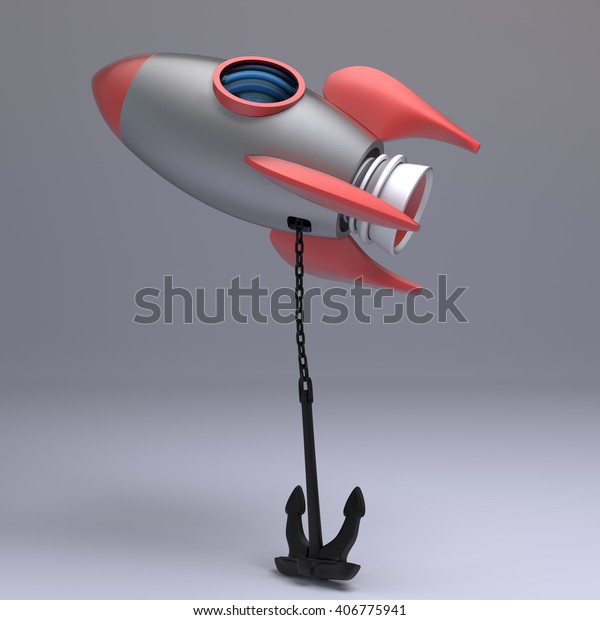
Anchored cables.

Or, just an anchor.


rocket-anchor-3d-illustration-600w-406775941.jpg
 
Edit: You can already use doppler radar to detect wind speed (using dust etc suspended in the air) so stellar TL tech will have no problem knowing that in two tenths of a second the wind will suffer an additional 920 newtons of force from a given direction due to a slight change in wind direction and strength.
Fair point, but the issue still hinges on how much thrust the ship can apply at the required vector, and how rapidly. As I noted, Thrust 1 is usually only thust 0.1 in the forwards direction, and strong winds can easily be exerting more than that. The solution would be to spin the ship, but that isn't instant, and in a gusty environment may be quite tricky.

The aerodynamics of the hull also play a big part... typically a ship's largest areas are dorsal and ventral (ESPECIALLY so in something like the Animal Class Safari ship), so a big sudden downdraft coming from a direction where you only have 20-30% thrust could be quite tricky. That could actually be more dangerous than headwinds, since most streamlined ships are streamlined to fore and any with control surfaces are dealing with winds they're designed to cope with.

 
Last edited:
Fair point, but the issue still hinges on how much thrust the ship can apply at the required vector, and how rapidly. As I noted, Thrust 1 is usually only thust 0.1 in the forwards direction, and strong winds can easily be exerting more than that. The solution would be to spin the ship, but that isn't instant, and in a gusty environment may be quite tricky.

The aerodynamics of the hull also play a big part... typically a ship's largest areas are dorsal and ventral (ESPECIALLY so in something like the Animal Class Safari ship), so a big sudden downdraft coming from a direction where you only have 20-30% thrust could be quite tricky. That could actually be more dangerous than headwinds, since most streamlined ships are streamlined to fore and any with control surfaces are dealing with winds they're designed to cope with.
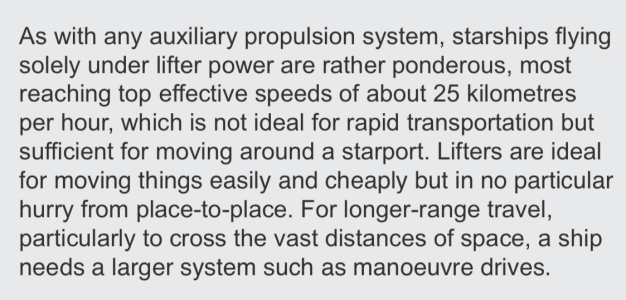
The Starship Operator’s Manual says this, so maybe that is a more direct number than .1 thrust?

1768952641715.png
 
Well, I'd expect lifters would suffice for light breezes. Above that, it's time to fire up the M-Drive, or run out the stays to moor the boat.
 
Lifters are the tech in the SOM, but they are invisible in any ship design. Apparently "free" or a side effect of a gravitized hull?

Personally, I don't like them. They are the thing that makes the streamlining rules for ships pretty nonsensical. If you can just lift straight up and down and don't really need to worry about aerodynamics except maybe in extreme weather, there really isn't any reason your boxy ship can't land on a planet. And with the discussions in this thread, you don't even need the different types of landing gear.

Besides that, I just think they are boring. :P
 
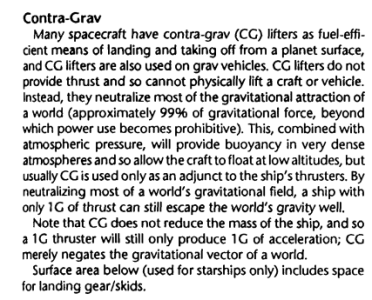
Well, they haven't been given stats in MgT2e. In T:NE, lifters did not provide any thrust. They just negate gravity, so the thrust you do have doesn't have to deal with that issue.

1769002589292.png

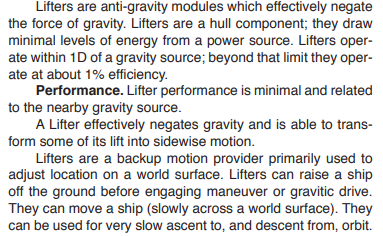
In T5, they are also a hull component, but can provide a little bit of thrust, but mostly just lift off the ground so you can engage your actual thrusters.

1769002875026.png
 
SOM and T5 are basically saying the same thing.

As far as streamlining goes, that should have a big effect on how fast you can take off and land, since lifters alone are slow. However, lifters plus M-Drive or some other propulsion would allow higher speeds.

No matter what you're using to propel the vessel, be it rockets, jets, propellors, gravitics etc, air is going to interact with the hull the same way, and unstreamlined is always going to sharply limit safe velocity and ability to control the craft.
 
Last edited:
We know that you can use anti-grav belts to move and not just levitate. And air/rafts and other grav vehicles are able to both lift and thrust using grav propulsion.

It also may be a question of mass, though some of the grav vehicles are capable of much greater flight speeds than a ship using it's lifters. Even the smallest of starships is going to out-mass a grav tank, let alone an air/raft.

Without knowing more it could be explained away as mass increases the capability for movement decreases. So the 25kph is the lower level limit for such things. That explanation isn't complete, but it also is an explanation and doesn't violate the rule.

As to hovering without landing... could be a few reasons to say it's not practical, and isn't used often - but its not impossible. Keeping your lifters constantly active requires your power plant, thus increasing your operational costs. It could cause additional strain on your lifters, causing shortened life spans and thus increasing your operational costs. Maybe they overheat after XX number of hours of continual operation.

Even massive starships are going to be affected by wind effects. A streamlined ship turned into the wind might be less affected than say a cube or a sphere, but nonetheless it's still affected. Like everything else man builds it can be crushed/snapped/broken by nature. The question is at what point does man lose to physics?
 
We have a very old rule that I think is still in play, that an Air/Raft can reach orbit in world Size hours. That's probably good enough for all pure lifter orbital transits.

Ships using drives to achieve orbital velocity can do that in a fraction of the time; the vessel is out of the actual atmosphere in minutes, then it's mostly a matter of what orbit? Low Earth Orbit is only a few hundreds of km altitude (although orbital velocity is the important number. The ISS has one of 7.66 km/s). Geosynchonous orbit is 3.075 km/s, at an altitude of 11,070 km.

Which brings up a salient point... to drop to a lower orbit you actually need to go faster, and that has nothing to do with gravitics. Be careful of assumptions when it comes to orbital mechanics and interface travel.
 
We have a very old rule that I think is still in play, that an Air/Raft can reach orbit in world Size hours. That's probably good enough for all pure lifter orbital transits.

Ships using drives to achieve orbital velocity can do that in a fraction of the time; the vessel is out of the actual atmosphere in minutes, then it's mostly a matter of what orbit? Low Earth Orbit is only a few hundreds of km altitude (although orbital velocity is the important number. The ISS has one of 7.66 km/s). Geosynchonous orbit is 3.075 km/s, at an altitude of 11,070 km.

Which brings up a salient point... to drop to a lower orbit you actually need to go faster, and that has nothing to do with gravitics. Be careful of assumptions when it comes to orbital mechanics and interface travel.
I think dropping to a lower orbit requires you to slow down, not speed up. Once you hit a lower orbit you start encountering the atmosphere, which slows you down further. Gravity does the rest and pulls you into the bosom of it's grasp.

Gravitics should be able to make you go faster or slower. And with gravitics you can cheat by ignoring gravity and orbital velocities and just ascend/descend. Rockets need horizontal velocity to achieve orbit, else they'd fall back down in low earth orbit. Grav vehicles ignore that rule and just keep going up since they don't need to care about gravity. Same principle that Blue Origin follows - they go up, and basically come back down at the same general area of where they launched from.
 
No. I'm not going to go into the physics of orbital mechanics here, but you can look it up. It's not simple simple, but gaining energy by getting closer to a gravity source will speed up an orbit.

Traveller gravitics aren't ignoring gravity but are providing lift or thrust, so the vehicle is still subject to all the usual physics. The current version of M-Drive has it reacting against a nearby massive object such as a planet or star. It's not truly reactionless, more akin to how you travel by walking. Each step pushes you forward a bit and pushes the earth in the opposite direction a tiny amount.

Also remember that the earth and the atmosphere are rotating objects, but on the surface and in the atmosphere friction and drag play a big part.
 
I think it depends how extra gravity drives express that gravitational force.

I've always thought that gravitational based motors exude a diffused field effect, and that spacecraft manoeuvre drives a focussed thrust one.

Complicated by inertial compensation, which seems a byproduct of the thrusting, and expresses itself as a field effect.

And the whole kit and caboodle is anchored to the nearest, sizeable, gravity well.
 
What is involved is transitioning from one orbit to another orbit changes when you're moving to a suborbital trajectory that will intersect with the surface. That's where a lot of the confusion arises.

Also, the effect of slowing down gains altitude and speeding up loses altitude only applies to thrust applied along the direction of orbit. If you're applying thrust in other axes it affects things differently.
 
Last edited:
SOM and T5 are basically saying the same thing.
Yes, T5 also has them magically appear and cost nothing and take up no space. Though T5 does specify that hovering is limited.

In T:NE, they took up space, used power, and cost money (though not a lot of any of those, particularly).
 
Yes, T5 also has them magically appear and cost nothing and take up no space. Though T5 does specify that hovering is limited.

In T:NE, they took up space, used power, and cost money (though not a lot of any of those, particularly).
In TNE though they were replacing entirely Man Drives and Thruster Plates. Frank Chadwick's mantra during development of TNE was "no more reactionless drives!" (of course, there was an outcry, and they snuck back in as an 'alternate technology' in FF&S).
 
Back
Top