How much actual volume required per crewman in a military spaceship?

Considering that the default manoeuvre drive is anchored to a gravity well, upto one thousand diameters, I conclude that it's pretty much connected to gravity.
 
Based on the placement of the manoeuvre drive on illustrations and the deckplans, I rather doubt that.

Also, the recent (comparatively recent) addition of vectored thrust.
 
It isn't though. The M drive creates a gravity well external to the ship. The ship then falls into the well.
Hmmm that doesn't track. If the ship is able to generate its own localised gravity well then the M-drive would be able to operate independent of any other astronomical objects, but we know that M-drive does not operate beyond 1000D (in MGT2 anyway).
 
Last edited:
It's conceivable that gravitic tech may be able to curve space in a fine enough manner to allow for controlled falling or gliding Especially in an atmosphere), although most likely the efficient way to vary lift is with directed thrust.

TNE explored the idea that lifters were reducing the vessel's effective density, letting it float in atmospheres but meaning you had to land on thrusters for worlds with low atmospheric pressure (which, fortunately, tend to be the low gravity ones). I quite liked that quirk.
 
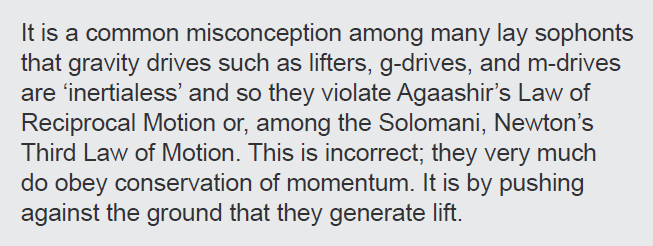
YTU can do anything as far as how M-Drives work, but the Mongoose line is that it's applying force to a local mass, preserving most of the physics. Technically not reactionless; planet goes that away a tiny amount, ship goes in the opposite vector a large amount.

SOM p.75:
1770935814622.png

You can't argue with Agaashir.
 
It's conceivable that gravitic tech may be able to curve space in a fine enough manner to allow for controlled falling or gliding Especially in an atmosphere), although most likely the efficient way to vary lift is with directed thrust.

TNE explored the idea that lifters were reducing the vessel's effective density, letting it float in atmospheres but meaning you had to land on thrusters for worlds with low atmospheric pressure (which, fortunately, tend to be the low gravity ones). I quite liked that quirk.
That last bit sounds very steam punk. We just need to paint the hull with gravity reflective paint :)
 
Well, it IS how airships work.

If you had a gadget that could reduce the density of air in the area above the vessel (which lowers air pressure), you'd generate lift. That's pretty much how moving airfoils work anyway. If you could vary the zone of low density to the sides, you could generate lateral thrust. Increasing the air density (pressure) underneath the craft would also provide lift.

Heating the air underneath the ship, or cooling it above would also affect pressure. You'd need some way of confining the gas for it to work very well, I'd think.

No gravity paint. Just air pressure.

Edit: I think I may have gotten things backwards regarding temperature and pressure there, but the principle still stands.

 
Last edited:
Back
Top