2300 Beta Aquilae

Firedrake

Mongoose
What information do we have on the aliens of the Beta Aquilae cluster?

Bayern's "The Return" (under Argyle 692d) implies that there are ruins being explored and a potential ship sighting.

The only other reference I can find is to an old web site pointing to Travellers' Digest issues 11-12 (which contain "An Overview of the American Arm" and "Exploration, American Style"); those articles mention that the cluster is being explored, but nothing about what might be there.
 
Summary from 2320 AD:

The Aquilans are a vanished alien species from the Beta Aquilae cluster, primarily associated with the Delta Aquilae A+B system. Physically, they were larger than humans — roughly 2 meters tall and 2-3 meters long — with elongated heads, pointed snouts, and hands bearing four fingers and two thumbs. Their technology was at least equal to humanity's circa 2320, including stutterwarp capability and impressive megastructures: six space elevators, an artificial orbital ring, and extensive automated defense networks.

About 350 years before 2320 (so around 1970 AD), they vanished entirely, leaving their cities, stations, and machinery still running but completely devoid of life. Their home planet retains no animal life whatsoever. What makes them particularly dangerous to explorers is their legacy of paranoia made physical — their facilities are riddled with mechanical traps, robotic ambushes, automated weapons platforms, and sentinel mines, suggesting they fully expected hostile visitors after their departure.

The cause of their disappearance is unknown. Theories range from mass exodus to plague, but the timing is ominous: their departure roughly coincides with the point when Earth's earliest powerful radio transmissions would have reached their home system. Whether that's coincidence, cause, or consequence remains one of the setting's central mysteries. A possible surviving vessel was spotted near Argyle 692, though this is unconfirmed.
 
First, some IP notes. The Beta Aquilae Cluster was in a DGP product, and thus their IP. GDW planned to use some of the ideas about exploring beyond the American Arm as one of their three focal storylines (see below). The Aquilans are the IP of Quicklink Interactive's successor.

The three threads for 2300AD were to be:
1. The Kafer War
2. The Provolution terrorist threat (encompassing all the cyber stuff)
3. Exploring beyond the boundaries of the American Arm

In the 1988 boxed set (and Challenge 33) they stated the state of play was:

1. A hunt for brown dwarves had recently started, few had been found and they had limited utility (i.e. ISO 417 hadn't been found, and neither had the "backdoor").
2. Trilon Corporations had recently acquired the plans for a stutterwarp tug, and planned to use it once built to send ships out. The limitations on the stutterwarp in the TD article never existed, and tugs have always been possible. It just needs a task roll.*

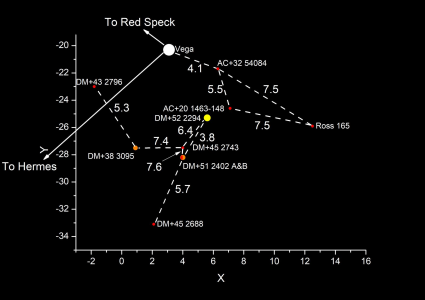
Per the semi-canon article AECA, the AECA (the 2300AD equivalent of NASA, the American civilian space agency) was sending expeditions to a garden world named Highland at DM+52 2294. The stars are just too far for a discharge (see map), and assumidly this is where the tug was for. They likely were using the dangerous "delay discharge" rule to go further than 7.7 ly.* The rules have always allowed the 7.7 ly limit to be exceeded, but it is moderately dangerous. There are ways of mitigating the risk involving having a second drive and ejecting the first is it threatens to breach. It's probably how all exploration craft reach new systems.

In reality, the reason was a simple misdrawn map.

* There are three engineering methods of going beyond 7.7 ly:

1. Tune the drive to increase range by 1 day's travel; difficult task, ship drive engineering skill, time taken = 3d6 h - engineers SDE skill (min 3 h)
2. Use a burner drive, the task to bring the new one online; difficult task, SDE, hazardous, time taken = 3d6 - engineers SDE * 30 min (min 1.5 h)
3. Use a tug. Two task rolls are needed, one to offline the drive and one to online it. The first is formidable, SDE, hazardous, 3d6 - SDE h (min 3 h). The second is exactly the same as bringing a drive up in (2).
1771624846147.png

AC+20 1463-148 would also be the launch point to the Beta Aquilae Cluster, via a brown dwarf. However, the brown dwarf is completely unnecessary. The BAC is accessible by tug:

AC+8 142-393 is 10.34 ly from AC+20 1463-148
AC+2 2155-242 is 11.12 ly ditto

Thus, if you can get to AC+20 1463-148, getting to Highland or the BAC is doable. However, the elephant in the sky is Vega. This is a very young, superhot star that won't have planets. In the 1988 stutterwarp rules revision, like Arcturus, it is a navigational nightmare. The Vega outpost is a station, like Station Arcture. Using post 1988 rules (including Mongoose editions), travel to and from Vega is near impossible, and requires burning a drive, because there is nowhere to discharge in the system.

 
Thanks Bryn; for clarity I am considering this only for my own games rather than potential publication, so IP isn't a concern. I was looking at the ending of Bayern and noting a reference that didn't seem to lead anywhere…

Some years ago I worked out a system of transit points that can in principle get you asymptotically up to 15.4 LY with all drive units recovered, but of course you need to have an awful lot of trust in the logistics.

The basic approach: Call 7.7 light years "L". Transit point 1 is at L/2 from the origin. Ship 1 goes there, ejects half-charged drive unit, transferring it to another vessel, keeping it online at all times. That specialised vessel eventually takes all the half-charged drives back to the origin point. Ship 1 brings up its own drive from cold..

But you can stage this. A second drive, brought online at L/2, can carry Ship 1 out to ¾L (that drive now having L/4 worth of charge) and then be similarly transferred and brought back. A third drive, brought online at ¾L, can take you out a further ⅛L and then be brought home. Etc. So with sufficient capital investment you can get arbitrarily close to L before you flip on the ship's "final" drive to take it the remaining distance, for a total transit distance of 2L.

Of course there may be some hazard to transferring the "live" drive units, and you still need drive tuners to bring the new drives online. This isn't something you do for a lark. But for a sufficiently critical situation it seems workable.
 
"Drive Tuners" don't exist in the primary canon, and are redundant. In the early 2300AD stuff, robot probes had been operating with multiple drives since the 2130's. The original stutterwarp lacked the full 7.7 ly range, and all the early probes and early manned exploration used multi-drives. This was changed in the 1988 rewrite to the stutterwarp always having had a 7.7 ly range.

NB: All tasks per original rules.

Now, if you accept the TD article, then Stanton's special tug drive is easier to bring offline (difficult, 12+ on d10* instead of formidable) task, but more problematic to bring online. It has a slower online of offline task (3d6 *3 h per attempt), but then requires an additional calibration task:

To calibrate a Stanton on/off stutterwarp: difficult (12+ on d10), SDE, uncertain, 6 mins.

This is a killer.

Uncertain tasks changed between the 1986 and 1988 editions of 2300AD.** The 1986 version followed the DGP rules, and is what the article (and all modules upto and including Bayern) uses:

Both player and GM roll the task (the latter in secret). If both roll success, then it is successful and the drive works. If either roll fails, then the drive will have a 2d6 roll on the hazard table. Nothing is said about if both fail, and I'd suggest a 3d6 roll on the mishap table.

The Mishap Table is:
2d6 (or 3d6 if hazardous)
2-6: Superficial damage. The drive will require repair later, but another attempt to online it may be made.
7-10: Minor damage. The drive is seriously damaged and irrepairable. Rebuilding it will cost 5-50% of the purchase for new parts etc., and is a routine task.
11-14: Major damage. The drive explodes. The engineers working on the drive are exposed to an EP=1 explosion (i.e. explosive force of 100 g of C4). Rebuilding the wrecking is a difficult task (12+) and costs 10-100% of the purchase price.
15+: Total destruction. The drive explodes with EP=3 effect (300g of C4). Rebuilding is formidable (16+ on d10) and the parts are 20-200% of new.

It is also implied that the Stanton drive is much less efficient than a normal one. Far better to use an ordinary drive. The increased hazard is during offlining, which happens back at a base. The issue is you might damage it when offlining, in which case you have to make repairs. Onlining a normal drive, which is what would happen in the field, is much less hazardous than a Stanton drive. It's a visit from the good-idea fairy.


* Actually 11+, but the 1986 edition used a d10 that went 0-9. I've made it a normal 1-10 d10 and up the target.

** The 1988 edition had both rolling, but the result being averaged instead, and a digital outcome of success or fail but you believe it's a success. A far better system would have been both roll, but the director's roll is the real one, and the players is what the character believes.
 
Back
Top