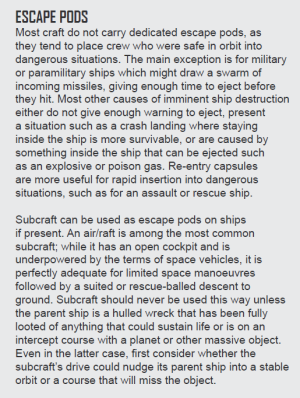
What real use are escape pods?

MarcusIII

Emperor Mongoose
When I was just designing a freighter I was about to add escape. pods and then I realized that for a ship of this type that just jumps from one large system to another there is no real need for them.

The ship jumps into a system at the edge of the 100D limit and starts heading towards the world. What could happen that people would be better off leaving the ship? It can't sink. It can burn to the water line. The grav engines or PP aren't going to explode. It is only a couple hours from help. Or less if a populated system. Same with departing a system. Travel to 100D from the planet and jump. You can't use them in J space obviously.
 
Massive hull breach
Power plant overload
Control system failure on reentry approach
Pirates
Collision
Bomb on board
Sabotage
Critical hull failure
Plus the psychological plus the crew and passengers get knowing we got an escape pod if space monkeys board the ship!
Imperial safety regulations
Insurance provider requirements
 
And of course, story plot line.
The hero escapes in the lifeboat one second before jump
Or the villain escapes.....
Or the droids with the death star plans escape
Or Dr Soongh escapes
Or the crew of the Canterberry
Yeah...no reason for that pesky escape pod/life boat
 
Pretty much no reason. The point is even made in the Starship Operator's Manual. In practical terms, the equivalent of lifeboats would be rescue balls and emergency space suits.
 

Attachments

  • 1768267941548.png
    1768267941548.png
    118.2 KB · Views: 11
If you have a failure during reentry there's no time. You are toast. Hull breach from what? And if so vacc suits are there. Power plants don't overload and explode. Pirates will just shoot you so you don't later ID them. Hulls don't just fall apart. If someone is going to take the time to sabotage (why would they do that) a ship they will just wreck all the systems. A collision just means wait in an undamaged part of the ship. The point is unless the ship completely blows up (in which case so do the pods and the people) why leave the ship when rescue is only a couple hours away? It's far cheaper to have vacc suits for all with extra tanks and just wait for the rescue ships. Anything that would REQUIRE you to leave the ship would have killed you already. If you were an interplanetary ship then large life boats, not small escape pods would make sense as they can take one across the entire star system if needed. Pods are useless in that case. So ships would have small craft where you would stuff people in IF the ship were destroyed and there were any survivors. Pods, pretty much a worthless adaptation from some sci fi movie.
 
Massive hull breach

Still better to shelter near the ship and its supplies; better to have designated life-support bunkers, possibly detachable, and suits or equipment to go aboard to get supplies and equipment .

Power plant overload

Fusion plants do not overload.

Control system failure on reentry approach

Possibly.


Why wouldn't they go after you assuming you might have valuables aboard the pods? Would this justify the commercial cost of adding the pods?

Bomb on board

Again, would this remote contingency justify the commercial cost of adding the pods?


Again, would this remote contingency justify the commercial cost of adding the pods?

Critical hull failure

Once again, better to shelter near the ship and its supplies.

Plus the psychological plus the crew and passengers get knowing we got an escape pod if space monkeys board the ship!

Possibly. Will the vessel purchaser/backer pay the expense for this reason?

Imperial safety regulations
Insurance provider requirements
Bureaucracy can't be argued against.
 
Devil's advocate impels me to suggest them as primarily for those situations where proximity to the vessel is no longer good, such as a developing onboard radiation hazard. Rescue balls and emergency suits aren't normally equipped with much in the way of thrust; I could see a case for a one-use lifeboat in that situation.

Or... a Stateroom that's built as one. In an emergency, return to your stateroom, secure the door and strap into the beds. The stateroom is then ejected from the stricken vessel. The design would be such as to ensure ongoing life support for a reasonable period of time from that already built into the stateroom, and a limited amount of reaction thrust and communications.

Build it as a variation on breakaway hulls, perhaps? 1 ton per 10 staterooms or part thereof, MCr2 per ton.
 
Last edited:
In theory, small smallcraft that can be easily accessed, and well maintained.

Of course, constant use should ensure that.

Escape pods are more for passengers, and large spacecraft.

It's possible that docking at Imperium starports requires a minimum per spacecraft, especially if you're taking on passengers.
 
Escape pods have always been the space-equivalent of lifeboats. We know that terrestrial lifeboats are required as ships can sink and floating for long periods is not necessarily advised. In sci-fi fiction we've seen lifepods/escape pods in many movies and tv series. They've become a relative norm.

Traveller has basically poo-pahed the idea as unnecessary, with the idea that ships won't explode, you can use small craft, rescue balls and/or you'll always be near a planet (100D) because that's how travel works.

I think the game probably takes too much liberty with the idea that they aren't needed, especially with passenger liners. Of course large liners aren't really in any of the books and even the few that are don't have enough parasite capacity to lift all their crew/passengers off. We know with people willing to do endure things you can cram a lot in a small space - witness some of the last evacuation flights out of Afghanistan and how many people were crammed into a military transport. The difference there is that no life support was needed. Oxygen was freely available, and while there may not have been enough bottles to share to pee in, I'm sure that those who got out were OK with that since they thought they were gonna live.

There is traffic outside the 100D limit, meaning that vessels will travel between planets and be potentially days away from any other ship. This matches historical transport on sea lanes. Lanes in space are not as far-fetched as one would think since planets are relatively slow travelers and if the path for ship 1 is the least time path, then it's pretty much the same for ship 2, and ships traveling in the opposite direction. So one can reasonable expect ships flying these sorts of routes would be able to lend emergency assistance. However if the ship had suffered too much damage then evacuation may be the passengers only hope till help arrives. Rescue balls are too short-lived, space suits don't have a lot of endurance, so you'd need a small craft - and they may not be available or even enough of them. Hence the reasonable idea of a lifepod/lifeboat.

It's fair to argue that it may be better to have a 10ton cutter or craft as your lifeboat, since you only need the lifeboat in an emergency. Perhaps you could have temporary seats along the sides instead of acceleration couches since comfort is secondary to living. There are many ways to possibly work it out, but sometimes dedicated craft do a better job.

Like with everything else, you still have some limitations. Tonnage to store emergency vehicles is the biggest factor. Then cost, then operation of them. It's probably pretty fair to argue both sides of this with a reasonableness. Would the future say "sayanora suckers - you better hope you only have to evacuate where someone is around to save you", or would it take a reasoned approach and mandate some backup and safety for both passengers and military personnel for ships of X size? I dunno. Like many of the rules, it's one that you can take or leave since you can play the game as you want.

Rule designers seem to operate more like business owners and see safety as an unnecessary expense and not really needed. Personally I'd hope for the latter (a reasonable approach to safety). That seems to match more modern-day safety factors. I'm not sure when the last time an aircraft had to ditch in the ocean, but they still make sure that every passenger jet of a certain size has emergency rafts, seats that double as a floatation cushion and inflatable life vests - even when that plane never flies over an ocean. It took a few disasters with enough death to mandage safety.

 
This bridge design can be ejected from the ship in an emergency to become a lifeboat for the command crew. The bridge has two weeks of life support and battery power, while emergency thrusters give it basic manoeuvring capabilities, equivalent to Thrust 0. A detachable bridge is even capable of soft-landing on a planetary surface.
 
The biggest issue I have with escape pods are the incredibly short life support available. With the power and fuel rules as they are long term survival is all but impossible. In Traveller "escape pods" are good for planetfall, and hope to gods there is an atmosphere.
 
It's fair to posit that most regulations would be based around being within 100D of a populated world. Commercial starships are very rarely anywhere else.
 
When I was just designing a freighter I was about to add escape. pods and then I realized that for a ship of this type that just jumps from one large system to another there is no real need for them.

The ship jumps into a system at the edge of the 100D limit and starts heading towards the world. What could happen that people would be better off leaving the ship? It can't sink. It can burn to the water line. The grav engines or PP aren't going to explode. It is only a couple hours from help. Or less if a populated system. Same with departing a system. Travel to 100D from the planet and jump. You can't use them in J space obviously.

Escape pods are probably nonsense, but consider lifeboats.

For small crews, a multi use small craft with low berths and an emergency autopilot system that goes to a starport traffic control beacon, or toward a stable orbit around a stellar object.

For large crews or large numbers of passengers, a number of lifeboats with 10 low berths (or however many), a rudimentary life support system, and a simple autopilot with a beacon. Something like a sealed cargo container with a grav module.

Situations:
  • Stay with the ship and survive on its life support until rescue or death.
  • Stay with the ship and go in low berths.
  • Use lifeboats with low berths.

Why lifeboats:
  • Something really stupid could happen, like some kind of catastrophic systems failure brought on by incompetence or negligence, like an electrical fire that destroys vital systems and leaves the ship interior uninhabitable.
  • Severe or catastrophic structural failure from debris collision or battle damage.
  • Some kind of drive failure which leaves the ship on a trajectory into deep space or into a gravity well.
  • Some crappy monster that got onboard because nobody wanted to listen to the 2nd Officer trying to enforce quarantine regulations.
  • Some other kind of contamination.
 
The rules don't cover the events where an escape pod would be necessary as it should be so unlikely as to never appear in a 2d6 event table and there are more important things to dedicate pages to. The rule books focus on the most likely events to occur. That doesn't mean that there aren't edge conditions. You design out all the common failure modes, sometime you need to put in last ditch emergency measures like escape pods to provide an extra layer of defence in the Swiss cheese model to cover the things that you didn't think of or couldn't mitigate. They also provide quite broad coverage. You can terminate any risk to life that is a function of being on the ship by not being on the ship (or at least trading them for some other risks that are more within your control)

Many of the reasons cited by Theophilus could occur if the circumstances were right. Never say never.
Someone might reluctantly have to steal the ship but if given the option to put the passengers and crew off alive might still take it on moral grounds. If completely outclassed you might be willing to surrender to pirates that had a reputation of putting people off the ship rather than fight to the death. If you don't have a means to put people off though...
If you are moving towards certain death putting life pods off now means at least they are not. If the threat is actively trying to kill all the people on board then instead of just having to destroy the main ship they have to track and destroy each individual life pod. You might be able to claim destroying a ship was a necessary expediate (in war) or unintentional (in the case of pirates) but hunting down individuals shows intent and is clearly murder.
Some disaster might occur on the ship (some violent alien life form breaks out of cargo) where it would be safer for the majority to be off the ship while specifically equipped crew deal with it (or die in the process at least trapping the threat on the main ship). Whilst you can lockdown certain areas of the ship many doors are only privacy locked. If the Beast of Cearbannog gets into the passenger compartment it could wreak havoc. Having 100km of cold vacuum between you and the monster might be a good thing.
A non-streamlined ship won't really "land" in a survivable state. A rescue bubble or vacc suit won't help you. A landing capable escape pod might. Ferrying people off a crashing ship may not be practical due to time constraints or simply because atmospheric docking with a burning ship is not straight forward. With a ship with 1000's of passengers there probably won't even be enough small craft in the area. Once the ship has crashed survivors from escape pods can still plunder it for resources and stay near it for location purposes.
Not all aircraft safety measures directly enhance the survivability of passengers. They are as much there to provide a moral boost and reduce panic. Oxygen masks give you something to do and stave off panic, you can survive on limited oxygen but your body will kick off panic response to try to get more. If you get immersed in cold water wearing the type of clothing most people have on airline fights then you will die of hypothermia in minutes. The floatation device is more for recovery of the body - sorry to disillusion you - have a nice flight.

My understanding is that you dive into the life pod and then the pod does everything else. In a stress situation that is far more likely to occur successfully than someone unfamiliar with a vacc suit donning it correctly or managing to operate a life bubble. I tend to assume that life pods are accessible directly from the stateroom and form an unobtrusive part of it. Prior to jump and emergence and during take off and landing (and at other times at the crews discretion) all off-duty crew and all passengers strap into a seat that is part of the pod in their stateroom. If something goes wrong the pod can be commanded (by the crew or by the ships computer in clearly defined scenarios) to close (sealing both pod and stateroom) and eject immediately. There will also be a guarded manual override in the pod itself but there will be a significant cost penalty for abuse. For a 13% increase in stateroom space and even lower cost increase it seems a reasonable upgrade and might provide a positive DM to finding Middle passengers. For 25% space increase and a modest cost increase you could use the re-entry pod and accommodate both passengers in a shared stateroom.

I would expect a dose of Fast per passenger would be a default inclusion of every lifeboat, escape pod or even emergency bubble. That would cheaply extend their endurance significantly if life support is the only limitation.

It occurs to me that if you are going to go the Fast drug route to passenger carriage then accommodating each passenger in a life pod rather than an acceleration seat (or even low berth) might offer some efficiencies. If the pods were small craft capable of landing and take off and thus manoeuvre then the carrier ship need not even enter the 100D limit. It could discharge its load of podded passengers programmed for a predetermined landing facility in system and collect a replacement batch. A fuel tender could be on standby and the whole operation could be complete in hours rather than the traditional week. Of course if you are refuelling from a tender then that tender could also be the transfer facility for the passengers. I am sure a 1DTon ship equipped with either acceleration couch or low birth is possible with the Small Craft rules.
 
Last edited:
We had this discussion on CotI years ago, pretty sure it has been discussed on these forums to.

One really good suggestion was each stateroom is a self contained survivial shelter.

The general consensus regardless was that in the vast majority of cases you stay with the ship and wait for rescue.
 
Escape Pods are pointless.

For escape pods to be worthwhile;
The incident has to be caused from not lack of maintenance. If it is, then the escape pods would be under maintained too.
The incident has to be fast enough that you cant fix it.
But slow enough to let folks travel to escape pods.

It has to be a really polite disaster.

If there opposing forces that required you to leave. You're still dead. Or at best captured.

Most planets arent inhabitable. So even if escape pod can make it to a planet. The planet will you too.

If you're in an uninhabited system. You're still dead. As most planets will kill you. If what you were up was legal. You'd have to be declared over due. Then probably declared mission. So that at least 2 weeks. On top of how long you have live to reach that point. Then after you're declared missing you have to wait for travel time to get to you. Even optimiscally thats a month, month and half.

If your in an inhabited system, then declare SoS, and wait the few hours for someone to get to you.

Escape pods provide nothing.
 
Back
Top