Single System games

Traveller has a desire for pragmatism.
Also Pondsmith still owes me Mekton Zeta. You're swimming Cyberpunk money. You took the kickstarter money. Where is it?!
 
We have a single-system campaign coming next fall: Messiahs of the World Ocean. We'll really get into every little detail about Bellerophon/Solomani Rim.

One challenge we have is that its star is a red dwarf (M1 V). Granted it's a large one as red dwarfs go, but most planets that orbit a star that small in its habitable zone would be tidally locked. There'd have to be some handwavey reason that Bellerophon rotates. We'll have to figure that out. I suppose I could just retroactively change it to a K-type, but I like to find ways to stick to canonical stats if possible, even when they don't make sense.
 
We have a single-system campaign coming next fall: Messiahs of the World Ocean. We'll really get into every little detail about Bellerophon/Solomani Rim.

One challenge we have is that its star is a red dwarf (M1 V). Granted it's a large one as red dwarfs go, but most planets that orbit a star that small in its habitable zone would be tidally locked. There'd have to be some handwavey reason that Bellerophon rotates. We'll have to figure that out. I suppose I could just retroactively change it to a K-type, but I like to find ways to stick to canonical stats if possible, even when they don't make sense.
Perhaps if the orbits are tight enough, another world or worlds cause the planet to rotate due to the tides. The mass of shifting water being enough to create a rotation. Perhaps different worlds cause different spins which could be interesting.
 
We have a single-system campaign coming next fall: Messiahs of the World Ocean. We'll really get into every little detail about Bellerophon/Solomani Rim.

One challenge we have is that its star is a red dwarf (M1 V). Granted it's a large one as red dwarfs go, but most planets that orbit a star that small in its habitable zone would be tidally locked. There'd have to be some handwavey reason that Bellerophon rotates. We'll have to figure that out. I suppose I could just retroactively change it to a K-type, but I like to find ways to stick to canonical stats if possible, even when they don't make sense.

Simplest way to avoid that is to have a big moon, or have the world itself be a moon. If there is something other than the primary that is exerting significant tidal forces, tidal lock on the primary can be avoided. And of course, even if the world is tidally locked on a gas giant or something, it's going to rotate in respect to the star.

An eccentric orbit can also result in a stable resonance, as Mercury has (it rotates 3 times for every 2 orbits). That would have significant weather effects, though.

An inner system gas giant might also prevent other planets getting tidally locked, although that might also result in stable resonances.

On top of that, there might be an out in terms of a deep ocean planet anyway (I'm not sure how deep Bellerophon's was meant to be) If there's sufficient water mass vs rock mass it might affect how tidal forces work. Atmosphere may come into that as well. (I only mention that one as worth checking up on - and maybe ignoring. It might go the other way and increase the odds of tidal locking for all I know)
 
Last edited:
The gas giant moon in the habitable zone probably works best, maybe with an eccentric orbit in which eclipses virtually never happen... or eclipses only last a few hours so as not to drastically affect climate. Based on the description in CT Adventure 9, it seems like a climatically stable world.

Alternatively, Bellerophon might have been struck by a planet-sized object within a few hundred million years, giving it a spin, and it is in the multi-hundred-million- to billion-year process of becoming tidally locked again.
 
Alternatively, Bellerophon might have been struck by a planet-sized object within a few hundred million years, giving it a spin, and it is in the multi-hundred-million- to billion-year process of becoming tidally locked again.
I like this approach.
Scientifically possible, leaves the existing details in place.

Similar to the travel time in Cluster Truck. Over the course of a campaign those outer planets will not move significantly enough to affect game play.
 
The gas giant moon in the habitable zone probably works best, maybe with an eccentric orbit in which eclipses virtually never happen... or eclipses only last a few hours so as not to drastically affect climate.
Jupiter's Galilean moons are in low inclination, low eccentricity orbits, and I suspect they still spend little enough time in shadow to wreck their insolation energy budgets.

(I'm cooking up an Earth-sized world locked to a Mars-sized moon and it's easy enough to make eclipse season a twice a year thing. The stellar class (established in Challenge) gives it a shorter year than I like, but I might just change the class - and so could you.
 
You could have any variety of moon orbit, either avoiding eclipses altogether or spending more or less time in shadow. But given that:

1) the moon would be orbiting outside the Roche limit (or it would have broken up)

2) closer in moons orbit faster so will spend less time in shadow

3) a planet's penumbra forms a cone, so the further out ones have less shadow to travel through

It's unlikely to be more than a local quirk that doesn't affect anything much. If the settlements are on the outer hemisphere, they won't experience eclipses, except possibly from sister moons.

Earth's big ass moon takes mere minutes at totality, though the lead up to it is usually a bit of an event.

In regards to gas giants, taking Ganymede as an example, it's in eclipse for about 3.5 hours every orbit (7.15 days). So only about 2% of the time... but also, the hemisphere that is currently undergoing eclipse has been in daylight for about 3 days and will be in daylight for about another 3 days afterwards. Because Ganymede is tidally locked on Jupiter, the eclipse always happens at midday on the inner hemisphere, with the outer hemisphere simply having 3.075 days of daylight and 3.075 days of night. A settlement on the outer hemisphere, like the far side of the Moon, would never see its planet.
 
We have a single-system campaign coming next fall: Messiahs of the World Ocean. We'll really get into every little detail about Bellerophon/Solomani Rim.

One challenge we have is that its star is a red dwarf (M1 V). Granted it's a large one as red dwarfs go, but most planets that orbit a star that small in its habitable zone would be tidally locked. There'd have to be some handwavey reason that Bellerophon rotates. We'll have to figure that out. I suppose I could just retroactively change it to a K-type, but I like to find ways to stick to canonical stats if possible, even when they don't make sense.
Having created a huge number of solar systems using UWP, Mongoose and Wiki data all I can say is don't sweat it too much.

The reality is that all our theories about exoplanets and exo solar systems get proven wrong on a regular basis. The theory that every planet around a Red Dwarf will be tidally locked is already being challenged now. The Bellerophon system has three Gas Giants and their location within the system will dramatically affect any planet in the solar system.

Plus you have the fallback of a mad wizard did it with the Ancients. They easily could have decided to terraform and modify the whole system if they felt like it.

So maybe have a Hot Jupiter that is a failed P-type Binary partner. Bellerophon orbits in the habitable zone with another Gas Giant in the next orbit out. The Hot Jupiter absorbs a lot of the flares given off by star due to its proximity and fast orbit. That solves the problem of why the atmosphere and water wasn't stripped from the planet. Give it a really dense core so it has a strong magnetic field as well.

You can also make the star young enough so tidal locking hasn't occurred yet.

Also a water world with a dense atmosphere is nearly perfect for transferring heat across the surface so even if the planet has a slow rotation it will not freeze up.

But basically very few players are going to ask "hey, shouldn't a planet orbiting a Red Dwarf be a airless, tidally locked rock?"

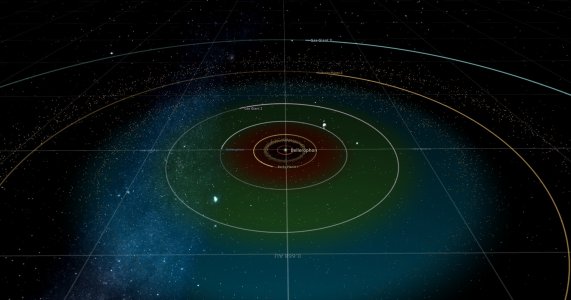
I quickly put together a system using the wiki data. The red circle close to the star is a Gas Giant 3x Jupiter's Mass. When you run the simulation all the orbits wobble due to the proximity of other large objects, but the orbits themselves are stable in AU terms.

That wobbling would help to counter act tidal locking.

I also made the star only 553 million years old, but you could make it younger.

Bellerophon has to be at the inner edge of the habitable zone. Red Dwarves put out a lot of IR but to have no ice caps you need to be in close. Bellerophon here has a equlibrium temperature of 13 degrees Celcius with a range from 36 at the equator and minus 28 at the poles but being 99%+ water the poles stay ice free.

Note that I haven't given Bellerophon an axial tilt which would change the temperatures via seasons.

Example System Bellerophon.jpg
 
Last edited:
Back
Top