Modules

mavikfelna

Emperor Mongoose
Ok, I have questions about Modules, because there is a conflict between the spreadsheets and the official designs and the design rules. @Geir do we have official errata for this stuff?

Hull Configurations, Specialized Hull Types and Additional Hull Types, do they affect the cost of the module hull spaces and can they be applied? There are official module designs with different Hull Configurations and the cost does appear to be affected by them. There are no examples of Hull Types in the official designs but why can't we do non-gravity or light hulls? Additional Hull Types probably aren't needed but if you wanted a double hulled module to leave somewhere with high pressure atmosphere or underwater, can you do it?

Does the module need to conform to the type of the hull that is carrying it? The Fighter Frame module is Dispersed Structure but the Modular Cutter is Streamlined, so does it matter? It would be much cheaper to make modules in Standard config than Streamlined for example, and there doesn't seem to be any reason the module would need to be streamlined, since it's internal to the hull.

Drives and Power Plants are specifically excluded in the rules for modules but there are many examples of official modules with power plants and at least 1 with an M-0 drive. So has the rule been errated? If M drives are ok, what about J drives?

If a module is designed to operate on it's own, does it need to pay full price for it's hull rather than the reduced price? This doesn't seem to be the case for the Orbital Outpost module.

How about hull options like Solar Coating or Stealth?

How about pods? Are they modules? The Ghalahk and other Elemental cruisers have modules with Bridges or Sub-Command Centers at least, does this break the no-bridge rule? Do they need to built on standard or on module hulls?
 
Ok, I have questions about Modules, because there is a conflict between the spreadsheets and the official designs and the design rules. @Geir do we have official errata for this stuff?

Hull Configurations, Specialized Hull Types and Additional Hull Types, do they affect the cost of the module hull spaces and can they be applied? There are official module designs with different Hull Configurations and the cost does appear to be affected by them. There are no examples of Hull Types in the official designs but why can't we do non-gravity or light hulls? Additional Hull Types probably aren't needed but if you wanted a double hulled module to leave somewhere with high pressure atmosphere or underwater, can you do it?

Does the module need to conform to the type of the hull that is carrying it? The Fighter Frame module is Dispersed Structure but the Modular Cutter is Streamlined, so does it matter? It would be much cheaper to make modules in Standard config than Streamlined for example, and there doesn't seem to be any reason the module would need to be streamlined, since it's internal to the hull.

Drives and Power Plants are specifically excluded in the rules for modules but there are many examples of official modules with power plants and at least 1 with an M-0 drive. So has the rule been errated? If M drives are ok, what about J drives?

If a module is designed to operate on it's own, does it need to pay full price for it's hull rather than the reduced price? This doesn't seem to be the case for the Orbital Outpost module.

How about hull options like Solar Coating or Stealth?

How about pods? Are they modules? The Ghalahk and other Elemental cruisers have modules with Bridges or Sub-Command Centers at least, does this break the no-bridge rule? Do they need to built on standard or on module hulls?

@Geir might not be the right person to ask. Maybe @MongooseChris.

Pods are not modules and have different, if no longer stated, build rules. Reverse engineering them from the pods in Element Class Cruisers and Opening Moves, they can have any system other than drives. I have pod versions that use docking clamps for mounting rather than permanent installations as that feels valid. They are not ships, as they have no drives, so lack of a bridge should be just fine.
 
Ok, I have questions about Modules, because there is a conflict between the spreadsheets and the official designs and the design rules. @Geir do we have official errata for this stuff?

Hull Configurations, Specialized Hull Types and Additional Hull Types, do they affect the cost of the module hull spaces and can they be applied? There are official module designs with different Hull Configurations and the cost does appear to be affected by them. There are no examples of Hull Types in the official designs but why can't we do non-gravity or light hulls? Additional Hull Types probably aren't needed but if you wanted a double hulled module to leave somewhere with high pressure atmosphere or underwater, can you do it?
Modules are calculated based on hull cost, so anything that changes "hull cost" changes cost for modules. E.g. In HG'16 armour modified hull cost, hence module cost, but in HG'22 armour is a separate system, hence does not affect module cost.

Hull size, configuration, and specialised hull types (HG'22, p12) should affect cost for modularity. Non-gravity, Double Hull, and Hamster cage should affect the cost. Modularity increases the cost of the hull, then the modules have a cost of their own in addition.


See Armoured Cruiser, HG'22, p243. It has 20.8% modules, and the cost is erroneously based on base hull cost, without modification for reinforced hull and military hull. Same with the Kokirrak on p276. Either they have changed the rule from HG'16 without rewriting it, or the ships are wrong.


Does the module need to conform to the type of the hull that is carrying it? The Fighter Frame module is Dispersed Structure but the Modular Cutter is Streamlined, so does it matter? It would be much cheaper to make modules in Standard config than Streamlined for example, and there doesn't seem to be any reason the module would need to be streamlined, since it's internal to the hull.
The Modular Cutter uses CT non-rules, not the HG rules for Modules. It's not the same type of modules.

By the rules MgT modules are internal, unlike the CT-inspired Cutter. House-rule to taste...


Drives and Power Plants are specifically excluded in the rules for modules but there are many examples of official modules with power plants and at least 1 with an M-0 drive. So has the rule been errated? If M drives are ok, what about J drives?

If a module is designed to operate on it's own, does it need to pay full price for it's hull rather than the reduced price? This doesn't seem to be the case for the Orbital Outpost module.
If it's operated independently, it's presumably a complete spacecraft, not a module. Sounds more like a breakaway section than a module.


How about hull options like Solar Coating or Stealth?
Modules are internal, they don't have external hulls.


How about pods? Are they modules?
No. There are no rules for Pods in the ECC-sense. They are essentially semi-independent spacecraft added without overhead or cost to the mothership. The connectors take 0 Dt and cost MCr 0, as far as I can see.


A pod in T5 is just a hull attached to the ship with a docking clamp. It's a normal hull, that can presumably be powered by the main ship. The pod is technically a separate vessel and can have as many, or as few, drives as it feels like.
 
Modules are internal installations, and pods are external attachments.

Modules have a fixed cost, so the presumption would be that the hull itself is adjusted to accommodate them.

Technically, pods are subhulls, and I haven't come across any design rules for them.
 
The ship pays the entire cost of the hull. A module fits inside that hull.
Which is why stations and base buildings as modules in a cutter (or elsewhere) need to use station/building rules, but are configured to fit in and link to an open module frame.
 
Modules are calculated based on hull cost, so anything that changes "hull cost" changes cost for modules. E.g. In HG'16 armour modified hull cost, hence module cost, but in HG'22 armour is a separate system, hence does not affect module cost.

Hull size, configuration, and specialised hull types (HG'22, p12) should affect cost for modularity. Non-gravity, Double Hull, and Hamster cage should affect the cost. Modularity increases the cost of the hull, then the modules have a cost of their own in addition.


See Armoured Cruiser, HG'22, p243. It has 20.8% modules, and the cost is erroneously based on base hull cost, without modification for reinforced hull and military hull. Same with the Kokirrak on p276. Either they have changed the rule from HG'16 without rewriting it, or the ships are wrong.


The Modular Cutter uses CT non-rules, not the HG rules for Modules. It's not the same type of modules.

By the rules MgT modules are internal, unlike the CT-inspired Cutter. House-rule to taste...


If it's operated independently, it's presumably a complete spacecraft, not a module. Sounds more like a breakaway section than a module.


Modules are internal, they don't have external hulls.


No. There are no rules for Pods in the ECC-sense. They are essentially semi-independent spacecraft added without overhead or cost to the mothership. The connectors take 0 Dt and cost MCr 0, as far as I can see.


A pod in T5 is just a hull attached to the ship with a docking clamp. It's a normal hull, that can presumably be powered by the main ship. The pod is technically a separate vessel and can have as many, or as few, drives as it feels like.
This is why I'm asking for clarifications, the rules are contradictory to the evidence of the designs.

The modules in HG and SCC are built with the rules from HG, so they are HG modules. But they don't follow the rules from CT or HG in many cases, including having a fully spaceworth station module and several independent planetary modules, so they can have external hulls, else they couldn't function outside of the craft. They are clearly modules, as they are meant to integrate into the Cutter and are costed as modules, despite not being built like modules. So are they actually breakaway? Which is an entire other problem I haven't been able to figure out yet either.

The Ghalahk cruiser in HG22 has module tonnage, but then has no modules and is built as if everything is integrated but the cost of the modular space is added to the ship's cost, just not the added cost of the modules themselves. In ECC, it has pods and they are clearly defined as just ships without bridges that are semi-permanently welded to the main hull but definitely separate. So are Pods actually Modules or not? HG22 supersedes ECC after all, but does it replace it in this case?
 
In theory, module bays can follow empty weapon bay accommodation rules.

Basically, they can act as cargo holds for items that can fit in there.

You can load items in there that have the exact same dimensions as the modules they were designed for, but that doesn't make those items modules.

Modules are designed to link into the spacecraft internal systems.
 
In theory, module bays can follow empty weapon bay accommodation rules.

Basically, they can act as cargo holds for items that can fit in there.

You can load items in there that have the exact same dimensions as the modules they were designed for, but that doesn't make those items modules.

Modules are designed to link into the spacecraft internal systems.
I've always assumed that to be the case. But things like the Orbital Station Module are built like modules, not ships or stations. It should be built as a station and given dimensions so it can fit in the module bay if that were the case. The rules say noting either way, though I've always assumed empty space was treated as cargo space.
 
What we've seen so far in the USN is that the modular ships have issues - and those issues are crews train to how their ship is configured to at present. When swapping out they have to retrain to get back to the expected normal operational baseline.

The USN thought the same thing - on paper modular ships sound great - just swap out the module needed for the ships mission at the time and you can save on the cost of a second hull. The reality is unless you swap out the crew and captain as well, they tend to fall into very human habits of familiarity with what is in front of them at the time.

Operational and well-trained are two entirely different things.
 
Cargo modules are good for freighters. If your ship is part of a major line it can drop a standard cargo module (or modules) and pick up another within hours. The ship can make substantially more runs per year with the module(s) you deliver are unloaded and refilled while you are making another jump. A totally different ship can pick up the module you dropped off.

A passenger ship can drop of the passenger module which functions alone as the hotel and take another group of tourists home in the same stateroom they spent their whole vacation on. If needed any compatible freighter becomes a liner or the liner can switch to freight.

Also your freighter can have other modules and change roles with the module having its own "crew". Modules that make your trader a yacht, safari ship, medical ship, science or survey vessel and more.
 
Cargo modules are good for freighters. If your ship is part of a major line it can drop a standard cargo module (or modules) and pick up another within hours. The ship can make substantially more runs per year with the module(s) you deliver are unloaded and refilled while you are making another jump. A totally different ship can pick up the module you dropped off.

A passenger ship can drop of the passenger module which functions alone as the hotel and take another group of tourists home in the same stateroom they spent their whole vacation on. If needed any compatible freighter becomes a liner or the liner can switch to freight.

Also your freighter can have other modules and change roles with the module having its own "crew". Modules that make your trader a yacht, safari ship, medical ship, science or survey vessel and more.
Has anyone done the math on something like that? With very large (say 1,000 dton) modules? LASH never took off in reality due to a few things that probably wouldn't be present for starship modules. The issue with the modules sitting empty is that you'd still have to pay maintenance on them, so if you swapped out a passenger one for a freighter you'd be stuck paying all that life support cost and not being able to use any of it (though maybe you could have an auxillary power plant on it and turn it into floating accommodations while it sat there?).
 
Cargo modules are good for freighters. If your ship is part of a major line it can drop a standard cargo module (or modules) and pick up another within hours. The ship can make substantially more runs per year with the module(s) you deliver are unloaded and refilled while you are making another jump. A totally different ship can pick up the module you dropped off.

A passenger ship can drop of the passenger module which functions alone as the hotel and take another group of tourists home in the same stateroom they spent their whole vacation on. If needed any compatible freighter becomes a liner or the liner can switch to freight.

Also your freighter can have other modules and change roles with the module having its own "crew". Modules that make your trader a yacht, safari ship, medical ship, science or survey vessel and more.
Or pods. I have a lot of ones like that in the ship’s link in my signature.
 
Has anyone done the math on something like that? With very large (say 1,000 dton) modules? LASH never took off in reality due to a few things that probably wouldn't be present for starship modules. The issue with the modules sitting empty is that you'd still have to pay maintenance on them, so if you swapped out a passenger one for a freighter you'd be stuck paying all that life support cost and not being able to use any of it (though maybe you could have an auxillary power plant on it and turn it into floating accommodations while it sat there?).
Yes, the idea for something like that would be to make it semi-independent so it can be dropped off and new one picked up by the ship and the ship gets underway quickly while the other container goes to where it needs to to unload. If it's live sophont housing, it just needs a power plant and you need a tug in the system you drop it at. You come back into the system later and drop off what you're carrying and pick that pod up again and off the new passengers go. If you've got a new ship jumping in every day, then pods don't have alot of downtime, depending on how long it takes to unload and reload them.
 
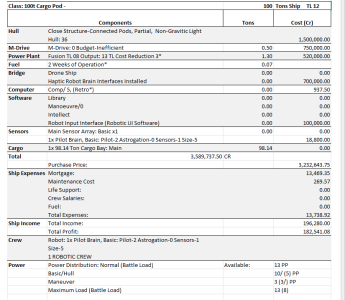
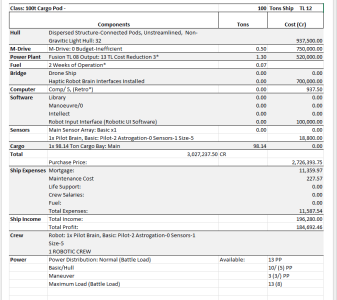
I created a 100 ton cargo pod to be towed in a jump net. The cost difference between having a dispersed hull and having a closed hull is actually significant at this level. @Terry Mixon insists he wouldn't allow a dispersed hull in his games, but it's perfectly legal so far as I'm concerned. The Laboratory Ship in HG22 p185 is an enclosed dispersed hull and there are 2 freighters in Traders and Gunboats, the Express Freighter on p 115, and the Mobray on p144 that are enclosed dispersed hulls. Terry wanted me to post it here to see what other people thought. So, IYTU, do you allow dispersed hull freighters?

1765079182948.png

1765079212602.png
 
I created a 100 ton cargo pod to be towed in a jump net. The cost difference between having a dispersed hull and having a closed hull is actually significant at this level. @Terry Mixon insists he wouldn't allow a dispersed hull in his games, but it's perfectly legal so far as I'm concerned. The Laboratory Ship in HG22 p185 is an enclosed dispersed hull and there are 2 freighters in Traders and Gunboats, the Express Freighter on p 115, and the Mobray on p144 that are enclosed dispersed hulls. Terry wanted me to post it here to see what other people thought. So, IYTU, do you allow dispersed hull freighters?

View attachment 6850

View attachment 6851
Not for a cargo container that is 98% cargo. I’ve mellowed on the ships, but not the container.
 
Back
Top