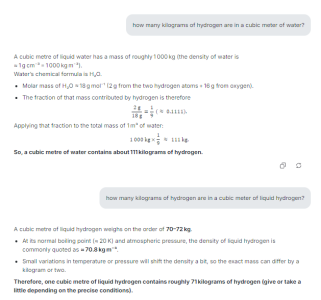
An interesting factoid, amount of hydrogen in water vs. LHyd

MarcusIII

Emperor Mongoose
A cubic meter of water contains approximately 111 kg of hydrogen, while a cubic meter of liquid hydrogen contains about 71 kg of hydrogen. In other words, water by volume contains 1.56 times as much hydrogen. So if you wanted to fill a fuel bladder with water to later process into 10 tons of LHyd you would only need to carry 6.9 tons of H2O to yield 10 tons of Jump fuel.

This is why I prefer to store H2O in collapsible fuel bladders. Also less problematic than big bags of LHyd in the cargo bay.
 
Last edited:
That is a fun idea.

I don't think the math works out.

Hydrogen is 11.1% of water by mass.
To get 10 tons of hydrogen:
Required water=10/.111≈90 tons of water

Sorry to burst your fuel bladder
 
That is a fun idea.

I don't think the math works out.

Hydrogen is 11.1% of water by mass.
To get 10 tons of hydrogen:
Required water=10/.111≈90 tons of water
the math is correct. Tested it in lab decades ago as a kid. You aren't doing the full calcs.

Volume Comparison (From 1 Liter of Water) Extract Hydrogen: yields about 111 grams of hydrogen (as H₂) and 889 grams of oxygen.

Volume of Liquid Hydrogen: A liter of liquid hydrogen contains about 71 grams (0.07 kg) of pure hydrogen
 
Last edited:
the math is correct. Tested it in lab decades ago as a kid. You aren't doing the full calcs.

Volume Comparison (From 1 Liter of Water) Extract Hydrogen: yields about 111 grams of hydrogen (as H₂) and 889 grams of oxygen.

Volume of Liquid Hydrogen: A liter of liquid hydrogen contains about 71 grams (0.07 kg) of pure hydrogen
Your maths is absolutely not correct. Impressive as your childhood science experiments are, they must have been a very long time ago!

You are almost exactly correct regarding the mass of hydrogen contained in a tonne (don't mix imperial and metric: it makes Baby Jesus sad) of water at room temperature: 112kg.

But this is where you're wrong:

So if you wanted to fill a fuel bladder with water to later process into 10 tons of LHyd you would only need to carry 6.9 tons of H2O to yield 10 tons of Jump fuel
If you want to get 10 tonnes of hydrogen - liquid or gaseous matters not one jot - you need 89.4 tonnes of water.

I'm not 100% sure how you are getting the figure wrong by such a large amount, but I suspect a clue is that you mix metric, imperial, mass and volume throughout.
 
Are tons DTons mayhap? Otherwise it is all irrelevant to Traveller.

Water however is also a weird substance (for example should be a gas at room temp, and ice shouldn't float on water) because of that cheeky hydrogen bond and the dipole.
 
You just won't get 10 tons of liquid Hydrogen out of 6.9 tons of water. Where is the extra mass coming from?
you are confusing mass and volume. Density is the key here. I'm sorry but you DO get 111 grams of H for every liter of H2O and 71 grams of H from every liter of LHyd. Go get some and do the experiment yourself if you don't believe me.
 
you are confusing mass and volume. Density is the key here. I'm sorry but you DO get 111 grams of H for every liter of H2O and 71 grams of H from every liter of LHyd. Go get some and do the experiment yourself if you don't believe me.
I think you might be correct in Traveller, because of using Displacement Tons vs actual tons.
  • 1 dton of water: ~14 tons
  • 1 dton of liquid hydrogen: ~1 ton
 
Are tons DTons mayhap? Otherwise it is all irrelevant to Traveller.

Water however is also a weird substance (for example should be a gas at room temp, and ice shouldn't float on water) because of that cheeky hydrogen bond and the dipole.
That's what he has done! He has confused cubic metres (1,000 litres) with dtons but (until his latest piece of "no you're wrong not me!") he has mixed his units, which is why he got the volume of water wrong by a factor of roughly 14.
 
Last edited:
the math is correct. Tested it in lab decades ago as a kid. You aren't doing the full calcs.

Volume Comparison (From 1 Liter of Water) Extract Hydrogen: yields about 111 grams of hydrogen (as H₂) and 889 grams of oxygen.

Volume of Liquid Hydrogen: A liter of liquid hydrogen contains about 71 grams (0.07 kg) of pure hydrogen
What on earth were they doing letting a kid play with liquid hydrogen in a lab? :)
 
I thought it was supposed to be methane that maximizes hydrogen content.

But water byproduct oxygen tends to be rather useful, as well.
methane does yield a little more LHyd than H2O does. It's just not as easy to come by and if a leak a problem. Methane is probably often scooped from GGs
 
Last edited:
Carrying water for later use as reserve fuel in cargo is a solid idea, especially if you have to jump through a system where you can't or don't want to refuel normally. Tanks of water (or containers of ice) are simple cargo.

However, to make the jump that has to be processed and the actual fuel tanks filled up with Hydrogen. It doesn't take THAT long to turn water into Hydrogen and oxygen - ocean refuelling typically takes 1D6 hours, so using cargo water would only take about the same time, although that gives unrefined fuel, so there is also the fuel processor time if you want refined fuel. But those are normal considerations.

Methane is possible, but standard ships are set up to scoop hydrogen or pump water and electrolyse it. The equipment to allow that won't allow you to extract hydrogen from Methane or Ammonia. So you would need purpose built methane scooping and processing equipment.

On the other hand, this isn't exotic technology. If you want to designate a fuel scoop or processor as a Methane one, go for it. Might as well say that it has the same mass, volume and cost as a water one. And maybe it would be possible to build a unit that combines both machines, using common parts such as the output that liquifies the hydrogen. Maybe 180% of the mass, volume and cost of a water refiner?
 
Last edited:
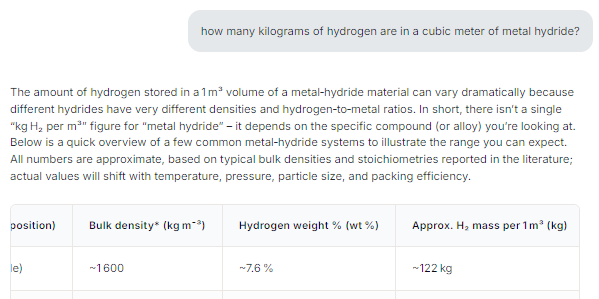
Water contains almost as much hydrogen as magnesium hydride (I asked about metal hydride, and magnesium hydride is the first and best entry on the list at 122kg per cubic meter):

1768973095972.png
 
Last edited:
Carrying water for later use as reserve fuel in cargo is a solid idea, especially if you have to jump through a system where you can't or don't want to refuel normally. Tanks of water (or containers of ice) are simple cargo.

However, to make the jump that has to be processed and the actual fuel tanks filled up with Hydrogen. It doesn't take THAT long to turn water into Hydrogen and oxygen - ocean refuelling typically takes 1D6 hours, so using cargo water would only take about the same time, although that gives unrefined fuel, so there is also the fuel processor time if you want refined fuel. But those are normal considerations.

Methane is possible, but standard ships are set up to scoop hydrogen or pump water and electrolyse it. The equipment to allow that won't allow you to extract hydrogen from Methane or Ammonia. So you would need purpose built methane scooping and processing equipment.

On the other hand, this isn't exotic technology. If you want to designate a fuel scoop or processor as a Methane one, go for it. Might as well say that it has the same mass, volume and cost as a water one. And maybe it would be possible to build a unit that combines both machines, using common parts such as the output that liquifies the hydrogen. Maybe 180% of the mass, volume and cost of a water refiner?

I assume a fuel processor can handle water and methane as gas giants have both.
 
Back
Top